

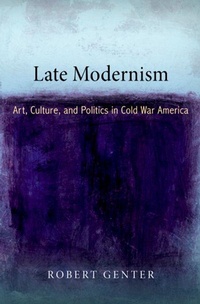
Late Modernism
Art, Culture, and Politics in Cold War America
1st Edition
Published on 6. June 2011
384 pages
978-0-8122-0007-2 (ISBN)
Description

In the thirty years after World War II, American intellectual and artistic life changed as dramatically as did the rest of society. Gone were the rebellious lions of modernism-Joyce, Picasso, Stravinsky-and nearing exhaustion were those who took up their mantle as abstract expressionism gave way to pop art, and the barren formalism associated with the so-called high modernists wilted before the hothouse cultural brew of the 1960s. According to conventional thinking, it was around this time that postmodernism with its characteristic skepticism and relativism was born.
In Late Modernism, historian Robert Genter remaps the landscape of American modernism in the early decades of the Cold War, tracing the combative debate among artists, writers, and intellectuals over the nature of the aesthetic form in an age of mass politics and mass culture. Dispensing with traditional narratives that present this moment as marking the exhaustion of modernism, Genter argues instead that the 1950s were the apogee of the movement, as American practitioners-abstract expressionists, Beat poets, formalist critics, color-field painters, and critical theorists, among others-debated the relationship between form and content, tradition and innovation, aesthetics and politics. In this compelling work of intellectual and cultural history Genter presents an invigorated tradition of late modernism, centered on the work of Kenneth Burke, Ralph Ellison, C. Wright Mills, David Riesman, Jasper Johns, Norman Brown, and James Baldwin, a tradition that overcame the conservative and reactionary politics of competing modernist practitioners and paved the way for the postmodern turn of the 1960s.
In Late Modernism, historian Robert Genter remaps the landscape of American modernism in the early decades of the Cold War, tracing the combative debate among artists, writers, and intellectuals over the nature of the aesthetic form in an age of mass politics and mass culture. Dispensing with traditional narratives that present this moment as marking the exhaustion of modernism, Genter argues instead that the 1950s were the apogee of the movement, as American practitioners-abstract expressionists, Beat poets, formalist critics, color-field painters, and critical theorists, among others-debated the relationship between form and content, tradition and innovation, aesthetics and politics. In this compelling work of intellectual and cultural history Genter presents an invigorated tradition of late modernism, centered on the work of Kenneth Burke, Ralph Ellison, C. Wright Mills, David Riesman, Jasper Johns, Norman Brown, and James Baldwin, a tradition that overcame the conservative and reactionary politics of competing modernist practitioners and paved the way for the postmodern turn of the 1960s.
Reviews / Votes
"Late Modernism is a boldly original and undoubtedly controversial study of how modernism was transformed, assimilated, and sometimes institutionalized after 1945, before being challenged in the 1960s and 1970s. Exhaustively researched and lucidly argued, the book sheds light on a large, idiosyncratic cast of artists and thinkers, from David Riesman and C. Wright Mills to Jasper Johns and Kenneth Burke. It provides us with a fresh, illuminating synthesis as it tracks the eddies and crosscurrents of postwar American culture." (Morris Dickstein, author of Gates of Eden and Dancing in the Dark) "Late Modernism makes a profound contribution to the understanding of the history of modernism in American arts and letters in the mid-twentieth century. I do not know of anything currently available in intellectual and cultural history that offers such a striking reformulation of the course of modernist ideas and practices in the decades after World War II." (Howard Brick, author of Age of Contradiction: American Thought and Culture in the 1960s)All prices
More details
Series
Language
English
Place of publication
Pennsylvania
United States
Target group
College/higher education
File size
3,23 MB
ISBN-13
978-0-8122-0007-2 (9780812200072)
Copyright in bibliographic data and cover images is held by Nielsen Book Services Limited or by the publishers or by their respective licensors: all rights reserved.
Schweitzer Classification
Other editions
Additional editions
Book
10/2010
University of Pennsylvania Press
€64.48
Article not available at the moment
Person
Robert Genter teaches in the Department of History at Nassau Community College, New York.
Content
Introduction. A Genealogy of Postwar American Modernism
Part I High Modernism in America: Self and Society in the Early Cold War
One. Science, Postmodernity, and the Rise of High Modernism
Two. Reconsidering the Authoritarian Personality in America: The Sociological Challenge of David Riesman
Three. Psychoanalysis and the Debate over the Democratic Personality: Norman Brown's Freudian Revisions
Part II The Revolt of Romantic Modernism: Beatniks, Action Painters, and Reichians
Four. A Question of Character: The Dramaturgy of Erving Goffman and C. Wright Mills
Five. Beyond Primitivism and the Fellahin: Receiving James Baldwin's Gift of Love
Six. Masculinity, Spontaneity, and the Act: The Bodily Ego of Jasper Johns
Seven. Rethinking the Feminine Within: The Cultural Politics of James Baldwin
Part III The Challenge of Late Modernism
Eight. Rhetoric and the Politics of Identification Writ Large: The Late Modernism of Kenneth Burke, C. Wright Mills, and Ralph Ellison
Conclusion. The Legacy of Late Modernism
Notes
Index
Acknowledgments
Part I High Modernism in America: Self and Society in the Early Cold War
One. Science, Postmodernity, and the Rise of High Modernism
Two. Reconsidering the Authoritarian Personality in America: The Sociological Challenge of David Riesman
Three. Psychoanalysis and the Debate over the Democratic Personality: Norman Brown's Freudian Revisions
Part II The Revolt of Romantic Modernism: Beatniks, Action Painters, and Reichians
Four. A Question of Character: The Dramaturgy of Erving Goffman and C. Wright Mills
Five. Beyond Primitivism and the Fellahin: Receiving James Baldwin's Gift of Love
Six. Masculinity, Spontaneity, and the Act: The Bodily Ego of Jasper Johns
Seven. Rethinking the Feminine Within: The Cultural Politics of James Baldwin
Part III The Challenge of Late Modernism
Eight. Rhetoric and the Politics of Identification Writ Large: The Late Modernism of Kenneth Burke, C. Wright Mills, and Ralph Ellison
Conclusion. The Legacy of Late Modernism
Notes
Index
Acknowledgments

