

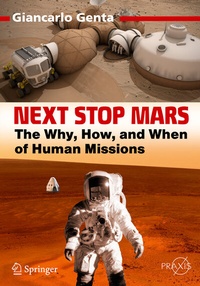
Next Stop Mars
Description

As the reality of a manned Mars voyage becomes more concrete, the details are still largely up in the air. This book presents an overview of proposed approaches past, present, and future, both from NASA and, increasingly, from other space agencies and private companies. It clearly displays the challenges and the ingenious solutions involved in reaching Mars with human explorers.
Reviews / Votes
"This book offers readers an extensive, clear discussion of the issues involved in establishing a human base on Mars. . The text is generously illustrated with photographs, illustrations, and tables. Four appendixes furnish readers with additional technical information, including guidance on calculating planetary positions, impulsive and low thrust trajectories, and information on locomotion on Mars. This text manages to be both an invaluable technical reference and an inspiring introduction to the field." (T. Barker, Choice, Vol. 56 (1), September, 2018)
"Next Stop Mars is one of the best books of its type I have seen, in discussing problems, opportunities, and alternatives for the first human Mars mission." (Richard Mckim, The Observatory, Vol. 138 (1262), February, 2018)
More details
Other editions
Additional editions
Person
Giancarlo Genta has been full Professor of Construction of Machines since 1987 and taught courses on Astronautic Propulsion, Construction of aircraft engines and motor vehicle technology. Since 1997 he has been Professor of Applied Stress Analysis II at the Master of Science courses of the University of Michigan which are held at the Politecnico di Torino.
His research activity has been focused on those subjects of Applied Mechanics more linked with the construction of machines, and particularly on static and dynamic structural analysis, dynamics of rotating machinery and of controlled systems, magnetic bearings. He is one of the founders of the Interdepartimental Mechatronics Laboratory of Politecnico di Torino, in which he works in the development of magnetic bearings and walking robots and components for spacecraft. Since 2012 he has chaired of study group SG 3.16 of the International Academy of Astronautics addressing a possible Mars mission's exploration, goals, requirements and technologies.
Giancarlo Genta is author of 24 books, 90 papers, published in Italian, American and English Journals and 263 papers presented to symposia. Two of the books are text books of Motor Vehicle Mechanics, Mechanics of Vibration and Mechanics of Space Robots (published in Italian and English), used in Italian and American Universities. Giancarlo Genta has previously co-authored a well received popular science book on space exploration with Michael Rycroft, published by Cambridge University Press. It received very good reviews, including a very favourable one from A.C. Clarke (see his website www.giancarlogenta.it) and a popular science book on the Search for Extraterrestrial Intelligence. He has also written two science fiction novels published in the Science and Fiction series by Springer.
Content
Preface.- 1: Half a century of projects.- 2: Reasons for human Mars Exploration.- 3: Mars and its satellites.- 4: Space environment and radiations.- 5: Human aspects.- 6: Interplanetary journey to Mars.- 7: Mission design.- 8: The outpost on Mars.- 9: Mobility on Mars.- 10: The ground segment.- 11: Timeframe and roadmap.- 12: A look to a more distant future.- 13: Example missions.- 14: Conclusions.- References.- Appendices.
