

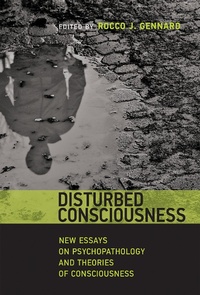
Disturbed Consciousness
Description

In Disturbed Consciousness, philosophers and other scholars examine various psychopathologies in light of specific philosophical theories of consciousness. The contributing authors—some of them discussing or defending their own theoretical work—consider not only how a theory of consciousness can account for a specific psychopathological condition but also how the characteristics of a psychopathology might challenge such a theory. Thus one essay defends the higher-order thought (HOT) theory of consciousness against the charge that it cannot account for somatoparaphrenia (a delusion in which one denies ownership of a limb). Another essay argues that various attempts to explain away such anomalies within subjective theories of consciousness fail.
Other essays consider such topics as the application of a model of unified consciousness to cases of brain bisection and dissociative identity disorder; prefrontal and parietal underconnectivity in autism and other psychopathologies; self-deception and the self-model theory of subjectivity; schizophrenia and the vehicle theory of consciousness; and a shift in emphasis away from an internal (or brainbound) approach to psychopathology to an interactive one. Each essay offers a distinctive perspective from the intersection of philosophy, consciousness research, and psychiatry.
Contributors Alexandre Billon, Andrew Brook, Paula Droege, Rocco J. Gennaro, Philip Gerrans, William Hirstein, Jakob Hohwy, Uriah Kriegel, Timothy Lane, Thomas Metzinger, Erik Myin, Inez Myin-Germeys, Myrto Mylopoulos, Gerard O'Brien, Jon Opie, J. Kevin O'Regan, Iuliia Pliushch, Robert Van Gulick
More details
Other editions
Additional editions
Person
Rocco J. Gennaro is Professor and Department Chair of Philosophy at the University of Southern Indiana and the author of The Consciousness Paradox: Consciousness, Concepts, and Higher-Order Thoughts (MIT Press).
Uriah Kriegel is Assistant Professor in the Department of Philosophy and Associate Director of the Center for Consciousness Studies at the University of Arizona.
Rocco J. Gennaro is Professor and Department Chair of Philosophy at the University of Southern Indiana and the author of The Consciousness Paradox: Consciousness, Concepts, and Higher-Order Thoughts (MIT Press).
Thomas Metzinger is Professor of Philosophy and Fellow at the Gutenberg Research College at the Johannes Gutenberg-Universität, Mainz, and an Adjunct Fellow at the Frankfurt Institute for Advanced Study in Frankfurt am Main. He is the editor of Neural Correlates of Consciousness and the author of Being No One, both published by the MIT Press.
Andrew Brook is Professor of Philosophy, Director of Interdisciplinary Studies, and Chair of the Cognitive Science Program at Carleton University, Ottawa.
William Hirstein is Professor of Philosophy at Elmhurst College, Illinois and the author of Brain Fiction: Self-Deception and the Riddle of Confabulation (MIT Press).
Philip Gerrans is Professor of Philosophy at the University of Adelaide.
Erik Myin is Professor of Philosophy at the University of Antwerp and coauthor of Radicalizing Enactivism: Basic Minds without Content (MIT Press).
