

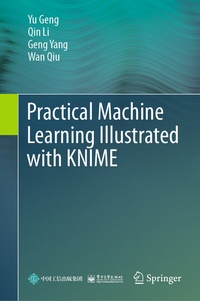
Practical Machine Learning Illustrated with KNIME
Description

This book guides professionals and students from various backgrounds to use machine learning in their own fields with low-code platform KNIME and without coding. Many people from various industries need use machine learning to solve problems in their own domains. However, machine learning is often viewed as the domain of programmers, especially for those who are familiar with Python. It is too hard for people from different backgrounds to learn Python to use machine learning. KNIME, the low-code platform, comes to help. KNIME helps people use machine learning in an intuitive environment, enabling everyone to focus on what to do instead of how to do.
This book helps the readers gain an intuitive understanding of the basic concepts of machine learning through illustrations to practice machine learning in their respective fields. The author provides a practical guide on how to participate in Kaggle completions with KNIME to practice machine learning techniques.
More details
Other editions
Additional editions
Persons
Yu Geng received his Ph.D. degree in Electrical and Computer Engineering from the Hong Kong University of Science and Technology, Hong Kong, China, in 2015. Now, he is an assistant professor at Shenzhen Institute of Information Technology, Shenzhen, China. He is also the lecturer for many companies in China to teach people how to use machine learning to advance their own careers. His research interests include semiconductor devices simulation and fabrication, data mining, and natural language processing.
Email: gengyabc@aliyun.com
Dr. Li Qin is an accomplished researcher with a Ph.D. from Hong Kong Polytechnic University, which he obtained in 2010. Following his postdoctoral work at Shenzhen University in 2013, he embarked on his journey as an associate professor at the Shenzhen Institute of Information Technology. His primary research focus is on the fundamental theories of pattern recognition.
Since 2001, Dr. Qin has made significant contributions to his field, publishing over 40 articles that have been recognized and cited in prestigious journals indexed by SCI/EI, with more than 10 of them being featured in SCI Zone 1. He has played a leadership role in guiding two Natural Science Foundation projects of Guangdong Province and holds five patents, including one in the United States.
Email: liqin@sziit.edu.cn
Dr. Yang Geng is a distinguished professional with an EngD. degree earned from Hong Kong Polytechnic University in 2018. He currently holds the title of Senior Engineer and serves as an esteemed member of the Shenzhen Emergency Management Technology Informatization Consulting Expert Committee. Dr. Yang's research primarily revolves around the innovative applications of artificial intelligence and blockchain technologies. His groundbreaking work has led to the successful implementation of numerous related achievements that have left a lasting impact in the field.
Email: yangg@sziit.edu.cn
Qiu Wan is the chairman and Director of Shenzhen Zhaoyang Institute of Information Technology, EMBA graduate from Tsinghua University, and holds a Bachelor's degree in Electronic Information Engineering from Zhejiang University. Formerly served as the Director of the Training Department of Shenzhen High-tech Association, with a primary focus on the application of artificial intelligence in intelligent manufacturing, smart management, and data mining.
Email: qwvivienqiu@hotmail.com
Content
Chapter 1 Overview of Artificial Intelligence and Machine Learning.- Chapter 2 Basic Knowledge of Machine Learning.- Chapter 3 Linear Regression.- Chapter 4 Logistic Regression.- Chapter 5 Model Optimization.- Chapter 6 Support Vector Machine.- Chapter 7 Decision Tree.- Chapter 8 Understanding of Decision Tree.- Chapter 9 Bayesian Analysis.- Chapter 10 Deep Learning.
