

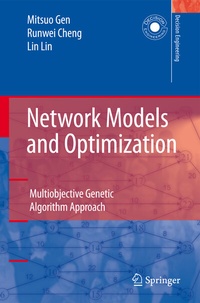
Network Models and Optimization
Description

Network models are critical tools in business, management, science and industry. "Network Models and Optimization" presents an insightful, comprehensive, and up-to-date treatment of multiple objective genetic algorithms to network optimization problems in many disciplines, such as engineering, computer science, operations research, transportation, telecommunication, and manufacturing. The book extensively covers algorithms and applications, including shortest path problems, minimum cost flow problems, maximum flow problems, minimum spanning tree problems, traveling salesman and postman problems, location-allocation problems, project scheduling problems, multistage-based scheduling problems, logistics network problems, communication network problem, and network models in assembly line balancing problems, and airline fleet assignment problems. The book can be used both as a student textbook and as a professional reference for practitioners who use network optimization methods to model and solve problems.
More details
Other editions
Additional editions
Persons
Professor Mitsuo Gen is currently a professor of the Graduate School of Information, Production and Systems at Waseda University. He previously worked as a lecturer and professor at Ashikaga Institute of Technology. His research interests include genetic and evolutionary computation; fuzzy logic and neural networks; supply chain network design; optimization for information networks; and advanced planning and scheduling (APS).
Runwei Cheng is a Doctor of Engineering and currently works for JANA Solutions, Inc.
Lin Lin is currently a PhD candidate and research assistant at Waseda University, where he gained his MSc from the Graduate School of Information, Production and Systems. His research interests include hybrid genetic algorthims; neural networks; engineering optimization; multiobjective optimization; applications of evolutionary techniques; production and logistics; communication networks; image processing and pattern recognition; and parallel and distributed systems.
Content
Multiobjective Genetic Algorithms.- Basic Network Models.- Logistics Network Models.- Communication Network Models.- Advanced Planning and Scheduling Models.- Project Scheduling Models.- Assembly Line Balancing Models.- Tasks Scheduling Models.- Advanced Network Models.
