

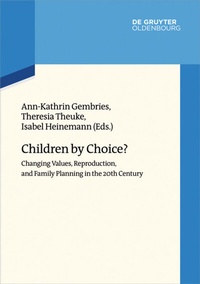
Children by Choice?
Description

During the 20th century, medico-technical advances such as the invention of the latex condom (1930), the arrival of the contraceptive pill on the free market (1960/61) and the birth of the first child conceived by in vitro fertilization (1978) contributed to the fact that in Europe and the USA, the planning, conceiving and making of children was increasingly perceived as a matter of individual and collective decision-making.
Especially since mid-century, these societies underwent profound political, economic and cultural evolutions. In the realm of human reproduction the relationship between the possible, the desirable, and the permitted had to be continually renegotiated.
This volume examines in nine chapters how thinking, speaking and acting changed with regards to reproduction and family planning throughout the modern and post-modern period. Applying an international comparative perspective, the study specifically focuses on the role of value changes underlying these transformation processes.
More details
Other editions
Additional editions
Persons
Isabel Heinemann , Universität Münster; Ann-Katrin Gembries , Universität Mainz; Theresia Theuke , Universität Mainz
Content
- Intro
- Contents
- Introduction: Children by Choice? Changing Values, Reproduction, and Family Planning in the 20th Century
- Birth Control as a National Threat? Pronatalist Discourses on Abortion in France and Germany (1920s-1970s)
- "Children by Choice" - Family Decisions and Value Change in the Campaigns of the American Planned Parenthood Federation (1942-1973)
- "Respect girls as future mothers": Sex Education as Family Life Education in State Socialist Hungary (1950s-1980s)
- Popular Medical Discourses on Birth Control in the Soviet Union during the Cold War: Shifting Responsibilities and Relational Values
- Paradox of the Pill: Oral Contraceptives in Spain and Poland (1960s-1970s)
- The Influence of American Sexual Studies on the 'Sexual Revolution' of Italian Women
- Discourses on Abortion and their Impact on Institutions in Czechoslovakia and the Czech Republic in the Second Half of the 20th Century (1950-2003)
- Narratives about Contraception and Abortion in the GDR (1972-1990) Caught between a Liberal Law, Normative Ways of Living and the Individualization of Family Planning
- From "Children by Choice" to "Families by Choice"? 20th-Century Reproductive Decision-Making between Social Change and Normative Transitions
- Authors
