

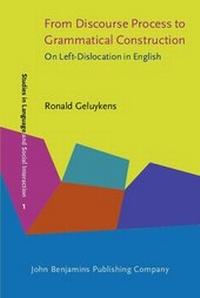
From Discourse Process to Grammatical Construction
On Left-Dislocation in English
1st Edition
Published on 16. October 1992
XII, 182 pages
978-90-272-8591-1 (ISBN)
Description

This study deals with interactional processes in conversational discourse, and the way they may get 'syntacticized' into grammatical constructions. It investigates the link between discourse function and syntactic form, and the ways in which grammatical form is a reflection on communicative function, through examining the communicative functions of Left-Dislocation in English. The investigation is corpus-based, and focuses on spontaneous conversation, but other discourse types are also taken into account. The overall perspective is resolutely empirical, and preconceptions about the possible functions of Left-Dislocation are avoided. Contents 1. Theoretical preliminaries; 2. Referent-introduction (1): interaction; 3. Referent-introduction (2): recoverability; 4. Referent-introduction (3): topicality; 5. Other functions of LD; 6. Prosodic aspects of LD; 7. LD in other discourse types; 8. A broader perspecitive; 9. General conclusion; Notes, Appendices, References, Subject and author indices.
More details
Other editions
Additional editions
Book
10/1992
John Benjamins Publishing Co
€104.94
Shipment within 10-15 days
Content
- FROM DISCOURSE PROCESS TO GRAMMATICAL CONSTRUCTION
- Editorial page
- Title page
- Copyright page
- Dedication
- Preface
- Table of contents
- Chapter 1. Theoretical Preliminaries
- 1.1. Functionalist Framework
- 1.1.1. Introduction
- 1.1.2. Linguistic Form and Communicative Function
- 1.1.3. DA versus CA Methodology
- 1.2. Information Flow in Discourse
- 1.2.1. Recoverability
- 1.2.2. Topicality
- 1.3. Interactional Aspects of Discourse10
- 1.4. LD as a Grammatical Construction
- 1.4.1. A First Approximation
- 1.4.2. Towards a Semantic Characterization
- 1.4.3. On Strict Coreferentiality
- 1.4.4. Conversational Factors
- 1.4.5. Summary
- 1.5. The Database
- 1.5.1. Discourse Typology
- 1.5.2. The Discourse and Conversational Database
- 1.5.3. System of Prosodie Analysis
- Chapter 2. Referent-Introduction (I): Interaction
- 2.1. Introduction
- 2.2. A Quantitative Appreciation of LD
- 2.3. LDs with Intervening Turn(s)
- 2.4. LDs with Intervening Pause
- 2.5. Pauseless LDs
- 2.6. Summary and Comments
- Chapter 3. Referent-Introduction (II): Recoverability
- 3.1. Recoverability Revisited
- 3.2. Completely Irrecoverable REFs
- 3.3. REFs without complete Irrecoverability
- 3.3.1. Inferable REFs
- 3.3.2. The Non-quantifiable Nature of Recoverability
- Chapter 4. Referent-Introduction (III): Topicality
- 4.1. Topicality Revisited
- 4.2. Direct Topicality
- 4.3. Indirect Topicality
- 4.4. Apparent Absence of Topicality
- Chapter 5. Other Functions of LD
- 5.1. LD and Contrastiveness
- 5.1.1. On Contrastiveness
- 5.1.2. Contrastive LDs
- 5.1.3. Listing - LDs
- 5.2. Idiosyncratic LDs
- 5.2.1. Conditional Clauses
- 5.2.2. Some Special Cases
- 5.3. Summary
- Chapter 6. Prosodie Aspects of LD
- 6.1. Introduction
- 6.2. Prosodie Boundaries between REF and PROP28
- 6.3. Intonational Aspects of LD
- 6.3.1. Referent-Introducing LDs
- 6.3.2. Other LDs
- 6.3.3. Intonation of the PROP
- 6.4. Summary
- Chapter 7. LD in Other Discourse Types
- 7.1. Introduction
- 7.2. LD in Non-Conversational Spoken Discourse
- 7.3. LD in Written Discourse
- 7.4. Quasi-LDs
- 7.5. Summary
- Chapter 8. A Broader Perspective
- 8.1. Introduction38
- 8.2. Recent Studies on LD in English
- 8.3. Other Recent Studies on LD
- 8.3.1. LD in German
- 8.3.2. ID in Spoken Standard French
- 8.3.3. LD in Italian Conversation
- 8.4. LD and Language Acquisition
- 8.5. Summary
- Chapter 9. General Conclusion
- 9.1. Summary of Functional Analysis
- 9.2. LD and Referent-Highlighting
- 9.3. Epilogue
- Notes
- Appendices
- Appendix 1. The Original Database
- Appendix 2. Extended Conversational Database
- Appendix 3. Transcription Conventions
- References
- Subject Index
- Author Index
- The series STUDIES IN DISCOURSE AND GRAMMAR
