

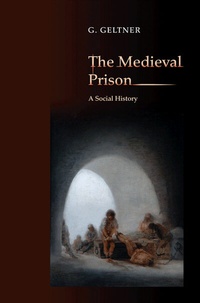
The Medieval Prison
A Social History
1st Edition
Published on 19. November 2018
288 pages
978-0-691-18768-6 (ISBN)
Description

The modern prison is commonly thought to be the fruit of an Enlightenment penology that stressed man's ability to reform his soul. The Medieval Prison challenges this view by tracing the institution's emergence to a much earlier period beginning in the late thirteenth century, and in doing so provides a unique view of medieval prison life.
G. Geltner carefully reconstructs life inside the walls of prisons in medieval Venice, Florence, Bologna, and elsewhere in Europe. He argues that many enduring features of the modern prison--including administration, finance, and the classification of inmates--were already developed by the end of the fourteenth century, and that incarceration as a formal punishment was far more widespread in this period than is often realized. Geltner likewise shows that inmates in medieval prisons, unlike their modern counterparts, enjoyed frequent contact with society at large. The prison typically stood in the heart of the medieval city, and inmates were not locked away but, rather, subjected to a more coercive version of ordinary life. Geltner explores every facet of this remarkable prison experience--from the terror of an inmate's arrest to the moment of his release, escape, or death--and the ways it was viewed by contemporary observers.
The Medieval Prison rewrites penal history and reveals that medieval society did not have a "persecuting mentality" but in fact was more nuanced in defining and dealing with its marginal elements than is commonly recognized.
G. Geltner carefully reconstructs life inside the walls of prisons in medieval Venice, Florence, Bologna, and elsewhere in Europe. He argues that many enduring features of the modern prison--including administration, finance, and the classification of inmates--were already developed by the end of the fourteenth century, and that incarceration as a formal punishment was far more widespread in this period than is often realized. Geltner likewise shows that inmates in medieval prisons, unlike their modern counterparts, enjoyed frequent contact with society at large. The prison typically stood in the heart of the medieval city, and inmates were not locked away but, rather, subjected to a more coercive version of ordinary life. Geltner explores every facet of this remarkable prison experience--from the terror of an inmate's arrest to the moment of his release, escape, or death--and the ways it was viewed by contemporary observers.
The Medieval Prison rewrites penal history and reveals that medieval society did not have a "persecuting mentality" but in fact was more nuanced in defining and dealing with its marginal elements than is commonly recognized.
More details
Other editions
Additional editions

Book
02/2014
Princeton University Press
€24.50
Shipment within 10-20 days
Book
07/2008
Princeton University Press
€59.52
Article not available at the moment
Person
G. Geltner is professor of medieval history at the University of Amsterdam.
Content
- Cover
- Title Page
- Copyright Page
- CONTENTS
- List of Illustrations
- Acknowledgments
- A Note on Dates and Money
- Prologue
- Introduction
- Chapter One: Italian Prisons: Three Profiles
- Venice
- Florence
- Bologna
- Conclusions
- Chapter Two: Aspects of Imprisonment
- Urban Development
- Administration and Bureaucracy
- Finance and Economy
- Punitive Imprisonment: Jurisprudence, Legislation, and Practice
- Conclusions
- Chapter Three: Prison Life
- The Terror of Arrest
- First Nights
- Familiar Order: The Wards
- Daily Life: Order and Dissidence
- The World Outside
- The Journey's End: Death, Escape, Release
- Conclusions
- Chapter Four: The Prison as Place and Metaphor
- Early Imaginaries: Martyrdom, Monasticism, and Purgation
- Excursus: Jail-Breaking Saints
- From Purgation to Purgatory: God's Great Prison
- This World and the Next: The Urban Prison
- Conclusions
- Conclusion: "Marginalizing" Institutions, Instituting Marginality
- Appendix One: A Prison Inventory from Bologna, 1305
- Appendix Two: Poems from the Prison
- Appendix Three: Le Stinche, a Reconstruction
- Abbreviations and Archives
- Notes
- Bibliography
- Index
