

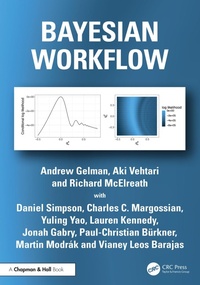
Bayesian Workflow
Will be published approx. on 28. August 2026
552 pages
978-1-040-72977-9 (ISBN)
Description

Bayesian statistics and statistical practice have evolved over the years, driven by advancements in theory, methods, and computational tools. Bayesian Workflow explores the intricate workflows of applied Bayesian statistics, aiming to uncover the tacit knowledge often overlooked in published papers and textbooks. By systematizing the process of Bayesian model development, the book seeks to improve applied analyses and inspire future innovations in theory, methods, and software. It emphasizes the importance of iterative model building, model checking, computational troubleshooting, and simulated-data experimentation, offering a comprehensive perspective on statistical analysis.
Through detailed examples and practical guidance, the book bridges the gap between theory and application, empowering practitioners and researchers to navigate the complexities of Bayesian inference. It is not a checklist or cookbook but a flexible framework for understanding and resolving challenges in statistical modeling and decision-making under uncertainty.
Features
Covers all aspects of Bayesian statistical workflow, including model building, inference, validation, troubleshooting, and understanding
Demonstrates iterative model development and computational problem-solving through real-world case studies
Explores computational challenges, calibration checking, and connections between modeling and computation
Highlights the importance of checking models under diverse conditions to understand their limitations and improve their robustness
Discusses how Bayesian principles apply to non-Bayesian methods in statistics and machine learning
Includes code snippets, exercises, and links to full datasets and code in R and Stan, with applicability to other programming environments like Python and Julia
This book is designed for practitioners of applied Bayesian statistics, particularly users of probabilistic programming languages such as Stan, as well as developers of methods and software tailored to these users. It also targets researchers in Bayesian theory and methods, offering insights into understudied aspects of statistical workflows. Instructors and students will find adaptable exercises and case studies to enhance their learning experience. Beyond Bayesian inference, the book's principles are relevant to users of non-Bayesian methods, making it a valuable resource for statisticians, data scientists, and machine learning professionals seeking to improve their modeling and decision-making processes.
Through detailed examples and practical guidance, the book bridges the gap between theory and application, empowering practitioners and researchers to navigate the complexities of Bayesian inference. It is not a checklist or cookbook but a flexible framework for understanding and resolving challenges in statistical modeling and decision-making under uncertainty.
Features
Covers all aspects of Bayesian statistical workflow, including model building, inference, validation, troubleshooting, and understanding
Demonstrates iterative model development and computational problem-solving through real-world case studies
Explores computational challenges, calibration checking, and connections between modeling and computation
Highlights the importance of checking models under diverse conditions to understand their limitations and improve their robustness
Discusses how Bayesian principles apply to non-Bayesian methods in statistics and machine learning
Includes code snippets, exercises, and links to full datasets and code in R and Stan, with applicability to other programming environments like Python and Julia
This book is designed for practitioners of applied Bayesian statistics, particularly users of probabilistic programming languages such as Stan, as well as developers of methods and software tailored to these users. It also targets researchers in Bayesian theory and methods, offering insights into understudied aspects of statistical workflows. Instructors and students will find adaptable exercises and case studies to enhance their learning experience. Beyond Bayesian inference, the book's principles are relevant to users of non-Bayesian methods, making it a valuable resource for statisticians, data scientists, and machine learning professionals seeking to improve their modeling and decision-making processes.
More details
Language
English
Place of publication
London
United Kingdom
Publishing group
Taylor & Francis Ltd
Target group
College/higher education
Professional and scholarly
Product notice
Reflowable
Illustrations
190 Line drawings, color; 53 Line drawings, black and white; 190 Illustrations, color; 53 Illustrations, black and white
File size
48,52 MB
ISBN-13
978-1-040-72977-9 (9781040729779)
Copyright in bibliographic data and cover images is held by Nielsen Book Services Limited or by the publishers or by their respective licensors: all rights reserved.
Schweitzer Classification
Other editions
Additional editions
Andrew Gelman | Aki Vehtari | Richard McElreath
Bayesian Workflow
Book
approx. 06/2026
1st Edition
Chapman & Hall/CRC
€148.50
Not yet published
Andrew Gelman | Aki Vehtari | Richard McElreath
Bayesian Workflow
Book
approx. 06/2026
1st Edition
Chapman & Hall/CRC
€66.00
Not yet published
Persons
Andrew Gelman is a professor of statistics and political science at Columbia University
Aki Vehtari is a professor of computer science at Aalto University
Richard McElreath is the director of the Max Planck Institute for Evolutionary Anthropology
Daniel Simpson is a machine learning engineer at dottxt
Charles Margossian is an assistant professor of statistics at the University of British Columbia
Yuling Yao is an assistant professor of statistics at the University of Texas
Lauren Kennedy is a senior lecturer in mathematical science at the University of Adelaide
Jonah Gabry is an applied statistics researcher at Columbia University
Paul-Christian Buerkner is a professor of statistics at TU Dortmund University
Martin Modrak is a researcher in bioinformatics at Charles University
Vianey Leos Barajas is an assistant professor of statistical sciences at the University of Toronto
Aki Vehtari is a professor of computer science at Aalto University
Richard McElreath is the director of the Max Planck Institute for Evolutionary Anthropology
Daniel Simpson is a machine learning engineer at dottxt
Charles Margossian is an assistant professor of statistics at the University of British Columbia
Yuling Yao is an assistant professor of statistics at the University of Texas
Lauren Kennedy is a senior lecturer in mathematical science at the University of Adelaide
Jonah Gabry is an applied statistics researcher at Columbia University
Paul-Christian Buerkner is a professor of statistics at TU Dortmund University
Martin Modrak is a researcher in bioinformatics at Charles University
Vianey Leos Barajas is an assistant professor of statistical sciences at the University of Toronto
Content
Part 1: From Bayesian inference to Bayesian workflow. 1 Bayesian theory and Bayesian practice. 2 Statistical modeling and workflow. 3 Computational tools. 4 Introduction to workflow: Modeling performance on a multiple choice exam. Part 2: Statistical workflow. 5 Building statistical models. 6 Using simulations to capture uncertainty. 7 Prediction, generalization, and causal inference/ 8 Visualizing and checking fitted models. 9 Comparing and improving models. 10 Statistical inference and scientific inference. Part 3: Computational workflow. 11 Fitting statistical models. 12 Diagnosing and fixing problems with fitting. 13 Approximate algorithms and approximate models. 14 Simulation-based calibration checking. 15 Statistical modeling as software development. Part 4: Case studies. 16 Coding a series of models: Simulated data of movie ratings. 17 Prior specification for regression models: Reanalysis of a sleep study.18 Predictive model checking and comparison: Clinical trial. 19 Building up to a hierarchical model: Coronavirus testing. 20 Using a fitted model for decision analysis: Mixture model for time series competition. 21 Posterior predictive checking: Stochastic learning in dogs. 22 Incremental development and testing: Black cat adoptions. 23 Debugging a model: World Cup football. 24 Leave-one-out cross validation model checking and comparison: Roaches. 25 Model building and expansion: Golf putting. 26 Model building with latent variables: Markov models for animal movement. 27 Model building: Time-series decomposition for birthdays. 28 Models for regression coefficients and variable selection: Student grades. 29 Funnel problem with latent variables: No vehicles in the park. 30 Computational challenge of multimodality: Differential equation for planetary motion. 31 Simulation-based calibration checking in model development workflow.
