

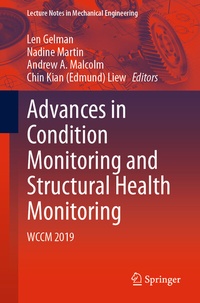
Advances in Condition Monitoring and Structural Health Monitoring
WCCM 2019
Published on 2. February 2021
XV, 795 pages
978-981-15-9199-0 (ISBN)
Description

This book comprises the selected contributions from the 2nd World Congress on Condition Monitoring (WCCM 2019), held in Singapore in December 2019. The contents focus on digitalisation for condition monitoring with the emergence of the fourth industrial revolution (Industry 4.0) and the Industrial Internet-of-Things (IIoT). The book covers latest research findings in the areas of condition monitoring, structural health monitoring, and non-destructive testing which are relevant for many sectors including aerospace, automotive, civil, oil and gas, marine, and manufacturing industries. Different monitoring systems and non-destructive testing methods are discussed to avoid failures, increase lifespans, and reduce maintenance costs of equipment and machinery. The broad scope of the contents will make this book interesting for academics and professionals working in the areas of non-destructive evaluation and condition monitoring.
More details
Series
Edition
1st ed. 2021
Language
English
Place of publication
Singapore
Singapore
Publishing group
Springer Singapore
Target group
Professional and scholarly
Product notice
Reflowable
Illustrations
XV, 795 p. 504 illus., 415 illus. in color.
File size
43,54 MB
ISBN-13
978-981-15-9199-0 (9789811591990)
DOI
10.1007/978-981-15-9199-0
Schweitzer Classification
Other editions
Additional editions
Len Gelman | Nadine Martin | Andrew A. Malcolm
Advances in Condition Monitoring and Structural Health Monitoring
WCCM 2019
Book
02/2021
Springer
€588.49
Shipment within 3-4 weeks
Persons
Len Gelman, Ph.D., Dr. of Sciences (Habilitation) joined Huddersfield University as Professor, Chair in Signal Processing/Condition Monitoring and Director of Centre for Efficiency and Performance Engineering, in 2017 from Cranfield University, where he worked as Professor and Chair in Vibro-Acoustical Monitoring since 2002. Len developed novel condition monitoring technologies for aircraft engines, gearboxes, bearings, turbines and centrifugal compressors. Len published more than 250 publications, 17 patents and is Co-Editor of 12 Springer books. He is Fellow of: BINDT, International Association of Engineers and Institution of Diagnostic Engineers, Executive Director, International Society for Condition Monitoring, Honorary Technical Editor, International Journal of Condition Monitoring, Editor-in-Chief, International Journal of Engineering Sciences (SCMR), Chair, annual International Condition Monitoring Conferences, Honorary Co-Chair, annual World Congresses of Engineering, Co-Chair, International Congress COMADEM 2019 and Chair, International Scientific Committee of Third World Congress, Condition Monitoring. Len is Editorial Board member of journals
Applied Sciences
,
Electronics
,
Sensors
, International Journal
Insight
,
International Journal of Acoustics and Vibration
,
International Journal of Prognostics and Health Management
,
International Journal of Basic and Applied Sciences
and
International Journal of Pure and Applied Mathematics
. He was Chair, First World Congress, Condition Monitoring, Chair, Second World Congress, Engineering Asset Management and Chair, International Committee of Second World Congress, Condition Monitoring. Len is Chair of International CM Groups of ICNDT and EFNDT and Member of ISO Technical Committee, Condition Monitoring. Len made 42 plenary keynotes at major international conferences. He was Visiting Professor at ten Universities abroad. Len received two Rolls-Royce (UK) Awardsfor Innovation, COMADIT Prize (by British Institute of NDT) for significant contribution through research/development in condition monitoring, Oxford Academic Health Science Network Award, William Smith Prize by UK Institution of Mechanical Engineers and USA Navy Award.
Nadine Martin is a senior researcher at the CNRS, Nat. Centre of Scientific Research, within GIPSA-lab, Grenoble Image Speech Signal & Automatic, Univ. Grenoble Alpes, France. In the signal-processing domain, her research interests are the analysis, detection and modeling of non-stationary signals in time-frequency domain with a particular interest in conditional preventive monitoring of complex systems such as wind turbines or paper machines. His current research focuses on expert-level automatic signal processing for continuous fault detection and localization with severity tracking. N. Martin is the author of around 150 papers, 2 patents, 7 book chapters, and co-editor of the book Time-frequency decision . Currently, she is an expert for MINALOGIC, the French Global Innovation Cluster for Digital Technologies, Chair of ISCM, the Int. Society for Condition Monitoring, Vice-Editor-in-Chief of IJCM, the International Journal of Condition Monitoring and a member of a working group of the International Committee of Nondestructive testing, ICNDT. Within ISCM, she is active in the scientific program of Condition Monitoring conferences.
Andrew A. Malcolm is the Deputy Group Manager for the Intelligent Process Verification Group, and Senior Technical Lead for the Non-Destructive Evaluation Team at the Advanced Remanufacturing and Technology Centre (ARTC) under the Agency for Science, Technology and Research (A*STAR) in Singapore. He received his MSc in Computer-Aided Engineering and his PhD for a thesis on precision measurement through fringe pattern analysis from Liverpool John Moores University in 1987 and 1995 respectively. Prior to joining A*STAR in early 1996, he worked for various UK and European companies developing vision systems for non-destructive testing, process control and product inspection, and for Liverpool John Moores University as an Industrial Research Fellow and Sessional Lecturer. He has a background in non-destructive testing and inspection, machine and computer vision, image processing, visual guidance systems for autonomous vehicles, stereo vision and teleoperation control. He is currently involved with a number of research and industry projects at ARTC developing and implementing novel techniques in the areas of ultrasonic testing, eddy current testing, thermography and X-ray imaging and computed tomography focusing on technology transfer for industrial implementation. Key application domains include aerospace, heavy machinery and fast-moving consumer goods (FMCG). His current research interests included X-ray computed tomography for visualisation and dimensional measurement, X-ray inspection and advanced imageprocessing, non-destructive testing and evaluation, application of artificial intelligence within NDE, and the role of NDE in Industry 4.0. He is a Fellow of the Non-destructive Testing Society of Singapore and currently chairman of the certification committee responsible for the internationally-recognised SGNDT certification scheme accredited by the Singapore Accreditation Council in accordance with ISO 9712:2012 and EN4179 schemes.
Chin Kian (Edmund) Liew has more than 15 years of teaching and research experience in the field of non-destructive testing and structural health monitoring. His early research interests were in guided wave ultrasound where he developed pattern recognition techniques to identify defects in metal beams. Subsequently, he researched on several emerging NDT methods to inspect helicopter composite airframe structures for Australian Aerospace, including phased array ultrasound, radiography, and thermography. He joined the Singapore Institute of Technology (SIT) in 2013 where he was instrumental in establishing an Authorised Training Organisation (ATO) at the university for the Singapore NDT (SGNDT) professional certification. He is currently an Associate Professor at SIT where he continues to be active in the field of NDT, delivering education and training, as well as conducting applied research for a diverse range of industry projects including for the rail, aerospace, civil, and marine engineering sectors.
Nadine Martin is a senior researcher at the CNRS, Nat. Centre of Scientific Research, within GIPSA-lab, Grenoble Image Speech Signal & Automatic, Univ. Grenoble Alpes, France. In the signal-processing domain, her research interests are the analysis, detection and modeling of non-stationary signals in time-frequency domain with a particular interest in conditional preventive monitoring of complex systems such as wind turbines or paper machines. His current research focuses on expert-level automatic signal processing for continuous fault detection and localization with severity tracking. N. Martin is the author of around 150 papers, 2 patents, 7 book chapters, and co-editor of the book Time-frequency decision . Currently, she is an expert for MINALOGIC, the French Global Innovation Cluster for Digital Technologies, Chair of ISCM, the Int. Society for Condition Monitoring, Vice-Editor-in-Chief of IJCM, the International Journal of Condition Monitoring and a member of a working group of the International Committee of Nondestructive testing, ICNDT. Within ISCM, she is active in the scientific program of Condition Monitoring conferences.
Andrew A. Malcolm is the Deputy Group Manager for the Intelligent Process Verification Group, and Senior Technical Lead for the Non-Destructive Evaluation Team at the Advanced Remanufacturing and Technology Centre (ARTC) under the Agency for Science, Technology and Research (A*STAR) in Singapore. He received his MSc in Computer-Aided Engineering and his PhD for a thesis on precision measurement through fringe pattern analysis from Liverpool John Moores University in 1987 and 1995 respectively. Prior to joining A*STAR in early 1996, he worked for various UK and European companies developing vision systems for non-destructive testing, process control and product inspection, and for Liverpool John Moores University as an Industrial Research Fellow and Sessional Lecturer. He has a background in non-destructive testing and inspection, machine and computer vision, image processing, visual guidance systems for autonomous vehicles, stereo vision and teleoperation control. He is currently involved with a number of research and industry projects at ARTC developing and implementing novel techniques in the areas of ultrasonic testing, eddy current testing, thermography and X-ray imaging and computed tomography focusing on technology transfer for industrial implementation. Key application domains include aerospace, heavy machinery and fast-moving consumer goods (FMCG). His current research interests included X-ray computed tomography for visualisation and dimensional measurement, X-ray inspection and advanced imageprocessing, non-destructive testing and evaluation, application of artificial intelligence within NDE, and the role of NDE in Industry 4.0. He is a Fellow of the Non-destructive Testing Society of Singapore and currently chairman of the certification committee responsible for the internationally-recognised SGNDT certification scheme accredited by the Singapore Accreditation Council in accordance with ISO 9712:2012 and EN4179 schemes.
Chin Kian (Edmund) Liew has more than 15 years of teaching and research experience in the field of non-destructive testing and structural health monitoring. His early research interests were in guided wave ultrasound where he developed pattern recognition techniques to identify defects in metal beams. Subsequently, he researched on several emerging NDT methods to inspect helicopter composite airframe structures for Australian Aerospace, including phased array ultrasound, radiography, and thermography. He joined the Singapore Institute of Technology (SIT) in 2013 where he was instrumental in establishing an Authorised Training Organisation (ATO) at the university for the Singapore NDT (SGNDT) professional certification. He is currently an Associate Professor at SIT where he continues to be active in the field of NDT, delivering education and training, as well as conducting applied research for a diverse range of industry projects including for the rail, aerospace, civil, and marine engineering sectors.
Content
1. Condition monitoring.- 2. Structural health monitoring.- 3. Non-destructive testing and evaluation.
