

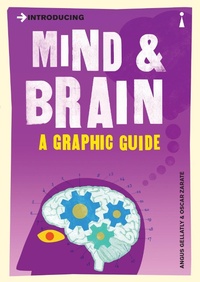
Introducing Mind and Brain
A Graphic Guide
Published on 5. April 2018
176 pages
978-1-78578-314-2 (ISBN)
Description

How do emotions affect your basic decision making? Why do certain smells prompt long-forgotten memories, and what makes us suddenly self-conscious?
How does the biological organ, the brain, give rise to all of the thoughts in your head - enable you to think, to feel, to be conscious and aware - to have 'a mind'?
Introducing Mind and Brain explains what the sciences have to say about planning and action, language, memory, attention, emotions and vision. It traces the historical development of ideas about the brain and its function from antiquity to the age of neuro-imaging.
Clearly explained by Professor of Psychology Angus Gellatly and award-winning artist Oscar Zarate, they invite you to take a fresh look at the nature of mind, consciousness and personal identity.
How does the biological organ, the brain, give rise to all of the thoughts in your head - enable you to think, to feel, to be conscious and aware - to have 'a mind'?
Introducing Mind and Brain explains what the sciences have to say about planning and action, language, memory, attention, emotions and vision. It traces the historical development of ideas about the brain and its function from antiquity to the age of neuro-imaging.
Clearly explained by Professor of Psychology Angus Gellatly and award-winning artist Oscar Zarate, they invite you to take a fresh look at the nature of mind, consciousness and personal identity.
More details
Other editions
Additional editions
Book
04/2018
Icon Books
€11.50
Shipment within 3-4 weeks
Persons
Angus Gellatly was Professor of Psychology and Head of Department at Keele University and is now at the Open University. He used to write fiction in the days when he had the time.
Oscar Zarate is a highly acclaimed graphic artist who has illustrated many Introducing titles. His prize-winning graphic novel A Small Killing is known throughout the world.
Content
- Intro
- Title Page
- Copyright
- Contents
- Mind and Brain: a Brief History
- Inventing the Mind
- What is the Mind?
- Meet the Brain
- Matter or Spirit?
- Pioneer Map-Makers
- The Mind of the Gaps
- Ventricles, Tissues and the Mind
- A Fish Called Wondercure
- Bumps on the Head
- The Beginning of Localization
- Beginning to Assemble Brain Functions
- Tracing the Progress
- Neurons and Glia
- Grey and White Matters
- The Electric Brain
- Abnormal Firing
- The Chemical Brian
- Chemical Malfunctions
- Brain, Hormones and Body
- The Geography of the Human Brain
- Evolution and Development
- The Hindbrain
- The Midbrain
- The Forebrain
- Left and Right Hemispheres (LH and RH)
- Mental Abilities
- Simple Minds 1: the Sea Slug
- Simple Minds 2: Frogs and Toads
- Simple Minds 3: Birds
- Simple Minds 4: Human Beings
- Complex Minds and Computers
- Language and the Brain
- Disorders of Language: the Aphasias
- A Model of Language Use
- Language and All the Brain
- Language, Interpretation and Action
- Movement and Mind
- Tuning the Movements
- Two Motor Movement Control System
- Levels of Control of Movement
- The Motor System
- Damage to the Motor System
- The Origins of Voluntary Movement
- Proprioception and Body Ego
- Smells and Emotions
- Emotional Reaction
- The Anatomy of Fear
- Fearful Symmetry
- Sub-cortical Learning
- Knowing When to be Afraid
- Emotions "Left and Right"
- Emotional Tone
- Emotion and Reason
- Emotions Involved in Decisions
- Memory Makes You Flexible
- What Amnesia tells us about Mind
- Two Kinds of Memory
- Memory with and without Emotions
- The Location of Memories
- The Complexity of Memory
- Sensing and Seeing
- The Anatomy of Vision
- Visual Areas: Colours, Directions and Shapes
- Loss of Colour
- Motion Blindness
- Higher Level Vision
- The Lower Visual Pathway: Effects of Injury on Recognition
- A Recognition Test
- The Middle Visual Pathway: Relative Spatial Positions
- The Upper Visual Pathway: Effects of Parietal Damage
- Mind Spaces
- Visual, Motor and Imaginai Spaces
- Representations of Space
- Attention and the Mind
- Experiments with Attention
- The Attentional Network
- Mental Grasp
- What is Consciousness?
- Blindsight
- Working Memory
- The Central Executive in Area 46
- Narrative Consciousness
- Free Will and the Frontal Lobes
- Responsive Movements
- Effects of Frontal Lobe Damage
- FL Damage and Unwanted Responses
- What is Free Will?
- The Self
- Loss of Self
- Denial of Loss
- Dissolution of Self
- Feelings of Transcendence
- Alternative Perceptions
- Sanity: Beliefs and Pathologies
- Explaining Delusions
- Hearing Voices
- The Impostors Delusion
- What Do We Learn About the Mind from Studying the Brain?
- Evolution of the Mind
- The Social Intellect
- Mind Reading
- Do Mental States Exist Outside Our Experience of Them?
- The Heider Experiment
- What About Personal Responsibility?
- Crime and Punishment
- Further Reading
- The Authors
- Acknowledgements
- Index
