

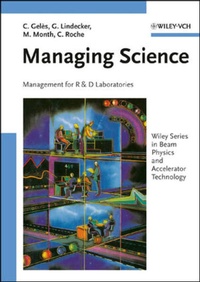
Managing Science
Management for R&D Laboratories
1st Edition
Published on 11. July 2008
XIX, 359 pages
978-3-527-61730-2 (ISBN)
Description

A unique "how-to" manual for the management of scientific laboratories
This book presents a complete set of tools for the management of research and development laboratories and projects. With an emphasis on knowledge rather than profit as a measure of output and performance, the authors apply standard management principles and techniques to the needs of high-flux, open-ended, separately funded science and technology enterprises. They also propose the novel idea that failure, and incipient failure, is an important measure of an organization's potential.
From the management of complex, round-the-clock, high-tech operations to strategies for long-term planning, Managing Science: Management for R&D Laboratories discusses how to build projects with the proper research and development, obtain and account for funding, and deal with rapidly changing technologies, facilities, and trends. The entire second part of the book is devoted to personnel issues and the impact of workplace behavior on the various functions of a knowledge-based organization.
Drawing on four decades of involvement with the management of scientific laboratories, the authors thoroughly illustrate their philosophy with real-world examples from the physics field and provide tables and charts. Managers of scientific laboratories as well as scientists and engineers expecting to move into management will find Managing Science: Management for R&D Laboratories an invaluable practical guide.
This book presents a complete set of tools for the management of research and development laboratories and projects. With an emphasis on knowledge rather than profit as a measure of output and performance, the authors apply standard management principles and techniques to the needs of high-flux, open-ended, separately funded science and technology enterprises. They also propose the novel idea that failure, and incipient failure, is an important measure of an organization's potential.
From the management of complex, round-the-clock, high-tech operations to strategies for long-term planning, Managing Science: Management for R&D Laboratories discusses how to build projects with the proper research and development, obtain and account for funding, and deal with rapidly changing technologies, facilities, and trends. The entire second part of the book is devoted to personnel issues and the impact of workplace behavior on the various functions of a knowledge-based organization.
Drawing on four decades of involvement with the management of scientific laboratories, the authors thoroughly illustrate their philosophy with real-world examples from the physics field and provide tables and charts. Managers of scientific laboratories as well as scientists and engineers expecting to move into management will find Managing Science: Management for R&D Laboratories an invaluable practical guide.
Reviews / Votes
"Managers...present a complete set of tools for managing research and development laboratories and projects." (SciTech Book News, March 2001)"...useful in a university course on research management or for any individual seeking an overview of the many facets and challenges of R&D management." (MRS Bulletin, September 2001)
"...the authors adopt a pragmatic approach...emphasizing the difficulty of accurately assessing organizational performance, but providing useful guidelines and best practices for improving it." (Physics Today, November 2001)
More details
Other editions
Additional editions
Software
01/2008
Wiley-VCH
€198.26
No shipping information available
Book
11/1999
Wiley-VCH
€139.00
Article exhausted; check different version
Persons
CLAUDE GELÈS (retired) was a technical manager at CERN (European Laboratory for Particle Physics).
GILLES LINDECKER is Head of Strategic Planning at CERN. MEL MONTH, PhD, is a scientist and educator at Brookhaven National Laboratory.
CHRISTIAN ROCHE, PhD, was formerly Associate Director for Forecasting and Planning at CERN.
GILLES LINDECKER is Head of Strategic Planning at CERN. MEL MONTH, PhD, is a scientist and educator at Brookhaven National Laboratory.
CHRISTIAN ROCHE, PhD, was formerly Associate Director for Forecasting and Planning at CERN.
Content
THE MANAGEMENT STRUCTURES.
Raisons d'Être.
Institutions and Decision-Making Systems.
Organization and Communications.
Policy Implementation.
Project Methodology and Management.
Infrastructure.
Human Resources Management.
Financial Statements.
Cost Assessment and Management.
Logistics.
General Services.
Supply Chain.
THE HUMAN DRAMA.
The Psycho-Social Life Case Study: The Failure Mode.
Performance.
Knowledge.
Money.
Judgment Case Study: Planning and Serendipity.
Epilogue: A Summary of the Nature of the Origins of Stagnation and Failure.
Selected References.
Raisons d'Être.
Institutions and Decision-Making Systems.
Organization and Communications.
Policy Implementation.
Project Methodology and Management.
Infrastructure.
Human Resources Management.
Financial Statements.
Cost Assessment and Management.
Logistics.
General Services.
Supply Chain.
THE HUMAN DRAMA.
The Psycho-Social Life Case Study: The Failure Mode.
Performance.
Knowledge.
Money.
Judgment Case Study: Planning and Serendipity.
Epilogue: A Summary of the Nature of the Origins of Stagnation and Failure.
Selected References.
