

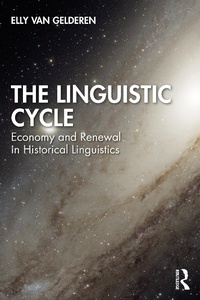
The Linguistic Cycle
Economy and Renewal in Historical Linguistics
1st Edition
Published on 31. July 2023
272 pages
978-1-000-91222-7 (ISBN)
Description

Cyclical language change is a linguistic process by which a word, phrase, or part of the grammar loses its meaning or function and is then replaced by another. This can even happen on the level of an entire language, which can experience a change in the language family it is a part of. This new text is a comprehensive introduction to this phenomenon, the mechanisms underlying it, and the relations between the different types of cycles. Elly van Gelderen reviews the subject widely and holistically, defining key terms and comprehensively presenting diverse theoretical perspectives and empirical findings.
With coverage of a variety of micro cycles and the more controversial macro cycles, incorporating cutting-edge work on grammaticalization, and drawing on examples from many languages and language families, this book accessibly guides readers through the state of the art in the field. With practical methodological guidance on how to identify and investigate linguistic cycles, and an array of useful pedagogical features, the book provides a coherent framework for approaching, understanding, and furthering research in linguistic cycles.
This text will be an indispensable resource for advanced students and researchers in historical and diachronic linguistics, language typology, and linguistic and grammatical theory.
With coverage of a variety of micro cycles and the more controversial macro cycles, incorporating cutting-edge work on grammaticalization, and drawing on examples from many languages and language families, this book accessibly guides readers through the state of the art in the field. With practical methodological guidance on how to identify and investigate linguistic cycles, and an array of useful pedagogical features, the book provides a coherent framework for approaching, understanding, and furthering research in linguistic cycles.
This text will be an indispensable resource for advanced students and researchers in historical and diachronic linguistics, language typology, and linguistic and grammatical theory.
More details
Edition
1. Auflage
Language
English
Place of publication
London
United Kingdom
Publishing group
Taylor & Francis Ltd
Target group
College/higher education
Product notice
Reflowable
Illustrations
34 Tables, black and white; 21 Line drawings, black and white; 21 Illustrations, black and white
ISBN-13
978-1-000-91222-7 (9781000912227)
Copyright in bibliographic data and cover images is held by Nielsen Book Services Limited or by the publishers or by their respective licensors: all rights reserved.
Schweitzer Classification
Other editions
Additional editions
Book
07/2023
1st Edition
Routledge
€207.90
Shipment within 10-20 days
Book
07/2023
1st Edition
Routledge
€63.50
Shipment within 10-20 days
Person
Elly van Gelderen is Regents' Professor of English and Linguistics at Arizona State University, USA. Her most recent books include The Linguistic Cycle: Language Change and the Language Faculty (2011), The Diachrony of Meaning (2018), and Third Factors in Language Variation and Change (2022).
Content
Preface
List of Tables
List of Figures
Abbreviations
1 Introduction
1 What is the linguistic cycle?
2 What kinds of cycles exist?
3 How and why to study cyclical change
3.1 The practical side
3.2 The theoretical side
4 Major questions in the study of cycles
5 Terminology
6 Conclusion and outline
Suggestions for further reading
Review questions and exercises
2 History
1 The late eighteenth and early nineteenth centuries
2 The late nineteenth and early twentieth centuries
3 The mid and late twentieth century
4 Recent generative work
5 Recent functionalist work
6 Conclusion
Suggestions for further reading
Review questions
3 Micro cycles: Determiner and Verbal Cycles
1 Definition of a micro cycle
2 Determiner Cycles
3 Copula Cycles
4 Tense and Aspect Cycles
4.1 The Imperfective Cycle
4.2 The Perfective Cycle
4.3 Imperfective and perfective renewal in Basque
5 Mood Cycles
6 Voice Cycles
7 Conclusion
Suggestions for further reading
Review questions and exercises
4 Micro cycles: Polarity and Discourse Cycles
1 Negative Cycles
1.1 Jespersen's Negative Cycle
1.2 Givon's Negative Cycle
1.3 Croft's Negative Cycle
2 Interrogative Cycles
3 Complementizer Cycles
4 Pragmatic Cycles
4.1 A definition
4.2 Temperal adverbs as sources
4.3 Emphatic Pronoun Cycles
5 Interactions between micro cycles
6 Conclusions
Suggestions for further reading
Review questions and exercises
5 Macro cycles
1 Definition of a macro cycle
2 Analytic to synthetic to analytic
3 Pronoun Cycles
3.1 Subject Cycle
3.2 Object Cycle
3.3 Morpheme Order
4 Case Cycles
5 Interactions involving macro cycles
6 Conclusions
Suggestions for further reading
Review questions and exercises
Appendix
6 Explanations and mechanisms
1 Clarity vs comfort
2 External factors
3 Construction Grammar
4 Early Minimalism: structural and featural economy
5 Later Minimalism: labeling and determinacy
6 Attractor states
7 Conclusions
Suggestions for further reading
Review questions and exercises
7 Conclusions and future directions
1 Insights from cycles
2 Criticisms of the cycle
3 Future directions
Suggested answers to the review questions and exercises
References
Indices
List of Tables
List of Figures
Abbreviations
1 Introduction
1 What is the linguistic cycle?
2 What kinds of cycles exist?
3 How and why to study cyclical change
3.1 The practical side
3.2 The theoretical side
4 Major questions in the study of cycles
5 Terminology
6 Conclusion and outline
Suggestions for further reading
Review questions and exercises
2 History
1 The late eighteenth and early nineteenth centuries
2 The late nineteenth and early twentieth centuries
3 The mid and late twentieth century
4 Recent generative work
5 Recent functionalist work
6 Conclusion
Suggestions for further reading
Review questions
3 Micro cycles: Determiner and Verbal Cycles
1 Definition of a micro cycle
2 Determiner Cycles
3 Copula Cycles
4 Tense and Aspect Cycles
4.1 The Imperfective Cycle
4.2 The Perfective Cycle
4.3 Imperfective and perfective renewal in Basque
5 Mood Cycles
6 Voice Cycles
7 Conclusion
Suggestions for further reading
Review questions and exercises
4 Micro cycles: Polarity and Discourse Cycles
1 Negative Cycles
1.1 Jespersen's Negative Cycle
1.2 Givon's Negative Cycle
1.3 Croft's Negative Cycle
2 Interrogative Cycles
3 Complementizer Cycles
4 Pragmatic Cycles
4.1 A definition
4.2 Temperal adverbs as sources
4.3 Emphatic Pronoun Cycles
5 Interactions between micro cycles
6 Conclusions
Suggestions for further reading
Review questions and exercises
5 Macro cycles
1 Definition of a macro cycle
2 Analytic to synthetic to analytic
3 Pronoun Cycles
3.1 Subject Cycle
3.2 Object Cycle
3.3 Morpheme Order
4 Case Cycles
5 Interactions involving macro cycles
6 Conclusions
Suggestions for further reading
Review questions and exercises
Appendix
6 Explanations and mechanisms
1 Clarity vs comfort
2 External factors
3 Construction Grammar
4 Early Minimalism: structural and featural economy
5 Later Minimalism: labeling and determinacy
6 Attractor states
7 Conclusions
Suggestions for further reading
Review questions and exercises
7 Conclusions and future directions
1 Insights from cycles
2 Criticisms of the cycle
3 Future directions
Suggested answers to the review questions and exercises
References
Indices
