

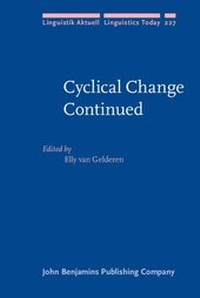
Cyclical Change Continued
1st Edition
Published on 15. March 2016
VIII, 418 pages
978-90-272-6743-6 (ISBN)
Description

This book presents new data and additional questions regarding the linguistic cycle. The topics discussed are the pronoun, negative, negative existential, analytic-synthetic, distributive, determiner, degree, and future/modal cycles. The papers raise questions about the length of time that cycles take, the interactions between different cycles, the typical stages and their stability, and the areal factors influencing cycles. The languages and language families that are considered in depth are Central Pomo, Cherokee, Chinese, English, French, Gbe, German, Hmong-Mien, Maipurean, Mayan, Mohawk, Mon-Khmer, Niger-Congo, Nupod, Quechuan, Sino-Tibetan, Tai-Kadai, Tuscarora, Ute, and Yoruboid. One paper covers several of the world's language families. Cyclical change connects linguists working in various frameworks because it is exciting to find a reason behind this fascinating phenomenon.
More details
Other editions
Additional editions
Elly Gelderen
Cyclical Change Continued
Book
03/2016
John Benjamins Publishing Co
€104.94
Shipment within 10-15 days
Person
Content
- Intro
- Cyclical Change Continued
- Editorial page
- Title page
- LCC data
- Table of contents
- Cyclical Change Continued
- 1. What is the cycle?
- 2. Analytic and synthetic
- 3. Recent work and emerging questions
- 4. Contributions to the cycle in this volume
- 5. Conclusion and future directions
- Acknowledgements
- References
- What Cycles When and Why?
- 1. Routinization, phonological erosion, and semantic fading
- 2. Semantic generalization and abstraction
- 3. Pragmatic reinforcement
- 3.1 Distributive cycles
- 3.2 Pronominal cycles
- 3.3 Negative cycles
- 4. Contributions from contact
- 5. Conclusion
- References
- Is radical analyticity normal?
- 1. Introduction
- 1.1 The problem
- 1.2 The proposal
- 1.3 Garden Path Number One: Radical analyticity
- 1.4 Garden Path Number Two: Cycles
- 2. West Africa
- 2.1 The languages, the problem
- 2.2 A solution?
- 2.3 Evidence, Part One: Language spread
- 2.4 Evidence, Part Two:
- 2.4.1 In syntax: Elimination of contextual rather than inherent morphology
- 2.4.2 In morphology: Grammatical simplification
- 2.4.3 In phonology: Monosyllabic template
- 2.5 Evidence Part Three: Distribution of Analyticity
- 2.5.1 Layers of analyticity
- 2.5.2 Analytic-lite: The Niger-Congo norm
- 2.5.2.1 Syntheticity increases incrementally westward of GYN. New Kwa. New Kwa differs from GYN is that as a group, it is about as analytic as English - and in some cases vastly less so. Akan varieties retain a degree of concordial affixation within the n
- 2.5.2.2 Syntheticity increases incrementally eastward of GYN. Edoid. In the best-known representative of this group just eastward of Yoruboid and Nupoid, Edo has vestiges of noun class marking, with a singular-plural distinction in animates (Omoregbe & Ai
- 2.5.2.3 Languages northward of GYN are more synthetic. Idoma. Noun class marking, with a singular/plural distinction, is reduced to one prefixal alternation, and verbal extensions are lost (Abraham 1951
- Adejoh 2012). However, the language is inflected in
- 2.6 What happened to Niger-Congo?
- 2.6.1 From the inside out?
- 2.6.2 Niger-Congo analyticity as evidence of cycles of second-language acquisition
- 2.6.3 Cyclical second language acquisition: Parallels
- 2.7 Two questions, two answers
- 3. Analyticity in the Sinosphere
- 3.1 Rolling back the tape
- 3.2 Language groups rendered analytic by Chinese migration
- 3.3 Proto-Sino-Tibetan over Chinese
- 3.4 Old Chinese: Ordinarily transmitted grammar?
- 3.5 Reading the data
- 3.6 Historical possibilities
- 4. If radical analyticity is so unnatural, why haven't these languages become synthetic?
- 5. Conclusion
- References
- An analytic-synthetic spiral in the history of English
- 1. Introduction
- 2. Terminology
- 3. Data
- 4. Method
- 5. The bird's eye perspective: The big merry-go-round
- 6. The jeweler's eye perspective
- 7. Discussion and Conclusion
- Acknowledgments
- References
- The Interaction between the French Subject and Object Cycles
- 1. Introduction
- 2. The Subject Cycle in general and in French
- 3. Changes in the third person subject pronoun
- 4. Changes in object pronouns
- 4.1 Acquisition
- 4.2 Three changes
- 5. The Object Cycle in general and in French
- 6. Account and puzzles
- 7. Conclusion
- References
- The Negative Existential Cycle viewed through the lens of comparative data
- 1. Introduction
- 2. Overview of the negative existential cycle
- 3. Application of the cycle on different kinds of samples
- 3.1 Graphic representation of the collected data
- 3.2 Summary and discussion of the types instantiated in the world-wide sample and in the families
- 3.2.1 Cross-linguisitic frequency of the NEC types
- 3.2.2 Overlaps of types within the NEC
- 3.3 Recapitulation of this section
- 4. Summary of the findings on Slavonic, Polynesian and Uralic
- 5. Diachronic analysis of the comparative data from Berber, Turkic and Dravidian
- 5.1 Berber
- 5.2 Turkic
- 5.3 Dravidian
- 5.3.1 Tamil
- 5.3.2 Kannada
- 6. Summary and concluding discussion
- 6.1 The dominance and also frequent overlap of types with variation
- 6.2 The use of negative existentials in nominalized constructions
- 6.3 Other lexicalizations of negation into the NEC
- 6.4 The constant renewal of the negative existentials
- 6.5 Jespersen Cycle vs. the NEC
- Abbreviations
- Appendix
- References
- Jespersen Cycles in the Mayan, Quechuan and Maipurean languages
- 1. Introduction
- 2. Negation in the Americas
- 3. Negation in the Mayan languages
- 4. Negation in the Quechuan languages
- 5. Negation in the Maipurean languages
- 6. Conclusion
- Abbreviations
- References
- Mayan Negation Cycles
- 1. Introduction
- 2. The Mayan languages
- 3. Historical reconstruction
- 3.1 Greater K'iche'an
- 3.2 Greater Mamean
- 3.3 Eastern Mayan
- 4. Ch'olan
- 4.1 Greater Tzeltalan
- 5. Greater Q'anjob'alan
- 6. Central Mayan
- 7. Proto-Mayan
- 8. Conclusion
- 1. Extension
- 2. Division
- 3. Clitic addition
- References
- The diachrony of pronominal agreement
- 1. Introduction
- 2. Referential coherence in discourse
- 3. Demonstratives and definite articles
- 3.1 Demonstrative modifiers
- 3.2 Demonstratives as definite articles
- 3.3 Demonstratives as pronouns
- 4. Pronouns
- 4.1 Independent personal pronouns: Discontinuity and contrast
- 4.2 Clitic anaphoric pronouns vs. zero anaphora
- 4.2.1 Preliminaries
- 4.2.2 Zero anaphora as default choice for referential continuity
- 4.3 Subject vs. object clitics: In search of a general principle
- 4.4 Pronominal agreement
- 4.5 Cliticization locus: 'Second-position clitics'?
- 5. Flexible word-order and referential coherence
- 6. Discussion
- References
- The Degree Cycle
- 1. Introduction
- 2. Theoretical background
- 2.1 Syntactic structure
- 2.2 Semantic categories
- 3. The CP Cycle and thus
- 3.1 Position of clausal thus
- 3.2 Reinforcement loss and renewal
- 4. Degree that and this
- 4.1 Background to this and that
- 4.2 Reanalysis of that: Possible paths
- 5. Degree adverb this (and thus)
- 6. Conclusion
- Sources
- References
- Modality and gradation
- 1. Introduction and background
- 2. Comparative temporality shifting to modality
- 2.1 Essentials of the trajectory: The temporal-based scale and facets of its erosion
- 2.1.1 English rather
- 2.1.2 German eher
- 2.2 Modal elements
- 2.2.1 Rather as a modal relator marking preferences in Present-day English
- 2.2.2 The modal flavors of eher
- 2.2.3 Further modal flavors in rather
- 3. More ordering and scalar structures operated on by eher and rather
- 3.1 Ordering
- 3.2 Modifying adjectives
- 4. More on how rather and eher spiraled twice
- 4.1 From temporal to modal: Why does 'rather' spiral to preference readings?
- 4.2 On the spiral to the modificational use
- and most specially, why it is one
- 4.3 Summary and outlook
- Acknowledgments
- References
- All you need is another 'Need'
- 1. Introduction
- 2. Dürfen and brauchen as modal verbs
- 2.1 Semantics
- 2.2 Morphosyntax
- 2.3 Interim summary
- 3. Bedürfen as a modal predicate
- 3.1 Semantics
- 3.2 Morphosyntax
- 3.3 Interim summary
- 4. The verbal NPI cycle
- 5. Conclusion
- Primary sources
- References
- Appendix
- The Grammaticalization of Yao and the Future Cycle from Archaic Chinese to Modern Mandarin*
- 1. Introduction
- 2. Yao as a full verb in Archaic Chinese
- 3. Yào as a modal auxiliary in Ancient Chinese
- 3.1 Deontics and futures
- 3.2 Forming Auxiliary Modals from Full Verbs
- 3.2.1 AspP and MP
- 3.2.2 Late Merge and labeling
- 4. The syntactic structure of deontic and future Yào in Modern Chinese
- 4.1 The ambiguous status of Yào in Modern Chinese
- 4.2 Yào as the head of a mood phrase
- 4.3 Verbal renewal
- 5. Conclusion
- References
- Author Index
- Subject and Language Index
