

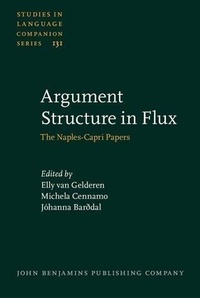
Argument Structure in Flux
The Naples-Capri Papers
1st Edition
Published in July 2013
VIII, 578 pages
978-90-272-7228-7 (ISBN)
Description

The present volume is centered around five linguistic themes: argument structure and encoding strategies; argument structure and verb classes; unexpressed arguments; split intransitivity; and existential and presentational constructions. The articles also cover a variety of typologically different languages, and they offer new data from under-researched languages on the issues of event and argument structure. In some cases novel perspectives from widely discussed languages on highly debated topics are offered, also addressing more theoretical aspects concerning the predictability and derivation of linking. Several contributions apply current models of the lexicon-syntax interface to synchronic data. Other contributions focus on diachrony and are based on extensive use of corpora. Yet others, although empirically and theoretically grounded, privilege a methodological discussion, presenting analyses based on thorough and long-standing fieldwork.
More details
Other editions
Additional editions
Book
06/2013
John Benjamins Publishing Co
€104.94
Shipment within 10-15 days
Persons
Content
- Argument Structure in Flux
- Editorial page
- Title page
- LCC data
- Dedication page
- Table of contents
- Argument structure in flux
- References
- Non-canonical subjects in clauses with noun predicates*
- 1. Introduction
- 2. The Italian "gli prese paura-construction"
- Anchor 100
- 4. A comparison with French
- 5. Further data and open questions
- 6. Conclusions
- References
- Differential agent marking in Hinuq
- 1. Introduction
- 2. A short introduction to Hinuq and its basic clause types
- 3. Three types of non-canonical agent constructions
- 3.1 The potential construction
- 3.2 The involuntary agent and the exterior force construction
- 3.3 Interim summary
- 4. The causative construction
- 5. Comparing non-canonical and canonical agents
- 5.1 Canonical marking of non-canonical agents
- 5.2 Semantic differences between non-canonical and canonical agents
- 5.3 Formal differences between non-canonical and canonical agents
- 6. Conclusion
- References
- Case variation and case alternation in Indo-European and beyond
- 1. Introductory remarks
- 2. Basic theoretical concepts and definitions
- 2.1 Case variation and case alternation: Preliminary remarks
- 2.2 Case variation vs. case alternation vs. case opposition
- 3. Sources of case variation
- 3.1 Functional (semantic) overlapping
- 3.2 Paradigmatic pressure/analogy
- 3.3 Phonological changes and (partial) case syncretism
- 3.4 Substrate/adstrate influence
- 4. Case variation and its outcomes
- 4.1 Case syncretism
- 4.2 Ousting
- 4.3 Dividing spheres of influence
- 5. Parameters of case variation
- 5.1 Identifiability
- 5.2 Formal (un)markedness
- 5.3 Distinguishability
- 5.4 Primary argument immunity principle (PAIP)
- 5.5 Paradigmatic independence
- 5.6 Semantic specificity
- 6. Competing constraints and hierarchies of parameters
- 7. Concluding remarks: Problems and perspectives for further studies
- References
- Constructional polysemy and argument realisation with the Irish GET verb
- 1. Introduction
- 1.1 Personal passive construction
- 1.1.1 Perfective variant of the personal passive
- 1.1.2 Prospective Imperfective variant of the personal passive
- 1.1.3 Progressive variant of the personal passive
- 1.2 The irregular morphology of the verb faigh
- 1.3 The usage patterns of these constructions in syntax
- 2. The GET constructions of Irish
- 2.1 The HAVE and BECOME senses of the Irish GET construction
- 2.2 The GET-RECIPIENT construction of Irish
- 2.3 The GET-PASSIVE construction of Irish
- 3. The common points of the Irish GET constructions
- 3.1 Light verb
- 3.2 The contribution of NP2
- 3.3 The Spatial underpinnings of location and state in Irish
- 3.4 The constructional schemata for Irish GET constructions
- 4. Discussion
- 5. Conclusion
- References
- Latin preverbs and verb argument structure
- 1. Introduction
- 2. Evolution of Latin preverbs
- 3. Argument structure of Latin preverbed verbs
- 4. The corpus analyses
- 4.1 Corpora
- 4.2 First investigation
- 4.3 Second investigation
- 4.3.1 Relevant variables
- 5. Conclusions
- References
- Experiencing linking
- 1. A linking issue or a mapping problem?
- 2. Theta roles and linking in Reinhart's system
- 2.1 Why c(ausality) and m(ental involvement)?
- 2.2 Linking feature clusters
- 3. Experiencing problems: A closer look at preoccupare/worry type verbs
- 3.1 Finer-grained syntax solution (Pesetsky 1995)
- 3.2 Finer-grained semantic solution (Pesetsky 1995)
- 3.3 Challenge for Pesetsky (1995): Syntax of reduced experiencers
- 3.4 Tackling the syntax of reduced EXP-verbs
- 4. German object experiencers
- 4.1 The solution: Gefallen versus quälen-type verbs
- 4.1.1 Interpretative differences
- 4.1.2 Mapping to syntax
- 5. Case-theta linking puzzles
- 5.1 Linking puzzles
- 5.2 Deriving case
- 5.3 Predictions for case-licensing
- 6. Conclusion
- References
- Introduce
- 1. Introduction
- 2. Previous studies of non-prototypical three-participant constructions
- 3. Introduce as a non-prototypical three-participant event: Research question and method
- 4. "Introducing" across Europe: Results
- 4.1 Slavic languages
- 4.2 Romance languages
- 4.4 Germanic languages
- 5. Summary and conclusion
- Abbreviations
- References
- On the relationship between lexical aspect, verbal meaning, and (lexical) argument structure*
- 1. Introduction
- 2. The role of argument structure in determining lexical aspect
- 2.1 A closer look at possible determinants of lexical aspect
- 2.2 Some remaining challenges
- 3. Proposing a lexical-syntactic approach to aspect
- 3.1 Lexical syntax: A framework for the analysis of argument structure
- 3.2 How informative is a lexical-syntactic approach to lexical aspect?
- 3.3 Lexical aspectual distinctions
- 3.3.1 Test 1-Interruption before arriving at the final state or place
- 3.3.2 Test 2-The scope of negation
- 3.3.3 Test 3-The behaviour of telic events with 'shifting' mass nouns
- 4. Apparent determinants of lexical aspect
- 4.1 Introduction
- 4.2 Elements at the traditional VP-level
- 4.2.1 On causation and agentivity as sources for telicity
- 4.2.2 The semantic properties of the object
- 4.3 The V-level: The verb (root)
- 4.3.1 Verbal aspectual features
- 4.3.2 The ± scale as a lexical verbal property
- 4.3.3 The 'two-point versus multi-point scale property' as a lexical verbal property
- 4.3.4 Temporal (in)dependence between subevents
- 5. Conclusions
- References
- Four Romanian verbs of occurring
- 1. Introduction
- 2. Sentence structure
- 2.1 a avea loc 'take place'
- 2.2 a se petrece 'occur'
- 2.3 a se întâmpla 'happen'
- 2.4 a (o) pati 'happen'
- 3. Semantic content
- 4. Argument mapping
- 4.1 Verbs of occurring as experiencer verbs
- 4.2 Verbs of occurring as existential verbs
- 5. Discourse-pragmatic function
- 6. Conclusions
- References
- The pro cycle
- 1. Background
- 2. The nature of pro
- 2.1 The properties of pro
- 2.2 Relationship between verb agreement and null subject
- 2.3 Types of pro
- 3. The history of Scandinavian pro
- 3.1 Old Norse
- 3.2 Mainland Scandinavian
- 4. Loss of pro
- 5. Origins of pro
- 5.1 Weak valency
- 5.2 Pronoun incorporation
- 6. Conclusion
- References
- Argument promotion and SE-constructions in Brazilian Portuguese
- Introduction
- 2. X-sentences
- 2. A possible analysis
- 2.1 Kallulli on feature suppression
- 2.2 X- sentences again
- 3. se constructions as non-active morphology
- 4. On the loss of se in BP and the emergence of X-sentences
- 5. Conclusion
- References
- Unaccusativity and the diachrony of null and cognate objects in Greek*
- 1. Introduction
- 2. Typology of verbal classes, null objects, and cognate objects
- 2.1 Theoretical remarks
- 2.1.1 Verbal classes
- 2.1.2 Null objects
- 2.1.3 Cognate objects
- 2.2 The Greek data
- 2.2.1 Null objects and alternating unaccusatives in Greek
- 2.2.2 Cognate objects and unaccusatives in Greek
- 3. Conclusions
- References
- Split intransitivity in Irish and the syntax-semantics interface
- 1. Introduction
- 2. Perfect selection in Irish: Basic data
- 3. Different kinds of intransitive and their perfects
- 3.1 Unaccusatives and unergatives in Irish
- 3.2 Some problems with perfect selection
- 4. Factors influencing the diagnostics for unaccusativity
- 4.1 Telicity
- 4.2 Agentivity
- 5. The Auxiliary selection hierarchy (ASH)
- 6. Change-of-location verbs in Irish
- 7. Change-of-state verbs
- 7.1 Anticausative verbs
- 8. Conclusion
- Sources
- References
- Semantic constraints on the Latin Impersonal Passive
- 1. Introduction
- 2. Cross-linguistic features of impersonal passives and the Latin state-of-affairs
- 2.1 Tendencies of impersonal passive constructions across languages
- 2.2 Generic and specific agents in the Latin impersonal passive
- 3. Telicity and agentivity in impersonal passivization
- 4. A case study from Latin
- 4.1 Prototypical telic and atelic verbs
- 4.1.1 Change of location
- 4.1.2 Controlled process
- 4.2 Controlled Process (motional)
- 4.3 Uncontrolled process
- 4.4 Continuation of a pre-existing State and Existence of State
- 4.5 Change of state
- 4.6 Interim summary
- 5. Conclusions
- References
- Texts and translations
- Medieval Texts
- Anchor 145
- Auxiliary selection in German
- 1. Introduction
- 2. Auxiliary selection as an indicator of unaccusativity/split intransitivity?
- 2.1 A hierarchy of semantic criteria for auxiliary selection: Levin and Rappaport Hovav (1995)
- 2.2 Linking rules and auxiliary selection in German
- 3. Auxiliary selection with German intransitive verbs
- 3.1 Three classes of sein-verbs in German
- 3.2 Problematic cases
- 4. The Auxiliary Selection Hierarchy
- 5. The diachronic development of haben- and sein-perfect in German
- 6. Short discussion and conclusion
- References
- Tornar and volver
- 1. Introduction
- 2. Compound tense auxiliary selection in Spanish
- 3. Variation in auxiliary selection between tornar and volver
- 4. The semantics of tornar and volver
- 5. Semantics and frequency as predictors as auxiliary selection
- 6. Conclusion
- Documents cited
- References
- Control and the evolution of possessive and existential constructions
- 1. Introduction
- 2. Transitive verbs of possession and differential object marking: The case of Spanish
- 3. Existential use of transitive verbs of possession: The case of Serbo-Croat
- 4. Possessive predication originating from existential predication: The case of Finnish
- 5. Possessive predication originating from comitative predication: The case of Tswana
- 5.1 The synchronic data
- 5.2 A diachronic hypothesis
- 6. Discussion and conclusion
- Abbreviations
- References
- Existential constructions
- 1. Existential constructions and the onomasiological perspective
- 2. E pluribus unum
- 3. The semasiological perspective
- 3.1 Types of particles
- 3.2 Types of predicates
- 3.3 Types of ENTITY
- 4. Conclusion
- References
- Variation and change in the presentational constructions of north-western Italo-Romance varieties*
- 1. Introduction
- 2. Modern data
- 3. The medieval vernaculars
- 3.1 Expression of the locative argument
- 3.2 Word order
- 3.3 Verb Agreement
- 3.4 Definiteness
- 3.5 Expletive subjects
- 4. Analysis of the diachronic changes
- 4.1 Change in word order
- 4.2 Verb agreement
- 4.3 'Presentational' marking: the grammaticalization of the locative pro-form
- 4.4 Presentational (event-reporting) structures with unaccusative verbs
- 4.5 Presentational structures with other verbs
- 5. Conclusion
- References
- Argument realization and existential pro-forms in early Italo-Romance
- 1. Introduction
- 1.1 The data
- 2. Existentials with essere and a definite noun phrase
- 2.1 The emergence and the reanalysis of the existential pro-form
- Primary Sources
- References
- Author index
- Language index
