

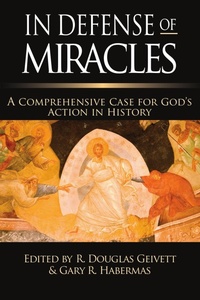
In Defense of Miracles
Description

Rumors of deception have surrounded claims of Jesus' resurrection ever since the soldiers appointed to guard his tomb made their report to the Jewish authorities. But no one has led the philosophic charge against miracles quite as influentially as David Hume with his 1748 essay "Of Miracles." Refined, revised, restated, his arguments still affect philosophic discussions of miracles today.
During the twentieth century, strong arguments have been raised by Antony Flew, professor emeritus at Keele University in England. Flew has contributed a fresh statement of his objections to the idea of God's acting in history just for this volume, which also includes Hume's classic critique as a part of the case against miracles.
In response, Douglas Geivett and Gary Habermas have assembled a distinguished team of scholars to rebut the objections and set forth the positive case for God's action in history:
Richard Purtill clarifies the word miracle, while Norman Geisler critiques Hume's case against miracles. Francis Beckwith and Winfried Corduan assess how we would recognize miracles in the past and in the present. Ronald Nash examines naturalism's exclusion of miracles and shows its self-referential incoherence. J. P. Moreland discusses whether science properly rules out the possibility of miracles. God's existence and action in history are probed by David Beck and Stephen Davis, while Douglas Geivett argues that within a theistic framework it is reasonable to expect miracles as confirmation of claims to special revelation. David Clark examines miracles within the context of various world religions. Robert Newman, John Feinberg, William Lane Craig and Gary Habermas conclude by investigating fulfilled prophecy, the virgin birth and incarnation of Jesus, the empty tomb, and the resurrection appearances.
In Defense of Miracles is a comprehensive, up-to-date discussion that should not be overlooked by anyone concerned with the current debate over miracles.
More details
Other editions
Additional editions
Persons
R. Douglas Geivett is professor of philosophy at Talbot School of Theology, Biola University, in La Mirada, California. His previous books include Evil and the Evidence for God (Temple University Press) and (coedited with Brendan Sweetman) Contemporary Perspectives on Religious Epistemology (Oxford University Press).
Gary R. Habermas (PhD, Michigan State University) is distinguished research professor and chair of the department of philosophy and theology at Liberty University in Lynchburg, Virginia.
Content
Introduction / R. Douglas Geivett and Gary R. Habermas Part 1: The Case Against Miracles 1. Of Miracles / David Hume 2. Neo-Humean Arguments About the Miraculous / Antony Flew Part 2: The Possibility of Miracles 3. Defining Miracles / Richard L. Purtill 4. Miracles the Modern Mind / Norman L. Giesler 5. History Miracles / Francis J. Beckwith 6. Recognizing a Miracle / Winfried Corduan Part 3: A Theistic Context for Miracles 7. Miracles Conceptual Systems / Ronald H. Nash 8. Science, Miracles, Agency Theory the God-of-the-Gaps / J. P. Moreland 9. God's Existence / W. David Beck 10. God's Actions / Stephen T. Davis 11. The Evidential Value of Miracles / R. Douglas Geivett Part 4: Christian Miracles--Case Studies 12. Miracles in the World Religions / David K. Clark 13. Fulfilled Prophecy as Miracle / RobertC. Newman 14. The Incarnation of Jesus Christ / John S. Feinberg 15. The Empty Tomb of Jesus / William Lane Craig 16. The Resurrection Appearances of Jesus / Gary R. Habermas Conclusion: Has God Acted in History? / R. Douglas Geivett and Gary R. Habermas Notes Bibliography List of Contributors
