

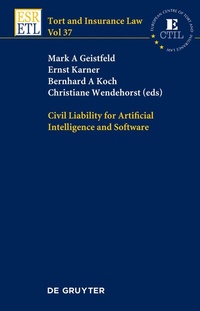
Civil Liability for Artificial Intelligence and Software
Description

Initiated by the European Commission, the first study published in this volume analyses the largely unresolved question as to how damage caused by artificial intelligence (AI) systems is allocated by the rules of tortious liability currently in force in the Member States of the European Union and in the United States, to examine whether - and if so, to what extent - national tort law regimes differ in that respect, and to identify possible gaps in the protection of injured parties. The second study offers guiding principles for safety and liability with regard to software, testing how the existing acquis needs to be adjusted in order to adequately cope with the risks posed by software and AI. The annex contains the final report of the New Technologies Formation of the Expert Group on Liability and New Technologies, assessing the extent to which existing liability schemes are adapted to the emerging market realities following the development of new digital technologies.
More details
Other editions
Additional editions
Persons
Content
- Intro
- Preface
- Table of Contents
- Comparative Law Study on Civil Liability for Artificial Intelligence
- Safety- and Liability-Related Aspects of Software
- Annex
- Liability for Artificial Intelligence and Other Emerging Digital Technologies
