

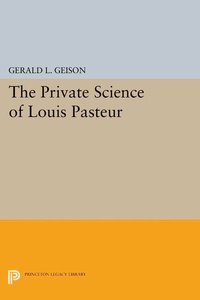
The Private Science of Louis Pasteur
1st Edition
Published on 14. July 2014
418 pages
978-1-4008-6408-9 (ISBN)
Description

In The Private Science of Louis Pasteur, Gerald Geison has written a controversial biography that finally penetrates the secrecy that has surrounded much of this legendary scientist's laboratory work. Geison uses Pasteur's laboratory notebooks, made available only recently, and his published papers to present a rich and full account of some of the most famous episodes in the history of science and their darker sides--for example, Pasteur's rush to develop the rabies vaccine and the human risks his haste entailed. The discrepancies between the public record and the "private science" of Louis Pasteur tell us as much about the man as they do about the highly competitive and political world he learned to master.
Although experimental ingenuity served Pasteur well, he also owed much of his success to the polemical virtuosity and political savvy that won him unprecedented financial support from the French state during the late nineteenth century. But a close look at his greatest achievements raises ethical issues. In the case of Pasteur's widely publicized anthrax vaccine, Geison reveals its initial defects and how Pasteur, in order to avoid embarrassment, secretly incorporated a rival colleague's findings to make his version of the vaccine work. Pasteur's premature decision to apply his rabies treatment to his first animal-bite victims raises even deeper questions and must be understood not only in terms of the ethics of human experimentation and scientific method, but also in light of Pasteur's shift from a biological theory of immunity to a chemical theory--similar to ones he had often disparaged when advanced by his competitors.
Through his vivid reconstruction of the professional rivalries as well as the national adulation that surrounded Pasteur, Geison places him in his wider cultural context. In giving Pasteur the close scrutiny his fame and achievements deserve, Geison's book offers compelling reading for anyone interested in the social and ethical dimensions of science.
Originally published in 1995.
The Princeton Legacy Library uses the latest print-on-demand technology to again make available previously out-of-print books from the distinguished backlist of Princeton University Press. These editions preserve the original texts of these important books while presenting them in durable paperback and hardcover editions. The goal of the Princeton Legacy Library is to vastly increase access to the rich scholarly heritage found in the thousands of books published by Princeton University Press since its founding in 1905.
Although experimental ingenuity served Pasteur well, he also owed much of his success to the polemical virtuosity and political savvy that won him unprecedented financial support from the French state during the late nineteenth century. But a close look at his greatest achievements raises ethical issues. In the case of Pasteur's widely publicized anthrax vaccine, Geison reveals its initial defects and how Pasteur, in order to avoid embarrassment, secretly incorporated a rival colleague's findings to make his version of the vaccine work. Pasteur's premature decision to apply his rabies treatment to his first animal-bite victims raises even deeper questions and must be understood not only in terms of the ethics of human experimentation and scientific method, but also in light of Pasteur's shift from a biological theory of immunity to a chemical theory--similar to ones he had often disparaged when advanced by his competitors.
Through his vivid reconstruction of the professional rivalries as well as the national adulation that surrounded Pasteur, Geison places him in his wider cultural context. In giving Pasteur the close scrutiny his fame and achievements deserve, Geison's book offers compelling reading for anyone interested in the social and ethical dimensions of science.
Originally published in 1995.
The Princeton Legacy Library uses the latest print-on-demand technology to again make available previously out-of-print books from the distinguished backlist of Princeton University Press. These editions preserve the original texts of these important books while presenting them in durable paperback and hardcover editions. The goal of the Princeton Legacy Library is to vastly increase access to the rich scholarly heritage found in the thousands of books published by Princeton University Press since its founding in 1905.
More details
Other editions
Additional editions
Gerald L. Geison
The Private Science of Louis Pasteur
Book
04/2016
Princeton University Press
€168.50
Available immediately
Gerald L. Geison
The Private Science of Louis Pasteur
Book
07/2014
Princeton University Press
€64.00
Shipment within 10-20 days

Gerald L. Geison
The Private Science of Louis Pasteur
Book
12/1996
Princeton University Press
€24.80
Article exhausted; check different version
Gerald L. Geison
The Private Science of Louis Pasteur
Book
05/1995
Princeton University Press
€76.88
Article exhausted; check different version
Person
Gerald L. Geison
Content
List of Illustrations and Tables
Preface
Ch. 1 Laboratory Notebooks and the Private Science of Louis Pasteur 3
Ch. 2 Pasteur in Brief 22
Ch. 3 The Emergence of a Scientist: The Discovery of Optical Isomers in the Tartrates 53
Ch. 4 From Crystals to Life: Optical Activity, Fermentation, and Life 90
Ch. 5 Creating Life in Nineteenth-Century France: Science, Politics, and Religion in the Pasteur-Pouchet Debate over Spontaneous Generation 110
Ch. 6 The Secret of Pouilly-le-Fort: Competition and Deception in the Race for the Anthrax Vaccine 145
Ch. 7 From Boyhood Encounter to "Private Patients": Pasteur and Rabies before the Vaccine 177
Ch. 8 Public Triumphs and Forgotten Critics: The Debate over Pasteur's Early Use of Rabies Vaccines in Human Cases 206
Ch. 9 Private Doubts and Ethical Dilemmas: Pasteur, Roux, and the Early Human Trials of Pasteur's Rabies Vaccine 234
Ch. 10 The Myth of Pasteur 259
Appendixes 279
Author's Note on the Notes and Sources 305
Notes to the Chapters 309
Acknowledgments 343
Bibliography 345
Index 367
Preface
Ch. 1 Laboratory Notebooks and the Private Science of Louis Pasteur 3
Ch. 2 Pasteur in Brief 22
Ch. 3 The Emergence of a Scientist: The Discovery of Optical Isomers in the Tartrates 53
Ch. 4 From Crystals to Life: Optical Activity, Fermentation, and Life 90
Ch. 5 Creating Life in Nineteenth-Century France: Science, Politics, and Religion in the Pasteur-Pouchet Debate over Spontaneous Generation 110
Ch. 6 The Secret of Pouilly-le-Fort: Competition and Deception in the Race for the Anthrax Vaccine 145
Ch. 7 From Boyhood Encounter to "Private Patients": Pasteur and Rabies before the Vaccine 177
Ch. 8 Public Triumphs and Forgotten Critics: The Debate over Pasteur's Early Use of Rabies Vaccines in Human Cases 206
Ch. 9 Private Doubts and Ethical Dilemmas: Pasteur, Roux, and the Early Human Trials of Pasteur's Rabies Vaccine 234
Ch. 10 The Myth of Pasteur 259
Appendixes 279
Author's Note on the Notes and Sources 305
Notes to the Chapters 309
Acknowledgments 343
Bibliography 345
Index 367
