

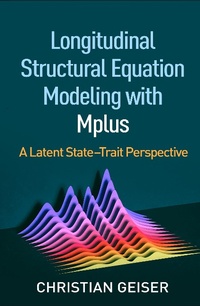
Longitudinal Structural Equation Modeling with Mplus
A Latent State-Trait Perspective
Published on 7. October 2020
344 pages
978-1-4625-4641-1 (ISBN)
Description

Researchers and graduate students in psychology, education, management, family studies, public health, sociology, and social work. May serve as a core or supplemental text in graduate-level courses on longitudinal data analysis, SEM, multivariate analysis, or applied statistics.
More details
Other editions
Additional editions
Christian Geiser
Longitudinal Structural Equation Modeling with Mplus
A Latent State-Trait Perspective
Book
11/2020
1st Edition
Guilford Press
€74.50
Shipment within 15-20 days
Person
Christian Geiser, PhD, is a former professor of quantitative psychology. He currently works as an instructor and statistical consultant. His areas of expertise are in structural equation modeling, longitudinal data analysis, latent class modeling, multitrait-multimethod analysis, and measurement. His website is https://christiangeiser.com/.
Content
List of Abbreviations
Guide to Statistical Symbols
1. A Measurement Theoretical Framework for Longitudinal Data: Introduction to Latent State-Trait Theory
1.1 Introduction
1.2 Latent State-Trait Theory
1.3 Chapter Summary
1.4 Recommended Readings
2. Single-Factor Longitudinal Models for Single-Indicator Data
2.1 Introduction
2.2 The Random Intercept Model
2.3 The Random and Fixed Intercepts Model
2.4 The ξ-Congeneric Model
2.5 Chapter Summary
2.6 Recommended Reading
3. Multifactor Longitudinal Models for Single-Indicator Data
3.1 Introduction
3.2 The Simplex Model
3.3 The Latent Change Score Model
3.4 The Trait-State-Error Model
3.5 Latent Growth Curve Models
3.6 Chapter Summary
3.7 Recommended Readings
4. Testing Measurement Equivalence in Longitudinal Studies
4.1 Introduction
4.2 The Latent State (LS) Model
4.3 The Latent State Model with Indicator-Specific Residual Factors (LS-IS Model)
4.4 Chapter Summary
4.5 Recommended Readings
5. Multiple-Indicator Longitudinal Models
5.1 Introduction
5.2 Latent State Change (LSC) Models
5.3 The Latent Autoregressive/Cross-Lagged States (LACS) Model
5.4 Latent State-Trait (LST) Models
5.5 Latent Trait Change (LTC) Models
5.6 Chapter Summary
5.7 Recommended Readings
6. Modeling Intensive Longitudinal Data
6.1 Introduction
6.2 Special features of Intensive Longitudinal Data
6.3 Specifying Longitudinal SEMs for Intensive Longitudinal Data
6.4 Chapter Summary
6.5 Recommended Readings
7. Missing Data Handling
7.1 Introduction
7.2 Missing Data Mechanisms
7.3 Maximum Likelihood Missing Data Handling
7.4 Multiple Imputation (MI)
7.5 Planned Missing Data Designs
7.6 Chapter Summary
7.7 Recommended Readings
8. How to Choose between Models and Report the Results
8.1 Model Selection
8.2 Reporting Results
8.3 Chapter Summary
8.4 Recommended Readings
References
Author Index
Subject Index
Guide to Statistical Symbols
1. A Measurement Theoretical Framework for Longitudinal Data: Introduction to Latent State-Trait Theory
1.1 Introduction
1.2 Latent State-Trait Theory
1.3 Chapter Summary
1.4 Recommended Readings
2. Single-Factor Longitudinal Models for Single-Indicator Data
2.1 Introduction
2.2 The Random Intercept Model
2.3 The Random and Fixed Intercepts Model
2.4 The ξ-Congeneric Model
2.5 Chapter Summary
2.6 Recommended Reading
3. Multifactor Longitudinal Models for Single-Indicator Data
3.1 Introduction
3.2 The Simplex Model
3.3 The Latent Change Score Model
3.4 The Trait-State-Error Model
3.5 Latent Growth Curve Models
3.6 Chapter Summary
3.7 Recommended Readings
4. Testing Measurement Equivalence in Longitudinal Studies
4.1 Introduction
4.2 The Latent State (LS) Model
4.3 The Latent State Model with Indicator-Specific Residual Factors (LS-IS Model)
4.4 Chapter Summary
4.5 Recommended Readings
5. Multiple-Indicator Longitudinal Models
5.1 Introduction
5.2 Latent State Change (LSC) Models
5.3 The Latent Autoregressive/Cross-Lagged States (LACS) Model
5.4 Latent State-Trait (LST) Models
5.5 Latent Trait Change (LTC) Models
5.6 Chapter Summary
5.7 Recommended Readings
6. Modeling Intensive Longitudinal Data
6.1 Introduction
6.2 Special features of Intensive Longitudinal Data
6.3 Specifying Longitudinal SEMs for Intensive Longitudinal Data
6.4 Chapter Summary
6.5 Recommended Readings
7. Missing Data Handling
7.1 Introduction
7.2 Missing Data Mechanisms
7.3 Maximum Likelihood Missing Data Handling
7.4 Multiple Imputation (MI)
7.5 Planned Missing Data Designs
7.6 Chapter Summary
7.7 Recommended Readings
8. How to Choose between Models and Report the Results
8.1 Model Selection
8.2 Reporting Results
8.3 Chapter Summary
8.4 Recommended Readings
References
Author Index
Subject Index
