

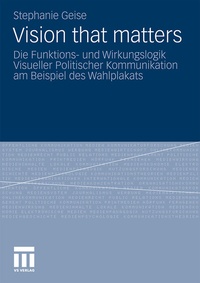
Vision that matters
Die Funktions- und Wirkungslogik Visueller Politischer Kommunikation am Beispiel des Wahlplakats
1st Edition
Published on 6. December 2010
416 pages
978-3-531-92736-7 (ISBN)
Description

Dr. Stephanie Geise ist Akademische Rätin und Habilitandin am Seminar für Empirische Kommunikationsforschung & Methoden der Universität Erfurt.
Reviews / Votes
"Die Arbeit leistet einen wesentlichen Beitrag zur empirischen Überprüfung von Thesen zur Wirkung visueller politischer Kommunikation, die seit Jahrzehnten im Raum stehen, aber auf ihre Untersuchung bislang warten mussten." Publizistik, 4-2011
More details
Other editions
Additional editions
Stephanie Geise
Vision that matters
Die Funktions- und Wirkungslogik Visueller Politischer Kommunikation am Beispiel des Wahlplakats
Book
11/2010
VS Verlag für Sozialwissenschaften
€49.99
Shipment within 10-15 days
Content
1 - Danke. [Seite 4]
2 - Inhalt [Seite 5]
3 - 1 Visualisierung der Politik - Politik der Visualisierung [Seite 19]
3.1 - 1.1 Visuelle Politische Kommunikation am Beispiel von Wahlplakaten [Seite 19]
3.2 - 1.2 Visuelle Politische Kommunikation [Seite 20]
3.3 - 1.3 Theoretische Verortung, Thesen und Forschungsfragen [Seite 22]
3.3.1 - 1.3.1 Arbeitsthesen zur theoretischen und empirischen Analyse des Gegenstandsbereichs VisuellerPolitischer Kommunikation [Seite 28]
3.3.2 - 1.3.2 Leitfragen der theoretischen Fundierung [Seite 29]
3.3.3 - 1.3.3 Leitfragen der methodischen Fundierung [Seite 29]
3.3.4 - 1.3.4 Leitfragen der empirischen Fundierung [Seite 29]
3.4 - 1.4 Ein Phasenmodell der Funktionsund Wirkungslogik Visueller Kommunikation [Seite 30]
3.5 - 1.5 Vorgehensweise und Struktur [Seite 35]
4 - 2 Der Modus Visueller Kommunikation und seine Funktionslogik [Seite 37]
4.1 - 2.1 Visuelle Kommunikation in Forschung und Diskurs [Seite 38]
4.1.1 - 2.1.1 Visuelle Kommunikation in wissenschaftlicher Forschung [Seite 38]
4.1.2 - 2.1.2 Visuelle Kommunikation im kritischen Diskurs [Seite 47]
4.2 - 2.2 Visuelle Kommunikation [Seite 51]
4.2.1 - 2.2.1 Visuelle Kommunikation und Bildkommunikation [Seite 52]
4.2.2 - 2.2.2 Was ist ein Bild? Definitionen des Bildbegriffs [Seite 53]
4.2.3 - 2.2.3 Bildbegriff, Gegenstandsbereich und Definition Visueller Kommunikation [Seite 60]
4.2.4 - 2.2.4 Der spezifische Modus Visueller Kommunikation [Seite 66]
4.3 - 2.3 Grundlegende Prozesse (Visueller) Wahrnehmung und Informationsverarbeitung [Seite 70]
4.3.1 - 2.3.1 Der klassische Wahrnehmungsprozess [Seite 72]
4.3.2 - 2.3.2 Wahrnehmung als Aufmerksamkeits- und Aktivierungsprozess [Seite 73]
4.3.3 - 2.3.3 Wahrnehmung als Entfaltungsprozess [Seite 74]
4.3.4 - 2.3.4 Wahrnehmung als Konstruktionsprozess [Seite 77]
4.3.5 - 2.3.5 Wahrnehmung und Informationsverarbeitung [Seite 80]
4.4 - 2.4 Spezifische Theorien zu Bildwahrnehmung und Bildverstehen [Seite 97]
4.4.1 - 2.4.1 Bildwahrnehmung und Bildverstehen als 'Konstruktionsprozess' [Seite 97]
4.4.2 - 2.4.2 Bilder als mentale Repräsentationen [Seite 99]
4.4.3 - 2.4.3 Die Theorie der Dualen Codierung [Seite 101]
4.4.4 - 2.4.4 Mentale und reale Bilder [Seite 102]
4.4.5 - 2.4.5 Bildverstehen, Bildkompetenz und Visual Persuasion [Seite 105]
5 - 3 Der Modus Politischer Kommunikation und seine Funktionslogik [Seite 107]
5.1 - 3.1 Politische Kommunikation und Politikvermittlung [Seite 108]
5.2 - 3.2 Funktionen von Politischer Kommunikation [Seite 112]
5.3 - 3.3 Bedeutung der Medien für Politik und Politikvermittlung [Seite 114]
5.4 - 3.4 Politische Kommunikation in der Mediengesellschaft [Seite 116]
5.4.1 - 3.4.1 Charakteristika der Mediengesellschaft [Seite 116]
5.4.2 - 3.4.2 Konsequenzen eines neuen Strukturwandels [Seite 117]
5.5 - 3.5 Entscheidungspolitik versus Darstellungspolitik: 'Spielen wir nicht alle Theater?' [Seite 131]
5.6 - 3.6 Konsequenzen für den Modus der Visuellen Politischen Kommunikation [Seite 135]
6 - 4 Integration: Der Modus Visueller Politischer Kommunikation und seine Funktionslogik am Beispiel des Wahlplakats [Seite 137]
6.1 - 4.1 Politische Kommunikation im Wahlkampf [Seite 138]
6.1.1 - 4.1.1 Themenmanagement: Strategisches Agenda Setting und Priming [Seite 140]
6.1.2 - 4.1.2 Kampagnenmanagement, Wahlwerbung und Negative Campaigning [Seite 151]
6.1.3 - 4.1.3 Visuelles Kommunikationsmanagement als Integrierte Visuelle Kommunikation [Seite 162]
6.2 - 4.2 Politische Kommunikation durch das Wahlplakat [Seite 170]
6.2.1 - 4.2.1 Das Plakat - Definition und Charakteristika des Mediums [Seite 170]
6.2.2 - 4.2.2 Die Wirkung von Wahlplakaten - Zum Forschungsstand [Seite 173]
6.2.3 - 4.2.3 Das Wahlplakat als typisches Medium Visueller Politischer Kommunikation [Seite 183]
7 - 5 Methodik der Studie zur Analyse der Funktions-und Wirkungslogik am Beispiel des Wahlplakats [Seite 185]
7.1 - 5.1 Überblick über den Untersuchungsaufbau und die Erhebungsmethoden in Testreihe I und II [Seite 186]
7.2 - 5.2 Die Integration von Befragung, Eyetracking und RTR im experimentellen Setting [Seite 188]
7.3 - 5.3 Ablauf der Erhebungen in Testreihe I und II [Seite 193]
7.4 - 5.4 Auswahl und Zusammensetzung des Stimulusmaterials [Seite 199]
7.5 - 5.5 Auswahl und Zusammensetzung der Stichproben von Testreihe I und II [Seite 201]
8 - 6 Empirie: Der Modus Visueller Politischer Kommunikation und seine Wirkungslogik am Beispiel des Wahlplakats [Seite 205]
8.1 - 6.1 Die Wirkungslogik Visueller Politischer Kommunikation am Beispiel des Wahlplakats [Seite 205]
8.2 - 6.2 Pre-attentive Prädisposition und 'Erster Eindruck' [Seite 206]
8.3 - 6.3 Allokation von Aufmerksamkeit und Aktivierung und Hierarchie der Wahrnehmungssequenz [Seite 219]
8.4 - 6.4 Reflektierte post-kommunikative Evaluation und Akzeptanz [Seite 263]
8.5 - 6.5 Memorizationen: Erinnerungswirksamkeit, Wiedererkennung und Zuordnungssicherheit [Seite 275]
8.6 - 6.6 Agenda-Setting [Seite 287]
8.7 - 6.7 Priming [Seite 308]
8.8 - 6.8 Applikatives Framing und Relatives Priming [Seite 322]
9 - 7 Vision that matters [Seite 335]
9.1 - 7.1 Die Wirkungslogik Visueller Politischer Kommunikation [Seite 335]
9.2 - 7.2 Vision that matters [Seite 337]
9.3 - 7.3 Reflektion und Perspektiven Kritische Würdigung und Empfehlungen für weiterführende Forschungsprojekte zu Visueller (Politis [Seite 342]
9.4 - 7.4 Epilog: Ein utopisches Projekt [Seite 350]
10 - Literaturverzeichnis [Seite 352]
11 - Anhang [Seite 388]
2 - Inhalt [Seite 5]
3 - 1 Visualisierung der Politik - Politik der Visualisierung [Seite 19]
3.1 - 1.1 Visuelle Politische Kommunikation am Beispiel von Wahlplakaten [Seite 19]
3.2 - 1.2 Visuelle Politische Kommunikation [Seite 20]
3.3 - 1.3 Theoretische Verortung, Thesen und Forschungsfragen [Seite 22]
3.3.1 - 1.3.1 Arbeitsthesen zur theoretischen und empirischen Analyse des Gegenstandsbereichs VisuellerPolitischer Kommunikation [Seite 28]
3.3.2 - 1.3.2 Leitfragen der theoretischen Fundierung [Seite 29]
3.3.3 - 1.3.3 Leitfragen der methodischen Fundierung [Seite 29]
3.3.4 - 1.3.4 Leitfragen der empirischen Fundierung [Seite 29]
3.4 - 1.4 Ein Phasenmodell der Funktionsund Wirkungslogik Visueller Kommunikation [Seite 30]
3.5 - 1.5 Vorgehensweise und Struktur [Seite 35]
4 - 2 Der Modus Visueller Kommunikation und seine Funktionslogik [Seite 37]
4.1 - 2.1 Visuelle Kommunikation in Forschung und Diskurs [Seite 38]
4.1.1 - 2.1.1 Visuelle Kommunikation in wissenschaftlicher Forschung [Seite 38]
4.1.2 - 2.1.2 Visuelle Kommunikation im kritischen Diskurs [Seite 47]
4.2 - 2.2 Visuelle Kommunikation [Seite 51]
4.2.1 - 2.2.1 Visuelle Kommunikation und Bildkommunikation [Seite 52]
4.2.2 - 2.2.2 Was ist ein Bild? Definitionen des Bildbegriffs [Seite 53]
4.2.3 - 2.2.3 Bildbegriff, Gegenstandsbereich und Definition Visueller Kommunikation [Seite 60]
4.2.4 - 2.2.4 Der spezifische Modus Visueller Kommunikation [Seite 66]
4.3 - 2.3 Grundlegende Prozesse (Visueller) Wahrnehmung und Informationsverarbeitung [Seite 70]
4.3.1 - 2.3.1 Der klassische Wahrnehmungsprozess [Seite 72]
4.3.2 - 2.3.2 Wahrnehmung als Aufmerksamkeits- und Aktivierungsprozess [Seite 73]
4.3.3 - 2.3.3 Wahrnehmung als Entfaltungsprozess [Seite 74]
4.3.4 - 2.3.4 Wahrnehmung als Konstruktionsprozess [Seite 77]
4.3.5 - 2.3.5 Wahrnehmung und Informationsverarbeitung [Seite 80]
4.4 - 2.4 Spezifische Theorien zu Bildwahrnehmung und Bildverstehen [Seite 97]
4.4.1 - 2.4.1 Bildwahrnehmung und Bildverstehen als 'Konstruktionsprozess' [Seite 97]
4.4.2 - 2.4.2 Bilder als mentale Repräsentationen [Seite 99]
4.4.3 - 2.4.3 Die Theorie der Dualen Codierung [Seite 101]
4.4.4 - 2.4.4 Mentale und reale Bilder [Seite 102]
4.4.5 - 2.4.5 Bildverstehen, Bildkompetenz und Visual Persuasion [Seite 105]
5 - 3 Der Modus Politischer Kommunikation und seine Funktionslogik [Seite 107]
5.1 - 3.1 Politische Kommunikation und Politikvermittlung [Seite 108]
5.2 - 3.2 Funktionen von Politischer Kommunikation [Seite 112]
5.3 - 3.3 Bedeutung der Medien für Politik und Politikvermittlung [Seite 114]
5.4 - 3.4 Politische Kommunikation in der Mediengesellschaft [Seite 116]
5.4.1 - 3.4.1 Charakteristika der Mediengesellschaft [Seite 116]
5.4.2 - 3.4.2 Konsequenzen eines neuen Strukturwandels [Seite 117]
5.5 - 3.5 Entscheidungspolitik versus Darstellungspolitik: 'Spielen wir nicht alle Theater?' [Seite 131]
5.6 - 3.6 Konsequenzen für den Modus der Visuellen Politischen Kommunikation [Seite 135]
6 - 4 Integration: Der Modus Visueller Politischer Kommunikation und seine Funktionslogik am Beispiel des Wahlplakats [Seite 137]
6.1 - 4.1 Politische Kommunikation im Wahlkampf [Seite 138]
6.1.1 - 4.1.1 Themenmanagement: Strategisches Agenda Setting und Priming [Seite 140]
6.1.2 - 4.1.2 Kampagnenmanagement, Wahlwerbung und Negative Campaigning [Seite 151]
6.1.3 - 4.1.3 Visuelles Kommunikationsmanagement als Integrierte Visuelle Kommunikation [Seite 162]
6.2 - 4.2 Politische Kommunikation durch das Wahlplakat [Seite 170]
6.2.1 - 4.2.1 Das Plakat - Definition und Charakteristika des Mediums [Seite 170]
6.2.2 - 4.2.2 Die Wirkung von Wahlplakaten - Zum Forschungsstand [Seite 173]
6.2.3 - 4.2.3 Das Wahlplakat als typisches Medium Visueller Politischer Kommunikation [Seite 183]
7 - 5 Methodik der Studie zur Analyse der Funktions-und Wirkungslogik am Beispiel des Wahlplakats [Seite 185]
7.1 - 5.1 Überblick über den Untersuchungsaufbau und die Erhebungsmethoden in Testreihe I und II [Seite 186]
7.2 - 5.2 Die Integration von Befragung, Eyetracking und RTR im experimentellen Setting [Seite 188]
7.3 - 5.3 Ablauf der Erhebungen in Testreihe I und II [Seite 193]
7.4 - 5.4 Auswahl und Zusammensetzung des Stimulusmaterials [Seite 199]
7.5 - 5.5 Auswahl und Zusammensetzung der Stichproben von Testreihe I und II [Seite 201]
8 - 6 Empirie: Der Modus Visueller Politischer Kommunikation und seine Wirkungslogik am Beispiel des Wahlplakats [Seite 205]
8.1 - 6.1 Die Wirkungslogik Visueller Politischer Kommunikation am Beispiel des Wahlplakats [Seite 205]
8.2 - 6.2 Pre-attentive Prädisposition und 'Erster Eindruck' [Seite 206]
8.3 - 6.3 Allokation von Aufmerksamkeit und Aktivierung und Hierarchie der Wahrnehmungssequenz [Seite 219]
8.4 - 6.4 Reflektierte post-kommunikative Evaluation und Akzeptanz [Seite 263]
8.5 - 6.5 Memorizationen: Erinnerungswirksamkeit, Wiedererkennung und Zuordnungssicherheit [Seite 275]
8.6 - 6.6 Agenda-Setting [Seite 287]
8.7 - 6.7 Priming [Seite 308]
8.8 - 6.8 Applikatives Framing und Relatives Priming [Seite 322]
9 - 7 Vision that matters [Seite 335]
9.1 - 7.1 Die Wirkungslogik Visueller Politischer Kommunikation [Seite 335]
9.2 - 7.2 Vision that matters [Seite 337]
9.3 - 7.3 Reflektion und Perspektiven Kritische Würdigung und Empfehlungen für weiterführende Forschungsprojekte zu Visueller (Politis [Seite 342]
9.4 - 7.4 Epilog: Ein utopisches Projekt [Seite 350]
10 - Literaturverzeichnis [Seite 352]
11 - Anhang [Seite 388]
