

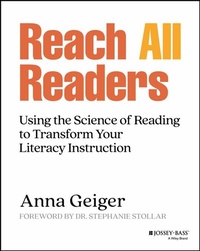
Reach All Readers
Description

The essential guide to teaching literacy skills to K-3 students
Reach All Readers is filled with practical tools for every kindergarten and early grade educator. This book addresses the science behind how students learn to read and how educators can apply this information in their classrooms every day. It is jam packed with research on literacy, spelled out in an easy-for-anyone-to-understand way. You'll also find evidence-based routines and activities to apply in the classroom. Learn the "how" of teaching literacy, and gain an understanding of why these approaches work. Charts and graphics illustrate concepts, so you can visualize how the big picture connects to practical applications and approaches. With Reach All Readers, teaching literacy is a breeze!
This reader-friendly guide to the science of reading education will help you improve your reading instruction with research-backed strategies. Literacy expert Anna Geiger breaks down complex concepts and presents them in an easy-to-digest format. Then, she offers concrete ideas you can implement immediately.
- Get all the must-know information about K-3 literacy education in one place
- Understand the latest research on how students learn and get tools for putting that research into practice
- Follow concrete lesson plans and practical tips to level up your literacy teaching
- Develop a big-picture understanding of literacy education so you know how best to help each and every student
Anyone responsible for teaching K-3 students reading, writing, and literacy skills-including teachers, homeschoolers, tutors, parents, and administrators-will want a copy of Reach All Readers.
More details
Other editions
Additional editions
Person
Anna Geiger, M.Ed., is a former classroom teacher who currently serves teachers through her website, The Measured Mom. She has shared articles, activities, and practical advice on teaching young readers and writers since 2013. Anna also hosts Triple R Teaching, a weekly podcast on literacy and the science of reading.
Content
Foreword xiii
Acknowledgments xv
About the Author xvii
Introduction 1
How This Book Is Organized 1
Chapter 1 The Big Picture 3
The Whole Word Method 3
Why Johnny Can't Read 3
Jeanne Chall's Research 4
Whole Language 4
The Report of the National Reading Panel 5
Balanced Literacy's Beginnings 5
Emily Hanford's Reporting 5
Scientifically-Based Research 7
The Simple View of Reading 9
Scarborough's Reading Rope 11
How the Brain Learns to Read 12
How We Learn Words 14
Key Things to Remember 18
Learn More 19
Notes 19
Chapter 2 The Science of Learning 23
What's Memory Got to Do with It? 23
Explicit Instruction 25
How to Ensure Your Students Remember What You Teach 35
Key Things to Remember 38
Learn More 38
Notes 38
Chapter 3 Oral Language 41
The Five Domains of Oral Language 41
Oral Language Routines 43
Make Your Classroom Language- Rich 49
Key Things to Remember 53
Free Resources 53
Learn More 54
Notes 54
Chapter 4 Phonemic Awareness and the Alphabetic Principle 57
Phonological Awareness 57
Phonemic Awareness: An Overview 60
Teaching Phonemic Awareness 67
Key Things to Remember 80
Free Resources 80
Learn More 80
Notes 81
Chapter 5 Phonics 83
Code Emphasis Versus Meaning Emphasis 83
Types of Phonics Instruction 86
Guidelines for Effective Phonics Instruction 90
The Debate Between Print-to-Speech and Speech-to-Print 131
Key Things to Remember 132
Free Resources 133
Learn More 133
Notes 134
Chapter 6 Fluency 141
The Components of Fluency 141
Fluency and Comprehension 143
Developing Automaticity at the Letter and Word Level 143
Developing Fluency at the Text Level 146
Key Things to Remember 154
Free Resources 155
Learn More 155
Notes 155
Chapter 7 Vocabulary 159
How to Decide Which Words to Teach: The Three Word Tiers 160
Teaching Individual Tier Two Words 162
Teaching Tier Three Words 165
Teaching Word-Learning Strategies 168
Key Things to Remember 172
Free resources 172
Learn More 172
Notes 172
Chapter 8 Comprehension 175
What Is Comprehension? 175
Teaching Sentence Comprehension 180
Reading Comprehension Strategies 185
Putting It All Together 195
Key Things to Remember 197
Learn More 197
Free Resources 197
Notes 198
Chapter 9 Linking Reading and Writing 201
Teach Handwriting 202
Teach Spelling 203
Teach Students to Write About What They Read 206
Teach That Sentences Contain a "Who" and a "Do" 206
Teach Students to Expand Simple Sentences 207
Teach Students to Combine Sentences 210
Teach Students to Connect Sentences 210
Teach Students to Write Paragraphs 212
Other Ways for Students to Respond to Text in Writing 214
Key Things to Remember 214
Free Resources 214
Learn More 215
Notes 215
Chapter 10 Dyslexia 217
What Is Dyslexia? 217
Help for Dyslexia 222
Key Things to Remember 223
Learn More 223
Notes 224
Chapter 11 Using MTSS to Reach All Readers 225
Multi-tiered Systems of Support (MTSS) 225
Delivering Tier 1 Instruction 231
Designing Your Daily Schedule 237
Key Things to Remember 238
Free Resources 239
Learn More 239
Notes 239
Conclusion 241
Glossary 243
Index 249
CHAPTER 1
The Big Picture
Debates about how best to teach reading are nothing new. The reading wars, which are essentially a disagreement about the proper role of phonics in reading instruction, began almost two centuries ago (Figure 1.1).
The Whole Word Method
In the mid-1800s, education reformer Horace Mann argued against explicit instruction in letters and sounds. He described letters as "skeleton-shaped, bloodless, ghostly apparitions"1 and advocated a whole word method instead. The whole word method taught children to read words as individual units based on shape.
This method gained traction, and major reading programs in the 1930s and 1940s adopted the look/say approach. Dick and Jane, a popular basal reading series of the time, repeated the most common high-frequency words in its stories.
Oh, Jane.
Look, Jane, look.
Look, look.
Oh, look.
Why Johnny Can't Read
Rudolf Flesch published his sensational book Why Johnny Can't Read in 1955. Flesch argued that phonics instruction is the most natural way to teach reading.2 The book became a bestseller, and the reading wars intensified.
Figure 1.1 History of the reading wars.
Jeanne Chall's Research
In the 1960s, Jeanne Chall, a leading researcher from Harvard, analyzed research studies comparing different approaches to beginning reading. She studied widely used basal reading programs and observed how reading is taught in over 300 classrooms.
Her conclusion?
A focus on systematic, sequential phonics instruction is the best approach for teaching beginning readers. It produces better outcomes in word recognition in the early grades and even helps reading comprehension improve up to fourth grade.3
To those who described phonics instruction as lifeless and boring, Chall noted that students' engagement was independent of the program but rather depended on the atmosphere created by the classroom teacher.4
Whole Language
The first edition of Jeanne Chall's book, Learning to Read: The Great Debate, should have ended the reading wars. But they were just heating up.
In the 1970s, the whole language method entered the scene. Whole language proponents believe that learning to read is very much like learning to speak: it's natural. If we surround children with quality literature and environmental print, and we read aloud to them, they'll pick up reading without a lot of explicit instruction.
Ken Goodman, one of the founders of whole language, wrote: "Reading is a psycholinguistic guessing game. It involves an interaction between thought and language. Efficient reading does not result from precise perception and identification of all elements, but from skill in selecting the fewest, most productive cues necessary to produce guesses which are right the first time."5
The Report of the National Reading Panel
In 1997, The United States Congress convened the National Reading Panel (NRP) to determine what research had to say about reading. In 2000, the NRP concluded that five key factors are essential in learning to read: phonemic awareness, phonics, fluency, vocabulary, and comprehension.6
Balanced Literacy's Beginnings
Around the time that the NRP began its work, balanced literacy was born. Balanced literacy was an attempt to end the reading wars between the whole language and phonics camps by taking the best from each approach. It became immensely popular in the early 2000s.
Balanced literacy has no agreed-upon definition; the balanced literacy I describe is rooted in Ken Goodman's work. Teachers typically teach beginning readers using predictable leveled books, which contain many words with sound-spellings that students have not yet been taught. In order to identify these words, students must use MSV: cues from context or pictures (meaning), cues from the structure of the sentence (syntax), or cues from the letters on the page (visual).This is known as three-cueing.
I was a balanced literacy teacher. I used running records to assess my students' reading levels and taught them to read using leveled books. I thought that children learn to read by reading, so my first graders spent most of the literacy block reading leveled books at their independent level.
I feared that too much phonics instruction would get in the way of comprehension and fluency, so I was careful not to overdo it. I taught phonics in fewer than 10 minutes a day during our word study lessons. If students were reading and encountered a word with a pattern we hadn't examined yet, I encouraged them to use the picture or context to "solve" the word.
Most of my students appeared to read their predictable books fluently, applying phonics with varying levels of success and moving through the guided reading levels.
When I had students who floundered, I increased their diet of leveled books and encouraged their parents to read more to them at home. I am sorry to say that I did not consider that something in my approach could have been wrong.
Emily Hanford's Reporting
In 2017, APM Reports released an audio documentary called "Hard to Read," with correspondent Emily Hanford, about why so many children with dyslexia have a hard time getting the help they need in school. The following year, Hanford reported that many educators either don't know what research reveals about how reading works or actively resist it.
It was Hanford's follow-up audio documentary "At a Loss for Words," published in 2019, that finally got my attention. A teacher commented on my website, asking what I thought about Hanford's reporting. When I read the transcript of the documentary, this paragraph jumped out at me:
For decades, reading instruction in American schools has been rooted in a flawed theory about how reading works, a theory that was debunked decades ago by cognitive scientists, yet remains deeply embedded in teaching practices and curriculum materials. As a result, the strategies that struggling readers use to get by-memorizing words, using context to guess words, skipping words they don't know-are the strategies that many beginning readers are taught in school. This makes it harder for many kids to learn how to read, and children who don't get off to a good start in reading find it difficult to ever master the process.7
I was taken aback by Hanford's condemnation of three-cueing (not to mention completely insulted by her use of the word "guess"), but I was also relatively sure that a journalist could not know more about how reading works than an experienced teacher. I planned to write a post refuting "At a Loss for Words," point by point.
On each of my daily walks, I tried to formulate what was sure to be a convincing rebuttal. But I never got very far; as it turned out, I didn't know as much about how reading works as I thought I did.
I began looking into the research myself. It didn't take long to discover that Hanford was right.
THE MODERN READING WARS: BALANCED VERSUS STRUCTURED LITERACY
Hanford's continued reporting has inspired me and countless others to take a closer look at balanced literacy, which is still the most prominent method for teaching reading in kindergarten through second grade in the United States.8
The ultimate goal of balanced literacy is to teach children to love reading. The ultimate goal of structured literacy is to teach children how to read.
Most balanced literacy teachers teach phonics, but this instruction is often unsystematic and disconnected from the other reading and writing their students do. Balanced literacy is defined in terms of activities that we do: reading aloud, shared reading, guided reading, and independent reading.
Structured literacy is an umbrella term coined by the International Dyslexia Association. It refers to an approach that provides systematic, explicit instruction in the alphabetic code. Structured literacy is focused on the elements that we teach: phonology, sound-symbol relationships, syllables, syntax, semantics, and morphology.9
Perhaps the most striking difference is the emphasis of each approach. Balanced literacy focuses on meaning right from the start. The ultimate goal of balanced literacy is to teach children to love reading. Structured literacy's early emphasis is the code. While it would be wonderful if children learned to love reading, the ultimate goal of structured literacy is to teach children how to read.
It's not that no one learns to read with balanced literacy instruction; about 40 percent of children learn to read as long as they receive broad instruction. But for at least 50 percent of all students, explicit, code-based instruction is absolutely essential for learning to read, and a systematic approach is advantageous for all students.10
Scientifically-Based Research
The science of reading is not a philosophy. It is not a "phonics first and only" approach. Nor is it a program or curriculum.
DEFINING THE SCIENCE OF READING
The Reading League is an organization whose mission is to promote...
