

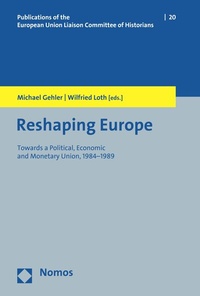
Reshaping Europe
Towards a Political, Economic and Monetary Union, 1984-1989
1st Edition
Published on 17. July 2020
524 pages
978-3-7489-0785-5 (ISBN)
Description

Wie kann man die neue Dynamik in der europäischen Einigungspolitik während der zweiten Hälfte der 1980er Jahre erklären? Was waren die treibenden Kräfte, die zur Einheitlichen Europäischen Akte führten, zur Vollendung des Binnenmarktes, zum Schengen-Abkommen, zur Süderweiterung und zu neuen Schritten zu einer Währungsunion und zu einer Gemeinsamen Außen- und Sicherheitspolitik?
Auf der Grundlage zahlreicher Entdeckungen in den Archiven zeigen Historiker aus zwölf Ländern, wie die Europäische Gemeinschaft auf die Herausforderungen der Globalisierung und die Reforminitiativen von Michail Gorbatschow reagierte. Sie schreiben damit ein neues Kapitel der Integrationsgeschichte: die Entstehung der Europäischen Union.
Mit Beiträgen von
Marta Alorda, Andrea Brait, Frédéric Bozo, Eric Bussière, Deborah Cuccia, Alice Cunha, Anjo G. Harryvan, Michael Gehler, Gilles Grin, Maria Eleonora Guasconi, Georg Kreis, Wilfried Loth, Marco Lovec, N. Piers Ludlow, Simone Paoli, Nicolae Paun, Kiran Klaus Patel, Daniela Preda, Frederike Schotters, Jasper Trautsch, Jan van der Harst, Laurent Warlouzet
More details
Other editions
Additional editions
Michael Gehler | Wilfried Loth
Reshaping Europe
Towards a Political, Economic and Monetary Union, 1984-1989
Book
07/2020
1st Edition
Nomos
€112.00
Shipment within 7-9 days
Content
- Cover
- Introduction
- European Integration by Mail: European Symbols and Subjects on Postage Stamps
- Part I: New Initiatives
- A Double-Edged Victory: Fontainebleau and the Resolution of the British Budget Problem, 1983-84
- A foreordained row
- A running sore
- The road to a lasting solution
- Conclusions
- The Relaunch of the Benelux Union and the Origins of the Schengen Agreement: The Interplay of two Sub-Regional Experiences
- Introduction
- The long path to regional de-bordering in post-war Europe
- An enlargement of the Benelux Union?
- The Benelux drive to multilateralism
- Conclusions
- Spinelli's Initiative and the European Parliament's Union Project
- The actions of the elected Parliament
- The Crocodile Club
- The Institutional Affairs Committee
- The Draft Treaty establishing the European Union
- A Dream Coming True: The Netherlands and the Creation of the European Common Market, 1984-1989
- Coming out of the crisis
- Underestimating the implications
- Ambiguities regarding monetary integration
- Serious reservations regarding political integration
- Conclusion
- Part II: The Single European Act and its Consequences
- European Political Cooperation and the Single European Act
- EPC during the 1970's: "a puny child" becomes "adolescent"
- EPC and the negotiation of the Single European Act: the issue of consistency
- The Single European Act, EPC and the relations with the Soviet Union in the second half of the 1980's
- Conclusions
- The Negotiations on the Single European Act
- Chronology
- Issues and Challenges
- Actors
- Main Results
- Main Reactions
- Theoretical Perspective
- The Single European Act in Perspective
- Unzufrieden mit der Einheitlichen Europäischen Akte. Zur Geschichte des italienischen Referendums von 1989
- Das italienische Europa-Referendum
- Die Wiederbelebung des Verfassungsentwurfs von 1984
- Die Unzufriedenheit mit der EEA von 1986
- Vorbereitung des Referendums
- Beratungen zum Referendumsgesetz
- Was unmittelbar auf das Referendum folgte
- The Transformative Impact of European Integration on Member States: The German Länder in Search of a New Role during the Second Half of the 1980s
- "Scandalous": Negotiating the Single European Act
- The Challenges of "Television without Frontiers"
- Conclusions
- Part III: Towards the Single Market Project and the Monetary Union
- The Single Market Project as a Response to Globalisation: The Role of the Round Table of European Industrialists and other non-state Actors in launching the European Union's Internal Market (1983-1992)
- Introduction
- The Round Table lobby, academic and political assessments
- Non-state actor policy impact: the Dekker paper
- Building up public support
- Non-state actor cooperation, the broader picture
- Conclusion
- Le Livre Blanc sur le marché intérieur objectif et instrument de la relance Delors
- Construction d'un consensus
- Les apports de la Commission Delors
- Retour à la politique
- Conclusion
- The Implementation of the Single Market Programme, 1985-1992
- Introduction
- A multifaceted Single Market Programme
- Environment and Industrial Interests: The Car-emission Directive (1989)
- The Neo-mercantilist Delors vs. the Neoliberals Sutherland and Brittan
- Conclusion
- Too Big a Club? The 1980s Common Agricultural Policy Crisis and Differentiated Integration
- Introduction: How many make a crowd?
- Conceptual framework: European integration as a club
- Research: The Common Agricultural Policy as a 'Sinatra case'
- The setting
- The 1980s crisis and reforms
- The 1992 MacSharry reform and after: price support reduction and compensatory payments
- Analysis: Why the Common Agricultural Policy club survived
- Embedded liberalism
- Dynamic relation with the contexts
- Conclusion: Not quantity but quality matters
- In search of the Holy Grail: France and European Monetary Unification, 1984-1989
- Reviving the European monetary agenda, 1984-1986
- Accelerating the pace, 1986-1988
- The 1989 upheavals and the road to Strasbourg
- Conclusion: the meaning of Strasbourg and beyond
- Between France and the Bundesbank: Hans-Dietrich Genscher, Helmut Kohl and the Breakthrough of the Monetary Union
- Genscher's memorandum
- The Delors Committee
- Mitterrand's pressure
- The final crisis
- Part IV: Enlargements and Neighborhoods
- The European Community's Struggle with the agro-budgetary Problem: Its Impact on the Spanish Accession Negotiations, 1979-1985
- The least loved Policy: the EEC's Enlargement to Portugal
- Portugal and EEC Accession: a three-act History
- On the bumpy Road to Brussels: Small State, Giant Obstacles
- A win-win Enlargement
- Austria's application as Precursor of EFTA Member States in Times of Reshaping Europe 1984/85-1989
- The Luxembourg Declaration, Jacques Delors' Single Market Project and Reluctant Austria 1984-86
- Formation of a SPÖ-ÖVP-Grand Coalition and the Haider FPÖ in Opposition - Brussels putting pressure on EFTA states and playing for time 1987-1989
- Successful Fighting at the Home Front and the Hummer-Schweitzer Report leading to Austria's Letter to Brussels 1989
- The Letter to Brussels with Preservation of Neutrality
- Mild Reactions by the Soviet Union and Severe Reservations in Brussels
- Outlook and Summary
- Part V: Cold War, European Security and Global Challenges
- Mikhail Gorbachev, European Security, and the Common European Home 1985-1989
- From "new Ostpolitik" to "new thinking"
- Gorbachev's new concept of security
- The struggle for the INF Treaty
- Conventional balance and general disarmament
- The unfinished Common European Home
- The Common European Home. The Soviet Prescription for reshaping Europe
- Gorbachev: How it all began
- A new Soviet policy in the making
- Common European Home and German Question: Two sides of the same coin
- The Common European Home: Reactions from the West
- Conclusions
- European Emancipation within the Atlantic Alliance? Franco-German Initiatives in European Defence
- Introduction
- Motives and driving forces
- Preconditions: Franco-German cooperation in security and defence during the Euro-missile crisis
- The American offer of technological and scientific cooperation concerning SDI
- The Reykjavik-effect
- Effects
- Limits and conflicts
- Conclusion
- The Breakthrough: Freedom and Security at the Vienna CSCE Follow-up Conference 1986-1989
- CSCE, Follow-up Process and the State of the Art
- The Outcome of the CSCE Vienna Follow-up Meeting
- Assessment by Austrian Foreign Minister Alois Mock
- Open Questions Remain
- Part VI: Summary and Conclusion
- Reshaping Europe by different Europeanisations 1984-1989. Summary and Conclusion
- List of Contributors
- List of Abbreviations
- Register of Persons
