

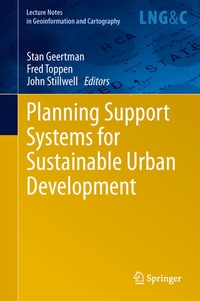
Planning Support Systems for Sustainable Urban Development
1st Edition
Published on 20. June 2013
XII, 484 pages
978-3-642-37533-0 (ISBN)
Description

This book collects a selection of the best articles presented at the CUPUM (Computers in Urban Planning and Urban Management) conference, held in the second week of July 2013 in Utrecht, the Netherlands. The articles included were selected by external reviewers using a double blind process.
More details
Series
Language
English
Place of publication
Berlin
Germany
Publishing group
Springer Berlin
Target group
Professional and scholarly
Product notice
Reflowable
Illustrations
XII, 484 p.
File size
14,86 MB
ISBN-13
978-3-642-37533-0 (9783642375330)
DOI
10.1007/978-3-642-37533-0
Schweitzer Classification
Other editions
Additional editions
Stan Geertman | Fred Toppen | John Stillwell
Planning Support Systems for Sustainable Urban Development
Book
07/2015
Springer
€160.49
Shipment within 7-9 days
Stan Geertman | Fred Toppen | John Stillwell
Planning Support Systems for Sustainable Urban Development
Book
07/2013
1st Edition
Springer
€160.49
Shipment within 7-9 days
Persons
Content
- Intro
- Preface
- Contents
- 1 Introduction to 'Planning Support Systems for Sustainable Urban Development'
- 1.Introduction to Planning Support Systems
- 2.PSS for Sustainable Urban Development
- 3.Structure of the Book
- 3.1 Part 1: Spatial Analysis and Urban Modelling
- 3.2 Part 2: Environmental Planning and Modelling
- 3.3 Part 3: Traffic and Network Modelling
- 3.4 Part 4: Web-Based Support Systems
- 3.5 Part 5: Planning and Policy Support
- 4.Conclusions
- References
- Part ISpatial Analysis and Urban Modelling
- 2 What-Ifs, If-Whats and Maybes: Sketch of Ubiquitous Collaborative Decision Support Technology
- Abstract
- 1.Introduction: Shifting Contexts
- 2.From Aggregate to Microscopic Models
- 3.The Shift to Integral Performance Assessments
- 4.Ubiquitous Pervasive Information
- 5.Implications for Research Agenda
- References
- 3 A Model of Land Use Change in City Areas Based on the Conversion of Unit Lots
- Abstract
- 1.Introduction
- 1.1 Land Use Model for Sustainable Urban Development
- 1.2 Behavioral Approach for Land Use Model
- 1.3 Limitation of Previous Approach
- 1.4 Our Approach to Micro Land Use Model
- 2.Approach to and Modeling of Land Use Conversions
- 3.Estimating the Probability of Lot Conversion
- 3.1 Probability of Lot Division
- 3.2 Probability of Building Demolition
- 3.3 Probability of Change in Land Category
- 3.4 Probability of Change of Building Type
- 4.Validation of Model
- 4.1 Accuracy of Estimates by Model
- 4.2 Stability Across Time
- 4.3 Spatial Extent Predictable with Model
- 5.Simulations for Predicting Future Land Use
- 5.1 Analyses, from the Point of View of Future Land Use
- 5.2 Analysis of Influence of Land Use Plans
- 5.2.1 Direction and Speed of Conversions of Forest or Agricultural Land
- 5.2.2 Direction and Speed of Conversions of Vacant Lots
- 5.2.3 Analysis of Conversions of Land Adjoining Main Roadways
- 5.2.4 Analysis of Conversions of Land Use with Respect to Zoning
- 6.Summary and Conclusions
- Acknowledgments
- References
- 4 Simulating the Dynamics Between the Development of Creative Industries and Urban Spatial Structure: An Agent-Based Model
- Abstract
- 1.Introduction
- 2.The General Framework for Simulating the Dynamics
- 3.Agents and Their Action Rules
- 3.1 Urban Government
- 3.1.1 Design of Supportive Policies
- 3.1.2 Land Use Planning Schemes
- 3.2 Creative Firms
- 3.2.1 Looking for Office Site
- 3.2.2 Looking for Workers
- 3.3 Creative Workers
- 3.3.1 Looking for Residence
- 3.3.2 Looking for Job
- 4.Model Implementation: The Case of Nanjing
- 4.1 Setting-Up Procedure
- 4.2 Running the Model in Nanjing
- 5.Conclusion
- References
- 5 LACONISS: A Planning Support System for Land Consolidation
- Abstract
- 1.Introduction
- 2.The Land Reallocation Process in Practice
- 3.LACONISS Components
- 3.1 The LandFragmentS Module
- 3.2 The LandSpaCES Design Module
- 3.3 The LandSpaCES Evaluation Module
- 3.4 The LandParcelS Module
- 4.System Implementation
- 4.1 Measuring Fragmentation in the Study Area
- 4.2 Designing Alternative Solutions
- 4.3 Evaluating the Alternative Solutions
- 4.4 Generating the Final Parcels
- 5.Conclusions
- References
- 6 Qualitative and Quantitative Comparisons of Agent-Based and Cell-Based Synthesis Estimation Methods of Base-Year Data for Land-Use Microsimulations
- Abstract
- 1.Introduction
- 2.Population Synthesis Estimation Methods
- 2.1 Cell-Based Methods
- 2.1.1 IPF Procedure
- 2.1.2 Goodness-of-Fit
- 2.2 Agent-Based Methods
- 2.2.1 Monte Carlo simulation
- 2.2.2 Goodness-of-Fit
- 3.Qualitative Comparison
- 3.1 Characteristics of Agents
- 3.2 Number of Attributes and Their Categories
- 3.3 Estimation Norm
- 3.4 Uniqueness
- 3.5 Complexity
- 3.6 Data Availability
- 3.7 Compatibility Between Agent-and Cell-Based Estimates
- 4.Quantitative Comparison
- 4.1 Data
- 4.2 Estimation
- 4.2.1 Cell-Based Method
- 4.2.2 Agent-Based Method
- 4.3 Comparison Framework
- 4.4 Comparison by Cell
- 4.5 Comparison by Agent
- 5.Concluding Remarks
- Acknowledgments
- References
- 7 Application of Land Use Model Combined with GIS and RS Technology in Supporting Urban Spatial Planning
- Abstract
- 1.Introduction
- 2.Materials and Methods
- 2.1 Study Area
- 2.2 Data Preparation and Processing
- 2.3 The CLUE-S Model
- 2.3.1 Scenarios Design and Assumptions
- 2.3.2 Logistic Regression
- 2.3.3 Simulation Spatial and Temporal Resolution Setting
- 2.3.4 Land Use Conversion Matrix and Elasticity Setting
- 2.4 Landscape Metrics
- 3.Results and Analysis
- 3.1 Spatio-Temporal Change of Land Use in Future Under Different Scenarios
- 3.2 Landscape Pattern Change Under Different Scenarios
- 3.3 Comparison Analysis of Simulated Results with Urban Planning Maps
- 4.Discussion and Conclusions
- Acknowledgments
- References
- 8 Planning Support Systems for Fiscally Sustainable Planning
- Abstract
- 1.Introduction
- 2.Background
- 2.1 Local Government Expenditure Modeling
- 2.2 Scenario Planning
- 2.3 Build-Out
- 2.4 Spatial and Temporal Growth Modeling
- 2.5 Impact Assessment
- 3.Methods
- 3.1 Scenarios
- 3.2 Build-Out
- 3.3 Spatial and Temporal Growth Modeling
- 3.4 The Fiscal Model
- 3.5 Impact Analysis
- 4.Results
- 5.Discussion and Conclusion
- Acknowledgments
- References
- Part IIEnvironmental Planning and Modelling
- 9 Generalisation of Planning Data as a Contribution to Strategic Environmental Assessments (SEA): The Example of a City-Wide Biotope-Type Assessment for Berlin
- Abstract
- 1.Introduction
- 2.Data and Methods
- 2.1 Data
- 3.Areal Weighting with Aggregation Rules
- 4.Results
- 5.Discussion
- 6.Recommendations
- Acknowledgments
- References
- 10 Using MapTablereg to Learn About Sustainable Urban Development
- Abstract
- 1.Introduction
- 2.Learning About Sustainability in Urban Planning
- 2.1 Environmental Integration as Learning
- 2.2 A Spatial Discussion
- 3.Planning Support Systems
- 4.The MapTablereg
- 4.1 The Tool
- 4.1.1 Hardware: MapTablereg
- 4.1.2 Software: ArcGIS and CommunityViz
- 4.1.3 The Area-Based Environmental Profile: The Sustainability Profile of the Location
- 4.2 Using MapTablereg
- 5.Experiences with MapTablereg in Utrecht: Rijnenburg
- 5.1 Rijnenburg: A Sustainable Neighborhood
- 5.2 MapTablereg in Rijnenburg
- 5.3 Experiences of the Planning Actors
- 5.3.1 GIS Specialists
- 5.3.2 Environmental Analysts
- 5.3.3 Urban Designers
- 5.4 Communicating with MapTablereg
- 6.Discussion: A Map-Based Touch Table for the Inclusion of Environmental Values
- 6.1 Learning with a Map-Based Touch Table
- 6.1.1 Learning as Reframing
- 6.1.2 Area-Specific Environmental Profiles
- 6.1.3 A Map-Based Touch Table
- 6.2 Lessons for the Future
- 7.Conclusion
- Acknowledgments
- References
- Websites
- 11 Ecosystem Services, Green Infrastructure and the Role of Planning Support Systems
- Abstract
- 1.Introduction
- 2.Ecosystem Services and Green Infrastructure
- 2.1 The Role of Valuation
- 2.2 The Case of New York's Water Supply
- 2.3 The Case of Johnson Creek in Portland
- 3.Planning Support Systems
- 3.1 Land Use Evolution and Impact Assessment Model
- 3.2 Visualization and Access to Information
- 4.Support for Planning Green Infrastructure in Illinois
- 4.1 The Illinois Green Infrastructure GeoPortal
- 4.2 Implementation
- 5.Conclusion
- Acknowledgments
- References
- 12 Urban CO2 Planning: A Decision Support System
- Abstract
- 1.Introduction
- 2.The Components of the Framework
- 2.1 The CA-Based Land-Use Model
- 2.2 The Transportation Model
- 2.3 The WRF-ACASA Coupled Model
- 3.The Example Application
- 4.Conclusions and Future Work
- Acknowledgments
- A.x(118). ACASA-WRF Model
- References
- 13 A GIS-Based Performance Metrics for Designing a Low Energy Urban Agriculture System
- Abstract
- 1.Introduction
- 2.A Recent Development in Planning Support System
- 3.Modeling Urban Design Scenarios Based on Performance Metrics
- 4.Problems Definition: A Low Energy Urban Agriculture and its Need of a Planning Support System
- 5.Research Design
- 5.1 Urban Informational Layers, System Boundary and Performance Measures
- 5.2 Urban Design Scenario Making
- 6.Test Case: Performance Dimension of Food and Energy Flows for Food System Design
- 6.1 Setting Scenarios
- 6.2 Data Mining on Vacant Lands
- 6.3 Food Flows
- 6.3.1 Performance Analysis of Food Flows
- 6.3.2 Scenario Analysis of Food Flows
- 6.3.3 Discussions on Food Flow
- 6.4 Energy Flows
- 6.4.1 Performance Analysis of Energy Flows
- 6.4.2 Scenario Analysis of Energy Flows
- 6.5 Total Carbon Mitigation
- 7.Conclusions
- References
- 14 A Comprehensive Review of Existing Urban Energy Models in the Built Environment
- Abstract
- 1.Introduction
- 2.Supply Models
- 3.Demand Models
- 3.1 Top-Down Approach
- 3.2 Bottom-Up Approach
- 3.3 Spatial Evaluation of Energy Demand
- 4.Integrated Modeling Approach
- 5.Discussion of the Reviewed Models
- 5.1 Supply and Demand Models
- 5.2 Integrated Models
- 5.2.1 Towards Integrated Multilayer Models
- 5.2.2 Spatial Implications of Renewable Energy Technologies
- 5.2.3 Simulation and Optimization Methods
- 6.Conclusions
- References
- Part IIITraffic and Network Modelling
- 15 A Procedure Using GIS to Analyze the Access by Non-Motorized Transport to Transit Stations
- Abstract
- 1.Introduction
- 2.Literature Review
- 3.The Survey Analysis and the Criteria for Spatial Analysis
- 4.Proposed Indicators
- 5.The Spatial Analysis Procedure Using GIS
- 6.An Example of Application
- 7.Conclusions
- Acknowledgments
- References
- 16 Locations with Frequent Pedestrian-Vehicle Collisions: Their Transportation and Neighborhood Environment Characteristics in Seattle and King County, Washington
- Abstract
- 1.Introduction
- 1.1 Objective
- 2.Methods
- 2.1 Research Design
- 2.2 Data Sources
- 2.3 Measurements
- 2.4 Statistic Analysis
- 3.Results
- 3.1 Descriptive Analysis
- 3.1.1 Model Results
- 4.Discussion
- 4.1 Transportation Infrastructure and Traffic Conditions
- 4.2 Regional Location
- 4.3 Neighborhood Environment and Activity Generators
- 4.4 Methodology
- 5.Conclusion
- Acknowledgments
- References
- 17 A Computer-Aided Approach for Planning Sustainable Trips to Large Trip Generators: The Case of Cycling Routes Serving University Campuses
- Abstract
- 1.Introduction
- 2.Literature Review
- 3.Method
- 4.Results
- 5.Conclusions
- Acknowledgments
- References
- 18 Walk Route: A New Methodology to Find the Optimal Walking Route in the City of Atlanta
- Abstract
- 1.Introduction
- 2.Methodology
- 2.1 Selecting Attributes of Walkability Cost
- 2.2 Developing an Analytical Hierarchy Process for Deriving Network Weights
- 2.3 Applying the Weights to Generate Walkability Score
- 2.4 Develop and Implement a Routing Algorithm
- 3.An Application in the City of Atlanta
- 3.1 Variable Selection and Spatial Transfer
- 3.2 Calculation of Variable Weights and Generation of Walkability Cost
- 3.3 Optimal Route Identification
- 4.Discussion
- 5.Conclusion
- References
- Part IVWeb-Based Support Systems
- 19 Access to UK Census Data for Spatial Analysis: Towards an Integrated Census Support Service
- Abstract
- 1.Introduction
- 2.Census Data Products and Census Support
- 3.Access to Aggregate Statistics Through InFuse
- 4.Digital Boundary Data from UKBORDERS
- 5.Interaction Data from WICID
- 6.Access to the Samples of Anonymised Records
- 7.Spatial Analysis of Ethnic Migration in Greater London
- 8.Conclusions: Towards an Integrated Census Support Service
- Acknowledgments
- References
- 20 The Online What if? Planning Support System
- Abstract
- 1.Introduction
- 2.Background
- 2.1 From GIS to Planning Support Systems
- 2.2 Online What if? Description
- 2.3 eResearch Infrastructure: The Way of the Future
- 3.Technical Architecture
- 4.The Online What if? Technical Architecture and Software Component
- 4.1 Implementation Strategy
- 4.2 GeoTools---The 2D Spatial Data Handling API
- 4.3 Persisting Spatial Data and Scenario Configurations
- 4.4 User Interface
- 5.Case Study Demonstrator
- 6.Conclusions
- Acknowledgments
- References
- 21 A Web-Based Fuzzy CA Model for Urban Growth Simulation
- Abstract
- 1.Introduction
- 2.The Fuzzy Constrained CA Model
- 2.1 Primary Transition Rules
- 2.2 Secondary Transition Rules
- 2.3 The Case Study Area and its Development Scenarios
- 3.A Framework for Web-based CA Modelling
- 3.1 Model Implementation
- 3.2 Model Deployment Over the Internet
- 3.3 User Interface
- 4.Conclusion
- Acknowledgments
- References
- 22 Flexible Geospatial Platform for Distributed and Collaborative Urban Modelling
- Abstract
- 1.Introduction
- 2.Conceptual Framework and Previous Efforts on GeoPortal
- 2.1 Motivation for Designing an Improved Modelling Infrastructure
- 3.Modelling Infrastructure, Components and Applications
- 3.1 System Infrastructure Design
- 3.1.1 Federated Database Server
- 3.1.2 Post-Processing and Visualization Tools
- 3.1.3 Content Management System
- 3.1.4 Users and Access Control
- 3.2 PostgreSQL Database Structure/Schema
- 3.2.1 Metadata Structure
- 3.2.2 Data Integration
- 3.3 Ajax-Based Visualization Application
- 3.3.1 State Saving and Sharing
- 3.3.2 Application Examples
- 3.4 Flex-Based Visualization Application
- 3.4.1 Data Retrieving
- 3.4.2 Application Examples
- 3.4.3 Mouse-Over Interaction
- 3.4.4 State Saving and Sharing
- 3.5 Summary
- 4.System Implementation and Use
- 4.1 Measurement of Accessibility
- 4.2 Collaborative Modelling Support
- 4.2.1 Scenario Comparison
- 4.2.2 Modeling Diagnose
- 4.2.3 View Sharing
- 5.Conclusion
- Acknowledgments
- References
- 23 The Participatory Cube: A Framework for Analysis of Online Participation Platforms
- Abstract
- 1.Introduction
- 2.Previous Work
- 2.1 The Virtual Sphere 2.0
- 2.2 Urban Sensing
- 2.3 Volunteered Geographic Information
- 2.4 Dimensions of Participation
- 3.Designing a Framework for the Analysis: The Participatory Cube
- 3.1 The Main Goal of the Model
- 3.2 Decision Power
- 3.3 Interactivity of Communication
- 3.4 Access to Space of Participation
- 3.5 The Participatory Cube
- 4.Presentation of Case Studies from Germany and Brazil
- 4.1 Leehrstandsmelder
- 4.2 Maerker Brandenburg and Berlin
- 4.3 Climate Change in Elmshorn
- 4.4 Urbanias
- 4.5 Portoalegre.cc
- 4.6 Cidade Democrática
- 5.Results of the Analysis
- 6.Conclusions and Further Research Directions
- References
- Part VPlanning and Policy Support
- 24 Application of Socio-Technical Research Methods in Understanding the Genesis and Potential Sustainability of Planning Support Systems
- Abstract
- 1.Introduction
- 2.Theoretical Frameworks
- 2.1 Actor-Network Theory Concepts and Components
- 2.2 Unified Theory of Acceptance and Use of Technology
- 2.3 Comparison of ANT and UTAUT
- 3.Interview Methodology
- 4.Questionnaire Methodology
- 5.Compare and Contrast Research Method Results
- 6.Discussion
- 7.Conclusion
- References
- 25 Governance Approaches in the Regeneration of Immigrant Communities: Potential Roles of Planning Support Systems (PSS)
- Abstract
- 1.Introduction
- 2.Modes of Governance and PSS
- 2.1 Three Key Stakeholders and Modes of Governance
- 2.2 Planning Support Systems
- 3.Case Studies
- 3.1 The Favela-Bairro Program
- 3.2 Kampung Improvement Program
- 3.3 The Redevelopment of ''Villages in the City''
- 4.Linking Governance, PSS, and the Regeneration of Immigrant Communities
- 4.1 Centralized Governance
- 4.2 Decentralized Governance
- 4.3 Public-Collective-Private Governance
- 4.4 Interactive Governance
- 4.5 Self-Governance
- 5.Conclusions and Discussions
- References
- 26 Supporting Planning Processes by the Use of Dynamic Visualisation
- Abstract
- 1.Introduction
- 2.Overview
- 3.Methodology
- 4.Case Study
- 4.1 ANP Questionnaire
- 4.2 Visualisation of ANP Elements
- 5.Methodology Evaluation
- 6.Conclusion and Discussion
- Acknowledgments
- References
- 27 Beauty and Brains: Integrating Easy Spatial Design and Advanced Urban Sustainability Models
- Abstract
- 1.Introduction
- 1.1 Context
- 1.2 Governance, Governing, Planning and Design
- 1.3 Science and Creativity Integrated in Design
- 2.Research Questions and Method
- 3.Observations and Discussion
- 3.1 Bridging the Right and the Left
- 3.2 More Lessons Learned
- 4.Tools for Planners, Planning for Tools
- 4.1 Beauty
- 4.2 The Brains
- 5.Past Experiences, Feelings, Reactions and Findings
- 5.1 Less is More
- 5.2 Flashy Gadget versus Black Box: Proceed with Care
- 5.3 Data Balance
- 5.4 The Right People at the Right Place (Phase)
- 6.The Next Case Studies: Public Participation and Smartness Modeling
- 7.Concluding Remarks
- Acknowledgments
- References
