

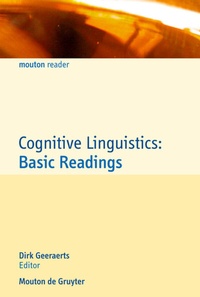
Cognitive Linguistics: Basic Readings
Description

Over the past decade, Cognitive Linguistics has grown to be one of the most broadly appealing and dynamic frameworks for the study of natural language. Essentially, this new school of linguistics focuses on the meaning side of language: linguistic form is analysed as an expression of meaning. And meaning itself is not something that exists in isolation, but it is integrated with the full spectrum of human experience: the fact that we are embodied beings just as much as the fact that we are cultural beings.
Cognitive Linguistics: Basic Readings brings together twelve foundational articles, each of which introduces one of the basic concepts of Cognitive Linguistics, like conceptual metaphor, image schemas, mental spaces, construction grammar, prototypicality and radial sets. The collection features the founding fathers of Cognitive Linguistics: George Lakoff, Ron Langacker, Len Talmy, Gilles Fauconnier, and Charles Fillmore, together with some of the most influential younger scholars. By its choice of seminal papers and leading authors, Basic Readings is specifically suited for an introductory course in Cognitive Linguistics. This is further supported by a general introduction to the theory and, specifically, the practice of Cognitive Linguistics and by trajectories for further reading that start out from the individual chapters.
Reviews / Votes
"[...] it should be immediately remarked that the coherence and unity of the book is skilfully preserved by the editor by means of a warming-up, user-friendly introduction to the field and a closing section with trajectories for further reading. [...]"Francisco Gonzálvez-García in: Funtions of Language, 2008 "[...] this collection may be highly recommended."Thora Tenbrink in: Cognitive Linguistics 2/2008 "The collection brings order into the vast field of cognitive research and highlights the foundational assumptions held in Cognitive Linguistics, which is particularly helpful for students and researchers from other disciplines."Thomas Verjans in: ICLA-website Mai 2007 http://www.cognitivelinguistics.org/Reviews/geeraerts "This volume with 12 basic readings from cognitive linguistics is a unique resource and reference instrument. It reflects and documents the most central tenets of CL: cognitive grammar (Langacker), grammatical construal (Talmy), radial networks (Brugman/Lakoff), prototype theory (Geeraerts), polysemy and vagueness (Tuggy), conceptual metaphor (Lakoff), image schemas and their transformations (Gibbs), conceptual metonymy and domain delimitation (Croft), mental spaces (Fauconnier/Turner), frame semantics (Fillmore), construction grammar (Goldberg), and usage based (psycho-)linguistics (Tomasello).In a nutshell: this is very judicious and persuasive selection of the really prototypical and most basic revolutionary insights of cognitive linguistics."René Dirven, October 2006 "The inclusion of main concepts in Cognitive Linguistics makes the present collection a valuable source for beginners as well as researchers in this domain. The editor has collected very good sources to introduce each concept and has added valuable information in his introduction to the book. By reading the book, a linguist may gain both familiarity with this fast-growing domain of linguistics and the means to delve into it further."Mohammad Rasekh Mahand in: Linguist List 18.1166 http://linguistlist.org/issues/18/18-1166.htmlMore details
Other editions
Additional editions

Person
Content
2 - Contents [Seite 5]
3 - Introduction A rough guide to Cognitive Linguistics [Seite 9]
4 - Chapter 1 Cognitive Grammar [Seite 37]
5 - Chapter 2 Grammatical construal [Seite 77]
6 - Chapter 3 Radial network [Seite 117]
7 - Chapter 4 Prototype theory [Seite 149]
8 - Chapter 5 Schematic network [Seite 175]
9 - Chapter 6 Conceptual metaphor [Seite 193]
10 - Chapter 7 Image schema [Seite 247]
11 - Chapter 8 Metonymy [Seite 277]
12 - Chapter 9 Mental spaces [Seite 311]
13 - Chapter 10 Frame semantics [Seite 381]
14 - Chapter 11 Construction Grammar [Seite 409]
15 - Chapter 12 Usage-based linguistics [Seite 447]
16 - Epilogue Trajectories for further reading [Seite 467]
