

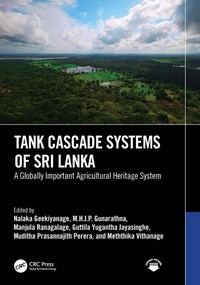
Tank Cascade Systems of Sri Lanka
A Globally Important Agricultural Heritage System
1st Edition
Published on 30. May 2025
556 pages
978-1-040-32933-7 (ISBN)
Description

The Tank Cascade System (TCS) of Sri Lanka is a connected series of tanks organized within a micro-catchment of a dry zone landscape for storing, conveying, and utilizing water from a temporary stream. FAO and the UN internationally recognize it as a Globally Important Agricultural Heritage System for food security and sustainable development in a changing climate. This edited volume offers comprehensive and holistic coverage of the entire scope of cascade systems including their origins, governance, and integration with agriculture, biodiversity, cultural linkages, associated livelihoods, degradation causes, restoration efforts, gender perspectives, and disaster resilience.
Features:
Provides comprehensive coverage of the evolution of the Tank Cascade Systems over two millennia in Sri Lanka.
Offers a holistic understanding of multifaceted dimensions of TCS from ecological importance to economic potential and offers a well-defined roadmap towards securing sustainable TCS.
Addresses critical challenges of water quality, deterioration and prevalence of human health issues, human-wildlife conflicts, and land degradation.
Discusses perspectives of restoring significant agricultural heritage systems around the globe for solving environmental and agricultural problems.
Includes practical case studies with replicable models for integrated landscape management and livelihood enhancement.
Outlines strategic approaches to sustainable management, encompassing ecosystem restoration, resilience against disasters, and gender-inclusive strategies.
This book is for researchers, academics, graduate, and senior undergraduate students in agriculture, environmental science, ecology, and soil science, and those interested in water conservation and sustainability in tropical landscapes. It also serves as an insightful reference for industry and government professionals, and human rights activists.
Features:
Provides comprehensive coverage of the evolution of the Tank Cascade Systems over two millennia in Sri Lanka.
Offers a holistic understanding of multifaceted dimensions of TCS from ecological importance to economic potential and offers a well-defined roadmap towards securing sustainable TCS.
Addresses critical challenges of water quality, deterioration and prevalence of human health issues, human-wildlife conflicts, and land degradation.
Discusses perspectives of restoring significant agricultural heritage systems around the globe for solving environmental and agricultural problems.
Includes practical case studies with replicable models for integrated landscape management and livelihood enhancement.
Outlines strategic approaches to sustainable management, encompassing ecosystem restoration, resilience against disasters, and gender-inclusive strategies.
This book is for researchers, academics, graduate, and senior undergraduate students in agriculture, environmental science, ecology, and soil science, and those interested in water conservation and sustainability in tropical landscapes. It also serves as an insightful reference for industry and government professionals, and human rights activists.
More details
Edition
1. Auflage
Language
English
Place of publication
London
United Kingdom
Publishing group
Taylor & Francis Ltd
Target group
College/higher education
Professional and scholarly
Illustrations
60 Tables, black and white; 57 Line drawings, color; 30 Line drawings, black and white; 53 Halftones, color; 11 Halftones, black and white; 110 Illustrations, color; 41 Illustrations, black and white
File size
146,61 MB
ISBN-13
978-1-040-32933-7 (9781040329337)
Copyright in bibliographic data and cover images is held by Nielsen Book Services Limited or by the publishers or by their respective licensors: all rights reserved.
Schweitzer Classification
Other editions
Additional editions
Nalaka Geekiyanage | M.H.J.P. Gunarathna | Manjula Ranagalage
Tank Cascade Systems of Sri Lanka
A Globally Important Agricultural Heritage System
Book
05/2025
1st Edition
CRC Press
€314.10
Shipment within 10-20 days
Persons
Nalaka Geekiyanage is a Senior Lecturer at Rajarata University, Sri Lanka. He holds a B.Sc. and M.Sc. from the University of Peradeniya and earned his Ph.D. from Kyoto University. His expertise lies in Forestry, Plant Ecology, and Restoration Ecology, with a focus on the ecological dynamics of tropical ecosystems. Geekiyanage has authored over 25 peer-reviewed journal articles and book chapters. He has been recognized with 15 awards and fellowships, including the President's Award for Scientific Publications. Geekiyanage serves as an Editor for the renowned journals Plant Ecology and Diversity and Journal of Sustainable Forestry. In addition to his academic work, he is actively involved in securing funding for research, development, and conservation initiatives, while being passionate about popularizing science.
M.H.J.P Gunarathna, Professor in Agricultural Engineering at the Rajarata University of Sri Lanka, earned First-Class Honors B.Sc. in Agriculture from the University of Ruhuna, M.Sc. in Agricultural Engineering from Central Luzon State University, Philippines and Ph.D. in Regional Resource Environmental Engineering from Kagoshima University, Japan. With over 40 articles and several books written in water management and environmental modelling, he's recognized as a 4-star researcher with an h-index of 14. He serves as a reviewer and editorial board member for several national and international journals and has received numerous awards for research excellence.
Manjula Ranagalage, Professor at Rajarata University, Sri Lanka, earned a Ph.D. in Geo-Environmental Sciences from the University of Tsukuba, Japan. With expertise in Geo-informatics and Geography, he's published over 50 articles and serves on editorial boards of international journals. He's a leading figure in Social Sciences and Humanities in Sri Lanka. He Was a JSPS postdoctoral Research Fellow at the University of Tsukuba, Japan. He won several national and international awards for research excellence. He is a council member of the National Research Council, Sri Lanka.
G.Y. Jayasinghe, Professor in Agricultural Engineering and Environmental Technology at Ruhuna University, Sri Lanka, received prestigious awards including the Endeavour Postgraduate Research Fellowship, Australia and Monbukagakusho Award, Japan. With over 150 publications and contributions to conferences, he's recognized for scholarly contributions. He serves as an expert for institutional reviews, showcasing expertise in Agricultural Engineering and Environmental Technology.
Muditha Prasannajith Perera, Professor in Geography at the University of Peradeniya, specializes in hydro-ecology, hydraulic civilization, and watershed management. Recognized for over 80 publications, and he serves as an editorial board member and reviewer for a few national and international journals. His expertise extends to tank cascade irrigation systems and watershed management projects in Sri Lanka, India, and Bangladesh. He coordinates academic programs at the Postgraduate Institute of Science, University of Peradeniya.
Meththika Vithanage, Professor in Natural Resources at the University of Sri Jayewardenepura, is a Highly Cited Researcher recognized by Clarivate Analytics. She received the Fayzah M. Al-Kharafi Award from TWAS in 2020. She has written and contributed to over 250 SCI journal articles, 60 book chapters, and 8 co-edited books. She serves as an Adjunct Professor at the University of Western Australia and the National Institute of Fundamental Studies, Sri Lanka.
M.H.J.P Gunarathna, Professor in Agricultural Engineering at the Rajarata University of Sri Lanka, earned First-Class Honors B.Sc. in Agriculture from the University of Ruhuna, M.Sc. in Agricultural Engineering from Central Luzon State University, Philippines and Ph.D. in Regional Resource Environmental Engineering from Kagoshima University, Japan. With over 40 articles and several books written in water management and environmental modelling, he's recognized as a 4-star researcher with an h-index of 14. He serves as a reviewer and editorial board member for several national and international journals and has received numerous awards for research excellence.
Manjula Ranagalage, Professor at Rajarata University, Sri Lanka, earned a Ph.D. in Geo-Environmental Sciences from the University of Tsukuba, Japan. With expertise in Geo-informatics and Geography, he's published over 50 articles and serves on editorial boards of international journals. He's a leading figure in Social Sciences and Humanities in Sri Lanka. He Was a JSPS postdoctoral Research Fellow at the University of Tsukuba, Japan. He won several national and international awards for research excellence. He is a council member of the National Research Council, Sri Lanka.
G.Y. Jayasinghe, Professor in Agricultural Engineering and Environmental Technology at Ruhuna University, Sri Lanka, received prestigious awards including the Endeavour Postgraduate Research Fellowship, Australia and Monbukagakusho Award, Japan. With over 150 publications and contributions to conferences, he's recognized for scholarly contributions. He serves as an expert for institutional reviews, showcasing expertise in Agricultural Engineering and Environmental Technology.
Muditha Prasannajith Perera, Professor in Geography at the University of Peradeniya, specializes in hydro-ecology, hydraulic civilization, and watershed management. Recognized for over 80 publications, and he serves as an editorial board member and reviewer for a few national and international journals. His expertise extends to tank cascade irrigation systems and watershed management projects in Sri Lanka, India, and Bangladesh. He coordinates academic programs at the Postgraduate Institute of Science, University of Peradeniya.
Meththika Vithanage, Professor in Natural Resources at the University of Sri Jayewardenepura, is a Highly Cited Researcher recognized by Clarivate Analytics. She received the Fayzah M. Al-Kharafi Award from TWAS in 2020. She has written and contributed to over 250 SCI journal articles, 60 book chapters, and 8 co-edited books. She serves as an Adjunct Professor at the University of Western Australia and the National Institute of Fundamental Studies, Sri Lanka.
Content
1. Executive Summary for Tank Cascade Systems of Sri Lanka: A Globally Important Agricultural Heritage System. Section 1: Background. 2. Evolution of Village Tanks to Tank Cascade Systems: An Archaeological and Historical Investigation. 3. Tank Cascade Systems of Sri Lanka: Concept, Components, and Complexity. 4. Hydrology and Water Management in Tank Cascade Systems of Sri Lanka. 5. Preserving Cultural Riches: The Fading Ritual Legacy of Sri Lanka's Tank Cascasde Systems. 6. The Economic Value of Ecosystem Services Arising from Village Tank Cascade Systems (TCS). 7. Biodiversity of Kala Oya Cascade System. 8. Ecological and Evolutionary Affinities of Avifauna in the Tank Cascade Systems of Sri Lanka. Section 2: Sustainable Utilization. 9. Knowledge and Wisdom of Fatmers in Tropical Agricultural Systems: Ethnobotanical Knowledge in Tank Cascade Systems of Sri Lanka. 10. Legacy of Animal Agriculture in Tank Cascade Systems. 11. Culture-based Fisheries in Tank Cascade Systems for Food Systems and Livelihoods. 12. Ornamental Aquatic Flora in Tank Cascade System of Sri Lanka: An Unexploited Treasure Trove. 13. Promise of Community-Based Agro-Ecotourism in Tank Cascade Systems of Sri Lanka. Section 3: Issues and Challenges. 14. Irrigation Water Quality Management in Tank Cascade Systems. 15. Moving Beyond Deterrence: Socio-economic Factors Driving Bio-Fence Adoption among Dry Zone Farmers to Mitigate Human-Elephant Conflict. 16. Tackling Issues of Soil Erosion and Sedimentation in Tank Cascade Systems of Sri Lanka. 17. Spatiotemporal Changes of the Forest Degradation in Tank Cascade Systems of Sri Lanka. 18.Role of Property Rights for Open Access Resources in Tank Cascade Systems in Sri Lanka. 19. Degradation of Tank Cascade Systems: Colonial Period to the Present-Day. 20. Managing Invasive Alien Plants in Tank Cascade Systems in Sri Lanka. Section 4: Sustainable Management. 21. Ecological Restoration of Sri Lanka's Tank Cascade Systems. 22. Nexus of Food Security and Tank Cascade Systems in Sri Lanka. 23. Building Resilience to Climate Change Impacts on Tank Cascade Systems-Livelihoods-Environment Nexus: A Synergic Management Approach. 24. Tank Cascade Systems of Sri Lanka and Human Health Implications. 25. Tank Cascade Systems and Disaster Resilience: An Integrated Approach. 26. Gender Perspective on Participatory Management of Tank Cascade Systems in Sri Lanka. 27. Nature-Based Solutions for Sustainable Agricultural Water Management: An Example of Sri Lanka's Tank Cascade Systems. 28. Governance of Village Tank Cascade System Restoration: Role of Watershed Scale Coordinating Mechanisms for Aligning Interests and Services. Section 5: Case Studies. 29. Significance and Conservation Strategies for Thaulla of Ancient Tanks in the Tank Cascade System in Sri Lanka. 30. Cyrtobagous salviniae for Bio-controlling Salvinia molesta in Tank Cascade Systems of Medawachchiya in Northcentral Sri Lanka. 31. A Case Study on Eco-cultural Heritage Tourism: An Innovative Rendezvous of Past Hydraulic Civilization with the Present and Future. 32. Managing Flood Risk in Tank Cascade Systems of Sri Lanka for Improved Disaster Resilience. 33. Declining Performance of Village Tanks: A Case Study in Vavuniya District, Sri Lanka. 34. Socio-cultural, Ecological and Legal Perspectives on Small Tank Management in a Cascade System in Anuradhapura, Sri Lanka. Section 6: Synthesis. 35. Research, Development, and Conservation Needs for Sustainable Management of Tank Cascade Systems.
