

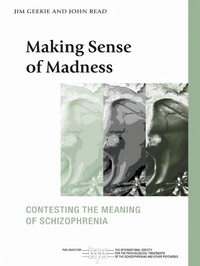
Making Sense of Madness
Contesting the Meaning of Schizophrenia
Published on 6. May 2009
208 pages
978-1-134-04337-8 (ISBN)
Description

The experience of madness - which might also be referred to more formally as 'schizophrenia' or 'psychosis' - consists of a complex, confusing and often distressing collection of experiences, such as hearing voices or developing unusual, seemingly unfounded beliefs. Madness, in its various forms and guises, seems to be a ubiquitous feature of being human, yet our ability to make sense of madness, and our knowledge of how to help those who are so troubled, is limited.
Making Sense of Madness explores the subjective experiences of madness. Using clients' stories and verbatim descriptions, it argues that the experience of 'madness' is an integral part of what it is to be human, and that greater focus on subjective experiences can contribute to professional understandings and ways of helping those who might be troubled by these experiences.
Areas of discussion include:
how people who experience psychosis make sense of it themselves
scientific/professional understandings of 'madness'
what the public thinks about 'schizophrenia'
Making Sense of Madness will be essential reading for all mental health professionals as well as being of great interest to people who experience psychosis and their families and friends.
Making Sense of Madness explores the subjective experiences of madness. Using clients' stories and verbatim descriptions, it argues that the experience of 'madness' is an integral part of what it is to be human, and that greater focus on subjective experiences can contribute to professional understandings and ways of helping those who might be troubled by these experiences.
Areas of discussion include:
how people who experience psychosis make sense of it themselves
scientific/professional understandings of 'madness'
what the public thinks about 'schizophrenia'
Making Sense of Madness will be essential reading for all mental health professionals as well as being of great interest to people who experience psychosis and their families and friends.
Reviews / Votes
"Jim Geekie and John Read have written a fascinating book about what psychiatrists call 'schizophrenia'. They address the usually ignored issue of how people who experience hallucinations and delusions make sense of those experiences themselves. They also tackle why it is that experts continue to disagree about what 'schizophrenia' is and, indeed, whether it exists at all. This is a 'must read' for all mental health professionals and everyone else interested in madness." - Professor Paul J Fink, Past President American Psychiatric Association, Temple University School of Medicine, USA"One can only hope that every new trainee in mental health will first read this book before exposing him - or herself to the confusing amount of theories and categorizations that have become accepted as "knowledge" of madness. Developing an attitude of continuously contesting and questioning accepted knowledge will help close the current gap between subjective experience and professional reductionism." - Prof. dr J. van Os, Dept. Psychiatry and Neuropsychology, Maastricht University, The Netherlands
"At long last, a book that eloquently demonstrates the necessity to listen to subjective experiences of madness in order to gain real insight into sanity, madness and the human condition. Humane, accessible and illuminating." - Jacqui Dillon, Chair of the National Hearing Voices Network, UK "Jim Geekie and John Read have written a fascinating book about what psychiatrists call 'schizophrenia'. They address the usually ignored issue of how people who experience hallucinations and delusions make sense of those experiences themselves. They also tackle why it is that experts continue to disagree about what 'schizophrenia' is and, indeed, whether it exists at all. This is a 'must read' for all mental health professionals and everyone else interested in madness." - Professor Paul J Fink, Past President American Psychiatric Association, Temple University School of Medicine, USA
"One can only hope that every new trainee in mental health will first read this book before exposing him - or herself to the confusing amount of theories and categorizations that have become accepted as "knowledge" of madness. Developing an attitude of continuously contesting and questioning accepted knowledge will help close the current gap between subjective experience and professional reductionism." - Prof. dr J. van Os, Dept. Psychiatry and Neuropsychology, Maastricht University, The Netherlands
"At long last, a book that eloquently demonstrates the necessity to listen to subjective experiences of madness in order to gain real insight into sanity, madness and the human condition. Humane, accessible and illuminating." - Jacqui Dillon, Chair of the National Hearing Voices Network, UK
"This is a book that should be read by all trainees in psychiatry." - The Canadian Journal of Psychiatry
More details
Series
Language
English
Place of publication
London
United Kingdom
Publishing group
Taylor & Francis Ltd
Target group
College/higher education
Professional and scholarly
Illustrations
8 s/w Abbildungen, 1 s/w Tabelle
1 Tables, black and white; 8 Illustrations, black and white
File size
1,56 MB
ISBN-13
978-1-134-04337-8 (9781134043378)
Copyright in bibliographic data and cover images is held by Nielsen Book Services Limited or by the publishers or by their respective licensors: all rights reserved.
Schweitzer Classification
Other editions
Additional editions
Book
02/2016
1st Edition
Routledge
€148.90
Shipment within 15-20 days
Book
05/2009
1st Edition
Routledge
€60.00
Shipment within 15-20 days
Persons
Jim Geekie is a clinical psychologist who has been working for Auckland District Health Board in New Zealand since 1995, mostly in the area of early intervention for psychosis. Before moving to New Zealand, he worked in Scotland and England as a psychologist, and before that he spent a few years living in East Africa, where he was employed as a teacher of psychology and philosophy.
John Read is an Associate Professor in Clinical Psychology at the University of Auckland, New Zealand. Before that he worked for twenty years as a clinical psychologist and manager of mental health services - predominantly in services for people diagnosed psychotic in the USA and New Zealand. He is the coordinating editor of Models of Madness: Psychological, Social and Biological Approaches to Schizophrenia (Routledge, 2004) and editor of the journal 'Psychosis: Psychological, Social and Integrative Approaches'.
John Read is an Associate Professor in Clinical Psychology at the University of Auckland, New Zealand. Before that he worked for twenty years as a clinical psychologist and manager of mental health services - predominantly in services for people diagnosed psychotic in the USA and New Zealand. He is the coordinating editor of Models of Madness: Psychological, Social and Biological Approaches to Schizophrenia (Routledge, 2004) and editor of the journal 'Psychosis: Psychological, Social and Integrative Approaches'.
Content
Introduction. The Subjective Experience of Madness. Making Sense of Madness I: Subjective Experience. Making Sense of Madness II: Lay Understandings. What Does the Public Think About 'Schizophrenia?' Making Sense of Madness III: Scientific/Professional Understandings of 'Madness.' Bringing it all Together. What 'Schizophrenia' Really Is. Where to From Here?
