

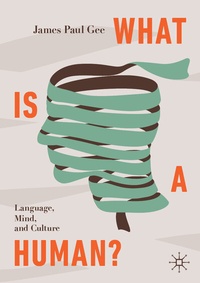
What Is a Human?
Description

In a sweeping synthesis of new research in a number of different disciplines, this book argues that we humans are not who we think we are. As he explores the interconnections between cutting-edge work in bioanthropology, evolutionary biology, neuroscience, human language and learning, and beyond, James Paul Gee advances, also, a personal philosophy of language, learning, and culture, informed by his decades of work across linguistics and the social sciences. Gee argues that our schools, institutions, legal systems, and societies are designed for creatures that do not exist, thus resulting in multiple, interacting crises, such as climate change, failing institutions, and the rise of nationalist nationalism. As Gee constructs an understanding of the human that takes into account our social, collective, and historical nature, as established by recent research, he inspires readers to reflect for themselves on the very question of who we are-a key consideration for anyone interested in society, government, schools, health, activism, culture and diversity, or even just survival.
More details
Other editions
Additional editions
Person
Content
Chapter 1: Introduction.- Part 1.- Chapter 2: Terman.- Chapter 3: Humans.- Chapter 4: More than Animals?.- Chapter 5: Human-Made Monsters.- Chapter 6: Conclusion to Part 1.- Part 2.- Chapter 7: Fetishes.-.Chapter 8: Examples of Fetishes.- Chapter 9: Doubling Fetishes.- Chapter 10: The Imaginarium.- Chapter 11: The Conscious Brain.- Chapter 12: The Gang of Six.- Chapter 13: Language.-Chapter 14: Stress and the State.- Chapter 15. Another Attempt to Answer Our Question.- Chapter 16: Conclusion to Part 2 .- Part 3.- Chapter 17: Inter-Human Artefacts.- Chapter 18: Embodied Meaning.- Chapter 19: Specific Universals.- Chapter 20: Morality.- Chapter 21: The Examined Life.- Chapter 22: Conclusion to Part 3.- Part 4.- Chapter 23: Plug-And-Play.- Chapter 24: Morality Again.- Chapter 25: Affinity.- Chapter 26: Conclusions to Part 4.- Chapter 27: Conclusion to Book.
