

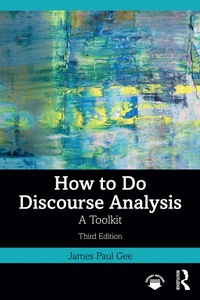
How to Do Discourse Analysis
A Toolkit
3rd Edition
Published on 28. February 2025
244 pages
978-1-040-26277-1 (ISBN)
Description

How to Do Discourse Analysis provides a comprehensive toolkit for conducting discourse analysis, offering 26 practical tools to examine how language is used to construct meaning, enact identities, and shape social realities. Written by renowned linguist James Paul Gee, it introduces key concepts like situated meanings, social languages, and Discourses, showing how language both reflects and creates social contexts.
This essential textbook takes readers through a step-by-step process of analyzing texts and talk, from examining grammar and vocabulary to uncovering underlying ideologies and power dynamics. It covers a wide range of discourse types, from everyday conversations to political speeches and social media posts. Gee draws on diverse examples from education, politics, media, and popular culture to illustrate the tools in action.
While grounded in linguistic theory, the book emphasizes hands-on application. Each tool is accompanied by sample analyses and practice exercises. This new edition incorporates recent developments in digital communication and updates examples for contemporary relevance, making it an ideal resource for advanced undergraduate and postgraduate students working in the areas of applied linguistics, education, psychology, anthropology, and communication.
This bestselling textbook is the ideal companion to An Introduction to Discourse Analysis: Theory and Method also by James Paul Gee.
This essential textbook takes readers through a step-by-step process of analyzing texts and talk, from examining grammar and vocabulary to uncovering underlying ideologies and power dynamics. It covers a wide range of discourse types, from everyday conversations to political speeches and social media posts. Gee draws on diverse examples from education, politics, media, and popular culture to illustrate the tools in action.
While grounded in linguistic theory, the book emphasizes hands-on application. Each tool is accompanied by sample analyses and practice exercises. This new edition incorporates recent developments in digital communication and updates examples for contemporary relevance, making it an ideal resource for advanced undergraduate and postgraduate students working in the areas of applied linguistics, education, psychology, anthropology, and communication.
This bestselling textbook is the ideal companion to An Introduction to Discourse Analysis: Theory and Method also by James Paul Gee.
Reviews / Votes
'The main strengths of How to Do Discourse Analysis and An Introduction to Discourse Analysis lie in the clear, engaging style that makes complicated concepts accessible through the use of metaphor, and the abundance of examples. I would recommend everyone who teaches discourse analysis to have these two books in their inventory, if not as main course books, then for selective use as a collection of readings and exercises.'Daria Dayter, Tampere University, Finland
More details
Edition
3rd edition
Language
English
Place of publication
London
United Kingdom
Publishing group
Taylor & Francis Ltd
Target group
College/higher education
ISBN-13
978-1-040-26277-1 (9781040262771)
Copyright in bibliographic data and cover images is held by Nielsen Book Services Limited or by the publishers or by their respective licensors: all rights reserved.
Schweitzer Classification
Other editions
Additional editions
Book
02/2025
3rd Edition
Routledge
€63.60
Shipment within 10-20 days
Book
02/2025
3rd Edition
Routledge
€207.70
Shipment within 10-20 days

Book
02/2025
Routledge
Unfortunately, price unknown
Available (delivery time upon request)
Person
James Paul Gee is a Regents Professor, Emeritus, at Arizona State University and an elected member of the National Academy of Education. He is the author of many books and papers on linguistics, literacy, discourse analysis, and learning. His books include What Video Games Have to Teach Us About Literacy and Learning (2007), Introducing Discourse: From Grammar to Society (2017), and What Is a Human? (2020).
Content
Introduction
Unit 1: Language and Context
1.1 Grammar
1.2 Language Acquisition
1.3 Speed and Clarity
1.4 Context and Cultural Knowledge
1.5 Making the Taken-for-Granted New and Strange
1.6 Working with The Making Strange Tool
1.7 Deixis
1.8 Working with the Deixis Tool
1.9 Context
1.10 Working with the Fill-In Tool
1.11 Subjects and Predicates
1.12 Working with Subject Tool
1.13 Intonation
1.14 Working with the Intonation Tool
1.15 The Frame Problem
1.16 The Frame Problem in Action
1.17 Working with the Frame Tool
Unit 2: Saying, Doing, and Designing
2.1 People Do things with Language, Not Just Say Things
2.2 Working with Doing and Not Just Saying Tool
2.3 Grammar as Tools for Structure and Meaning
2.4 Working with the Grammar as Choice Tool
2.5 Vocabulary
2.6 Working with the Vocabulary Tool
2.7 Topics and Themes
2.8 Working with the Topic and Theme Tool
2.9 Stanzas
2.10 Working with the Stanza Tool
Unit 3: Building Things in the World
3.1 Building Tasks
3.2 Building Things with Language
3.3 An Example: A Collaboration around Oral History
3.4 The Context is Reflexive Tool
3.5 Working with the Context is Reflexive Tool
3.6 Working with the Significance Building Tool
3.7 Working with the Practices/Activities Building Tool
3.8 Working with the Identities Building Tool
3.9 Working with the Relationships Building Tool
3.10 Working with the Politics Building Tool
3.11 Working with the Connections Building Tool
3.12 Working with the Sign Systems and Knowledge Building Tool
3.13 Topic Flow or Topic Chaining Tool
3.14 Working with the Topic Flow or Topic Chaining Tool
Unit 4: Theoretical Tools
4.1 Six Theoretical Tools
4.2 The Situational Meaning Tool
4.3 Working with the Situational Meaning Tool
4.4 The Social Languages Tool
4.5 Working with the Social Languages Tool
4.6 The Intertextuality Tool
4.7 Working with the Intertextuality Tool
4.8 The Figured Worlds Tool
4.9 Working with the Figured Worlds Tool
4.10 The Big "D" Discourse Tool
4.11 Working with the Big "D" Discourse Tool
4.12 Notes about Discourses
4.13 Notes about DiscoursesThe Big "C" Conversation Tool
4.14 Working with the Big "C" Conversation Tool
4.15 Conclusion
Unit 1: Language and Context
1.1 Grammar
1.2 Language Acquisition
1.3 Speed and Clarity
1.4 Context and Cultural Knowledge
1.5 Making the Taken-for-Granted New and Strange
1.6 Working with The Making Strange Tool
1.7 Deixis
1.8 Working with the Deixis Tool
1.9 Context
1.10 Working with the Fill-In Tool
1.11 Subjects and Predicates
1.12 Working with Subject Tool
1.13 Intonation
1.14 Working with the Intonation Tool
1.15 The Frame Problem
1.16 The Frame Problem in Action
1.17 Working with the Frame Tool
Unit 2: Saying, Doing, and Designing
2.1 People Do things with Language, Not Just Say Things
2.2 Working with Doing and Not Just Saying Tool
2.3 Grammar as Tools for Structure and Meaning
2.4 Working with the Grammar as Choice Tool
2.5 Vocabulary
2.6 Working with the Vocabulary Tool
2.7 Topics and Themes
2.8 Working with the Topic and Theme Tool
2.9 Stanzas
2.10 Working with the Stanza Tool
Unit 3: Building Things in the World
3.1 Building Tasks
3.2 Building Things with Language
3.3 An Example: A Collaboration around Oral History
3.4 The Context is Reflexive Tool
3.5 Working with the Context is Reflexive Tool
3.6 Working with the Significance Building Tool
3.7 Working with the Practices/Activities Building Tool
3.8 Working with the Identities Building Tool
3.9 Working with the Relationships Building Tool
3.10 Working with the Politics Building Tool
3.11 Working with the Connections Building Tool
3.12 Working with the Sign Systems and Knowledge Building Tool
3.13 Topic Flow or Topic Chaining Tool
3.14 Working with the Topic Flow or Topic Chaining Tool
Unit 4: Theoretical Tools
4.1 Six Theoretical Tools
4.2 The Situational Meaning Tool
4.3 Working with the Situational Meaning Tool
4.4 The Social Languages Tool
4.5 Working with the Social Languages Tool
4.6 The Intertextuality Tool
4.7 Working with the Intertextuality Tool
4.8 The Figured Worlds Tool
4.9 Working with the Figured Worlds Tool
4.10 The Big "D" Discourse Tool
4.11 Working with the Big "D" Discourse Tool
4.12 Notes about Discourses
4.13 Notes about DiscoursesThe Big "C" Conversation Tool
4.14 Working with the Big "C" Conversation Tool
4.15 Conclusion
