

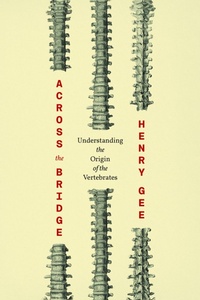
Across the Bridge
Understanding the Origin of the Vertebrates
1st Edition
Published on 22. December 2022
288 pages
978-0-226-40319-9 (ISBN)
Description

"Addresses an important topic for biologists and zoologists about vertebrates' place in the 'grand scheme'... genuinely witty and charming... magnificent." -Neil J. Gostling, University of Southampton
Our understanding of vertebrate origins and the backbone of human history evolves with each new fossil find and DNA map. Many species have now had their genomes sequenced, and molecular techniques allow genetic inspection of even non-model organisms. But as longtime Nature editor Henry Gee argues in Across the Bridge, despite these giant strides and our deepening understanding of how vertebrates fit into the tree of life, the morphological chasm between vertebrates and invertebrates remains vast and enigmatic.
As Gee shows, even as scientific advances have falsified a variety of theories linking these groups, the extant relatives of vertebrates are too few for effective genetic analysis. Moreover, the more we learn about the species that do remain-from sea-squirts to starfish-the clearer it becomes that they are too far evolved along their own courses to be of much use in reconstructing what the latest invertebrate ancestors of vertebrates looked like. Fossils present yet further problems of interpretation. Tracing both the fast-changing science that has helped illuminate the intricacies of vertebrate evolution as well as the limits of that science, Across the Bridge helps us to see how far the field has come in crossing the invertebrate-to-vertebrate divide-and how far we still have to go.
"A beautiful ode to some of the least appreciated animals... guides the reader joyfully through deuterostomes-weaving disparate elements of embryology, paleontology, and morphology into an unprecedented and accessible narrative." -Jakob Vinther, University of Bristol
Our understanding of vertebrate origins and the backbone of human history evolves with each new fossil find and DNA map. Many species have now had their genomes sequenced, and molecular techniques allow genetic inspection of even non-model organisms. But as longtime Nature editor Henry Gee argues in Across the Bridge, despite these giant strides and our deepening understanding of how vertebrates fit into the tree of life, the morphological chasm between vertebrates and invertebrates remains vast and enigmatic.
As Gee shows, even as scientific advances have falsified a variety of theories linking these groups, the extant relatives of vertebrates are too few for effective genetic analysis. Moreover, the more we learn about the species that do remain-from sea-squirts to starfish-the clearer it becomes that they are too far evolved along their own courses to be of much use in reconstructing what the latest invertebrate ancestors of vertebrates looked like. Fossils present yet further problems of interpretation. Tracing both the fast-changing science that has helped illuminate the intricacies of vertebrate evolution as well as the limits of that science, Across the Bridge helps us to see how far the field has come in crossing the invertebrate-to-vertebrate divide-and how far we still have to go.
"A beautiful ode to some of the least appreciated animals... guides the reader joyfully through deuterostomes-weaving disparate elements of embryology, paleontology, and morphology into an unprecedented and accessible narrative." -Jakob Vinther, University of Bristol
More details
Other editions
Additional editions
Book
07/2018
University of Chicago Press
€69.95
Article exhausted; check different version
Person
Henry Gee is a senior editor at
Nature and the author of such books as
Jacob's Ladder,
In Search of Deep Time,
The Science of Middle-earth, and, most recently,
The Accidental Species: Misunderstandings of Human Evolution, the last published by the University of Chicago Press. He lives in Cromer, Norfolk, England, with his family and numerous pets.
Content
- Intro
- Contents
- Preface
- Chapter One : What Is a Vertebrate?
- 1.1 Vertebrates in Context
- 1.2 What Makes a Vertebrate?
- 1.3 Breaking Branches
- 1.4 Summary
- Chapter Two : Shaking the Tree
- 2.1 Embranchements and Transformation
- 2.2 Evolution and Ancestors
- 2.3 Summary
- Chapter Three : Embryology and Phylogeny
- 3.1 From Embryos to Desperation
- 3.2 Genes and Phylogeny
- 3.3 Summary
- Chapter Four : Hox and Homology
- 4.1 A Brief History of Homeosis
- 4.2 The Geoffroy Inversion
- 4.3 The Phylotypic Stage
- 4.4 The Meaning of Homology
- 4.5 Summary
- Chapter Five : What Is a Deuterostome?
- Chapter Six : Echinoderms
- Chapter Seven : Hemichordates
- Chapter Eight : Amphioxus
- Chapter Nine : Tunicates
- Chapter Ten : Vertebrates
- Chapter Eleven : Some Non- deuterostomes
- Chapter Twelve : Vertebrates from the Outside, In
- 12.1 Introduction
- 12.2 The Organizer
- 12.3 The Notochord
- 12.4 Somitogenesis
- 12.5 Segmentation and the Head Problem
- 12.6 The Nervous System
- 12.7 Neural Crest and Cranial Placodes
- 12.8 The Skeleton
- 12.9 Summary
- Chapter Thirteen : How Many Sides Has a Chicken?
- 13.1 Introduction
- 13.2 The Enteric Nervous System
- 13.3 The Head and the Heart
- 13.4 The Urogenital System
- 13.5 The Gut and Its Appendages
- 13.6 Immunity
- 13.7 The Pituitary Gland
- 13.8 Summary
- Chapter Fourteen : Some Fossil Forms
- 14.1 Fossils in an Evolutionary Context
- 14.2 Meiofaunal Beginnings
- 14.3 Cambroernids
- 14.4 Vetulicystids
- 14.5 Vetulicolians
- 14.6 Yunnanozoans
- 14.7 Pikaia
- 14.8 Cathaymyrus
- 14.9 The Earliest Fossil Vertebrates
- 14.10 Conodonts
- 14.11 Ostracoderms and Placoderms
- 14.12 Summary
- Chapter Fifteen : Breaking Branches, Building Bridges
- 15.1 Defi ning the Deuterostomes
- 15.2 Ambulacraria
- 15.3 Echinoderms
- 15.4 Hemichordates
- 15.5 Chordates
- 15.6 Amphioxus
- 15.7 The Common Ancestry of Tunicates and Vertebrates
- 15.8 Tunicates
- 15.9 Vertebrates
- 15.10 Cyclostomes
- 15.11 Gnathostomes
- 15.12 The Evolution of the Face
- 15.13 Crossing the Bridge
- 15.14 Conclusions
- Notes
- References
- Index
