

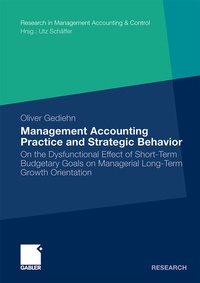
Management Accounting Practice and Strategic Behavior
On the Dysfunctional Effect of Short-Term Budgetary Goals on Managerial Long-Term Growth Orientation
Published on 10. March 2010
XV, 195 pages
978-3-8349-8606-1 (ISBN)
Description

Dr. Oliver Gediehn completed his doctoral thesis at the Chair of Management Accounting and Control at the European Business School, Oestrich-Winkel. He works as a consultant in Berlin.
More details
Other editions
Additional editions
Oliver Gediehn
Management Accounting Practice and Strategic Behavior
On the Dysfunctional Effect of Short-Term Budgetary Goals on Managerial Long-Term Growth Orientation
Book
02/2010
Springer Gabler
€59.99
Shipment within 7-9 days
Persons
Dr. Oliver Gediehn completed his doctoral thesis at the Chair of Management Accounting and Control at the European Business School, Oestrich-Winkel. He works as a consultant in Berlin.
Content
Structuration Theory and Management Accounting Research.- Management Accounting and Managerial Long-Term Orientation.- Research Design.- Field Interviews.- Questionnaire Survey.- Discussion and Outlook.
A Introduction (p. 1)
"Without continual growth and progress, such words as improvement, achievement, and success have no meaning." Benjamin Franklin
1. Research Issue and Objectives
Achieving sustainable sales growth has recently been among the most important topics for business managers in large corporations. Practitioner journals portrait companies in a "do-or-die struggle" for sustained and profitable growth and explore the sources, drivers, and processes of growth.
The attempt to achieve a favorable long-term sales growth trajectory complements the continuous strive for profitability and operational excellence - and creates a latent conflict between short-term efforts for profitability and long-term concerns for growth. Academic research mirrors this conflict and its implications in the stream of literature devoted to the balancing of short-term goal achievement and the encouragement of strategic management behavior or, more generally, managerial long-term orientation.
While short-term goal achievement relates mostly to the attainment of budgetary targets8 or financial planning targets, in general, the operationalization of strategic behavior and long-term orientation is manifold.
It includes the strive for strategic renewal, innovation and adaptation, the concern for long-term positioning and growth, as well as the pursuit of entrepreneurial initiatives. A prominent topic of this stream of research is the role and relevance of management accounting.
To the most part, researchers see current management accounting systems and practices as functional with respect to short-term goal achievement but as dysfunctional or at least problematic with respect to the encouragement of strategic management behavior.
The literature on `economic short-termism` for example proposes the short-term focus on "flawed" management (accounting) practices as one potential root cause for myopic management behavior. Similarly, the Reliance on Accounting Performance Measures (RAPM) research stream assigns an excessive short-term focus as dysfunctional effect to the traditional (accounting-based) management control system.
A common characteristic of these two streams of research is the narrow quantitative empirical base. The impact of the allegedly flawed management practices on economic short-termism builds largely on theoretical arguments while the scarce empirical evidence is only circumstantial or anecdotal in nature.
The various dysfunctional consequences of RAPM including motivational aspects of job satisfaction or jobrelated tension as well as behavioral aspects such as tactical gaming or data manipulation are subjects of extensive empirical research. Yet, only few studies deal with the particular issue of managerial long-term orientation and those that do, fail to deliver conclusive results due to conceptual and methodological limitations.
In summary, the existing management accounting literature "is still inconclusive" to answer as to whether current management accounting practices and in particular the dominant RAPM practice have a dysfunctional effect on managerial long-term orientation. Consequently, the study responds to Van der Stede`s (2000, p. 120) call for future research on this topic and aims to render a more definite answer on the existence of the dysfunctional effect ideally reconciling the previous anecdotal and quantitative empirical evidence.
Reflecting the currently prevailing concern for growth in practice, the study explicitly addresses long-term growth orientation as an element of strategic management behavior and the more inclusive notion of managerial longterm orientation. This approach results in the following first research question guiding the study:
Does RAPM have a dysfunctional effect on managerial long-term growth orientation?
The study is conducted in the tradition of Hopwood`s call to study management accounting "in the context in which it operates".
"Without continual growth and progress, such words as improvement, achievement, and success have no meaning." Benjamin Franklin
1. Research Issue and Objectives
Achieving sustainable sales growth has recently been among the most important topics for business managers in large corporations. Practitioner journals portrait companies in a "do-or-die struggle" for sustained and profitable growth and explore the sources, drivers, and processes of growth.
The attempt to achieve a favorable long-term sales growth trajectory complements the continuous strive for profitability and operational excellence - and creates a latent conflict between short-term efforts for profitability and long-term concerns for growth. Academic research mirrors this conflict and its implications in the stream of literature devoted to the balancing of short-term goal achievement and the encouragement of strategic management behavior or, more generally, managerial long-term orientation.
While short-term goal achievement relates mostly to the attainment of budgetary targets8 or financial planning targets, in general, the operationalization of strategic behavior and long-term orientation is manifold.
It includes the strive for strategic renewal, innovation and adaptation, the concern for long-term positioning and growth, as well as the pursuit of entrepreneurial initiatives. A prominent topic of this stream of research is the role and relevance of management accounting.
To the most part, researchers see current management accounting systems and practices as functional with respect to short-term goal achievement but as dysfunctional or at least problematic with respect to the encouragement of strategic management behavior.
The literature on `economic short-termism` for example proposes the short-term focus on "flawed" management (accounting) practices as one potential root cause for myopic management behavior. Similarly, the Reliance on Accounting Performance Measures (RAPM) research stream assigns an excessive short-term focus as dysfunctional effect to the traditional (accounting-based) management control system.
A common characteristic of these two streams of research is the narrow quantitative empirical base. The impact of the allegedly flawed management practices on economic short-termism builds largely on theoretical arguments while the scarce empirical evidence is only circumstantial or anecdotal in nature.
The various dysfunctional consequences of RAPM including motivational aspects of job satisfaction or jobrelated tension as well as behavioral aspects such as tactical gaming or data manipulation are subjects of extensive empirical research. Yet, only few studies deal with the particular issue of managerial long-term orientation and those that do, fail to deliver conclusive results due to conceptual and methodological limitations.
In summary, the existing management accounting literature "is still inconclusive" to answer as to whether current management accounting practices and in particular the dominant RAPM practice have a dysfunctional effect on managerial long-term orientation. Consequently, the study responds to Van der Stede`s (2000, p. 120) call for future research on this topic and aims to render a more definite answer on the existence of the dysfunctional effect ideally reconciling the previous anecdotal and quantitative empirical evidence.
Reflecting the currently prevailing concern for growth in practice, the study explicitly addresses long-term growth orientation as an element of strategic management behavior and the more inclusive notion of managerial longterm orientation. This approach results in the following first research question guiding the study:
Does RAPM have a dysfunctional effect on managerial long-term growth orientation?
The study is conducted in the tradition of Hopwood`s call to study management accounting "in the context in which it operates".
