

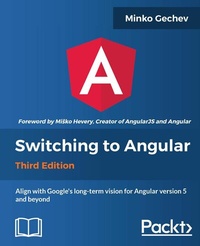
Switching to Angular
Align with Google's long-term vision for Angular version 5 and beyond
3rd Edition
Published on 8. July 2025
280 pages
978-1-78862-945-4 (ISBN)
Description

No detailed description available for "Switching to Angular".
All prices
More details
Edition
3rd Revised edition
Language
English
Place of publication
Birmingham
United Kingdom
Target group
Professional and scholarly
US School Grade: College Graduate Student
Edition type
Revised edition
File size
3,32 MB
ISBN-13
978-1-78862-945-4 (9781788629454)
Copyright in bibliographic data and cover images is held by Nielsen Book Services Limited or by the publishers or by their respective licensors: all rights reserved.
Schweitzer Classification
Other editions
Additional editions
Person
Gechev Minko :
Minko Gechev is a Google Developer Expert for the Angular team and a presenter at over 40 worldwide conferences, including ng-conf, AngularConnect, AngularUP, and many others. Minko is co-author of the official Angular style guide, and has developed codelyzer - a tool for static analysis of Angular applications and best practices, which is part of the Angular CLI, and currently has over a million downloads each month. Minko is a former member of the Angular Mobile Team where his role involved him with tools for facilitating the process of developing Progressive web applications with Angular easier. Other projects by the author include the AngularJS style guide, which is translated to 13 different languages, aspect.js, Angular Seed, and many others. Minko Gechev is co-founder and CTO at Rhyme and strongly believes in open source software.
Minko Gechev is a Google Developer Expert for the Angular team and a presenter at over 40 worldwide conferences, including ng-conf, AngularConnect, AngularUP, and many others. Minko is co-author of the official Angular style guide, and has developed codelyzer - a tool for static analysis of Angular applications and best practices, which is part of the Angular CLI, and currently has over a million downloads each month. Minko is a former member of the Angular Mobile Team where his role involved him with tools for facilitating the process of developing Progressive web applications with Angular easier. Other projects by the author include the AngularJS style guide, which is translated to 13 different languages, aspect.js, Angular Seed, and many others. Minko Gechev is co-founder and CTO at Rhyme and strongly believes in open source software.
Content
- Cover
- Title Page
- Copyright
- Credits
- Foreword
- About the Author
- www.PacktPub.com
- Customer Feedback
- Table of Contents
- Preface
- Chapter 1: Switching to the One Angular
- Introducing the One Angular
- From AngularJS to Angular
- The new beginning
- Angular and SemVer
- Summary
- Chapter 2: Get Going with Angular
- The evolution of the web - time for a new framework
- The evolution of ECMAScript
- Web components
- Web workers
- Lessons learned from AngularJS in the wild
- Controllers
- Scope
- Dependency injection
- Server-side rendering
- Applications that scale
- Templates
- Change detection
- Summary
- Chapter 3: The Building Blocks of an Angular Application
- A conceptual overview of Angular
- Changing directives
- Getting to know Angular components
- Components in action
- Components in Angular
- Angular modules
- Bootstrapping an Angular application
- Pipes
- Defining pipes
- Improving change detection
- Classical change detection
- Change detection in AngularJS
- In zone.js
- Simplified data flow
- Enhancing AngularJS's change detection
- Services
- The new router
- Angular route definition syntax
- Summary
- Chapter 4: TypeScript Crash Course
- Introduction to TypeScript
- Compile-time type checking
- Better support by text editors and IDEs
- There's even more to TypeScript
- Using TypeScript
- Installing TypeScript with npm
- Running our first TypeScript program
- TypeScript syntaxes and features introduced by ES2015 and ES2016
- ES2015 arrow functions
- Using the ES2015 and ES2016 classes
- Defining variables with block scope
- Meta-programming with ES2016 decorators
- Using configurable decorators
- Writing modular code with ES2015
- Using the ES2015 module syntax
- Taking advantage of the implicit asynchronous behavior of the module
- Using aliases
- Importing all the module exports
- Default exports
- ES2015 module loader
- ES2015 and ES2016 recap
- Taking advantage of static typing
- Using explicit type declarations
- The any type
- Understanding the primitive types
- The Enum types
- Understanding the object types
- The array types
- The Function types
- Defining classes
- Using access modifiers
- Defining interfaces
- Interface inheritance
- Implementing multiple interfaces
- Further expressiveness with TypeScript decorators
- Writing generic code using type parameters
- Using generic functions
- Having multiple type parameters
- Writing less verbose code with the type inference of TypeScript
- Best common type
- Contextual type inference
- Introducing structural typing
- Using ambient type definitions
- Using predefined ambient type definitions
- Custom ambient type definitions
- Summary
- Chapter 5: Getting Started with Angular Components and Directives
- The "Hello world!" application in Angular
- Setting up our environment
- Installing the sample project repository
- Using Angular and TypeScript
- Using Angular directives
- The ngFor directive
- Improved semantics of the directives syntax
- Declaring variables inside a template
- Using syntax sugar in templates
- Defining Angular directives
- Setting the directive's inputs
- Understanding the directive's constructor
- Better encapsulation of directives with NgModules
- Using NgModules for declaring reusable components
- Using the custom element schema
- Creating custom Angular components
- Introducing the component's view encapsulation
- Implementing the component's controllers
- Handling user actions
- Using inputs and outputs
- Determining the inputs and outputs
- Defining the inputs and outputs
- Passing inputs and consuming the outputs
- Event bubbling
- Renaming the inputs and outputs
- An alternative syntax to define inputs and outputs
- Explaining Angular's content projection
- Basic content projection in Angular
- Projecting multiple content chunks
- Nesting components
- Using view children and content children
- View child versus content child
- Hooking into the component's life cycle
- Order of execution of the life cycle hooks
- Defining generic views with TemplateRef
- Understanding and enhancing the change detection
- The order of execution of the change detectors
- Understanding Angular's change detection strategies
- Introducing immutable data structures and OnPush
- Using immutable data in Angular
- Summary
- Chapter 6: Dependency Injection in Angular
- Why do I need dependency injection?
- Dependency injection in Angular
- Benefits of using dependency injection
- Declaring providers
- Using the @Injectable decorator
- Introducing forward references
- Configuring providers
- Using existing providers
- Defining factories for instantiating services
- Declaring optional dependencies
- Understanding multiproviders
- Child injectors and visibility
- Instantiating an injector
- Building a hierarchy of injectors
- Using dependency injection with components and directives
- Introducing the element injectors
- Declaring providers for the element injectors
- Exploring dependency injection with components
- View providers versus providers
- Using the @SkipSelf decorator
- Summary
- Chapter 7: Working with the Angular Router and Forms
- Developing the "Coders repository" application
- Exploring the Angular router
- Using PathLocationStrategy
- Configuring routes
- Using routerLink and router-outlet
- Lazy-loading with loadChildren
- Prefetching of the lazy-loaded routes
- RouterModule.forRoot versus RouterModule.forChild
- Using Angular's forms module
- Developing template-driven forms
- Digging into the markup of the template-driven form
- Using the built-in validators
- Defining custom validators
- Using select inputs with Angular
- Using the NgForm directive
- Two-way data binding with Angular
- Storing the form data
- Listing all the stored data
- Summary
- Chapter 8: Explaining Pipes and Communicating with RESTful Services
- Developing model-driven forms in Angular
- Using composition of control validators
- Exploring the HTTP module of Angular
- Using Angular's HTTP module
- Defining parameterized views
- Defining nested routes
- Transforming data with pipes
- Developing stateless pipes
- Using Angular's built-in pipes
- Developing stateful pipes
- Using stateful pipes
- Using Angular's AsyncPipe
- Using AsyncPipe with observables
- Summary
- Chapter 9: Tooling and Development Experience
- Running an application in a web worker
- Web workers and Angular
- Bootstrapping an application running in a web worker
- Migrating an application to web workers
- Making an application compatible with web workers
- Initial load of a single-page application
- Initial load of a single-page application with server-side rendering
- Server-side rendering with Angular
- Enhancing our development experience
- Text editors and IDEs
- Angular language service
- Bootstrapping a project with angular-cli
- Using angular-cli
- Angular quick starters
- Angular seed
- Angular webpack starter
- Ahead-of-time compilation in Angular
- How code generation works
- Introducing the concept of ahead-of-time compilation
- Constraints of the ahead-of-time compilation
- How to use the ahead-of-time compilation of Angular
- Summary
- Index

