

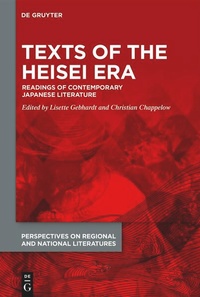
Texts of the Heisei Era
Readings of Contemporary Japanese Literature
1st Edition
Published on 4. December 2025
VI, 148 pages
978-3-11-221292-9 (ISBN)
Description

This volume with contributions on the literature of the Heisei era (1989-2019) contains analyses of contemporary Japanese literature. It presents authors such as Shimada Masahiko, Abe Kazushige, Tawada Yôko and Shôno Yoriko, who use sophisticated, self-reflective language and subversive arguments against systems of power to criticize the times in the context of the question of national identity and transculturality.
More details
Other editions
Additional editions
Lisette Gebhardt | Christian Chappelow
Texts of the Heisei Era
Readings of Contemporary Japanese Literature
E-Book
12/2025
1st Edition
De Gruyter
€99.95
Available for download
Lisette Gebhardt | Christian Chappelow
Texts of the Heisei Era
Readings of Contemporary Japanese Literature
Book
12/2025
1st Edition
De Gruyter
€99.95
Shipment within 5-7 days
Persons
Lisette Gebhardt
, Goethe-Universität, Frankfurt a.M.;
Christian Chappelow
, Goethe-Universität, Frankfurt a.M.
Content
- Intro
- Foreword
- Contents
- War Memory and the Emperor: Late-Work Poetry by Wakamatsu Jotaro (1935-2021)
- 1 Introduction: Warnings of a post-war author
- 2 Critical perspectives on the Japanese present - Generationality and regionality in a contemporary Japanese literature
- 3 Zeitenwende - Texts for a post-democratic Japan?
- 4 After the war is before the war? Pacifist poems in times of remilitarization
- 5 The symbolic figure of the emperor
- 6 Final thoughts
- 7 Interview with Wakamatsu Jotaro
- Bibliography
- Japanese "Masochism" in the Literature of Shimada Masahiko
- 1 The topic of Japanese subjectivity in Shimada's fiction
- 2 A short history of cultural masochism within Japanese literature
- 3 Political masochism and symbolic castration in Japanese-US relations
- 4 The double bind of nationalism
- 5 Symbolic castration and sophisticated masochism
- 6 Symbolic castration and a global Japan
- 7 Conclusion
- Bibliography
- The Challenges of Ribi Hideo's Border-Crossing Writing: The "Alley" (roji) in China
- 1 Introduction
- 2 Mapping criticisms of Japanese border-crossing literature
- 3 Writing about China in Japanese
- 4 Discovering the "own home at the end of alleys"
- 5 Manshu ekusupuresu or "home to go back to"
- 6 Henri Takeshi Rewitsuki no natsu no kiko or the indefinable identity
- 7 Gaze or in search for the "own home" that does not exist anymore
- 8 Conclusion
- Bibliography
- Dissecting Social Malaise in Literature: Abe Kazushige's Textual Interplay with the Heisei Era
- 1 Introduction
- 2 Sketching contemporary social malaise in Japan
- 3 The literature of social malaise
- 4 Abe Kazushige: Fantasies of power
- 5 Nipponia Nippon: Isolation and obsession
- 6 Conclusions
- Bibliography
- Shono Yoriko: Literature as a Battlefield
- 1 The writer and her means of struggle. From "nameless" to "heretical" writer of pure literature
- 2 The urge for pure literature
- 3 Preserving women's sanctuary
- 4 Instead of a conclusion
- Bibliography
- The State as the Enemy: Kurokawa So's Iwaba no ue kara - Subversive Citizens in the Post-Fukushima mirai shosetsu and the Japanese Political Entertainment Literature
- 1 A short exploration of Heisei literature
- The main causes for the situation can be summarized in four parts
- 2 Kurokawa So: A little-known author and the post-Fukushima mirai shosetsu
- 3 A regime and its power games: War, nuclear waste, technospheres
- 4 Civil resistance: A political lesson
- 5 Criticism of the state and the freedom of expression
- 6 Subversive entertainment: A different Japanese literature?
- Bibliography
- About the Contributors
- Name Index
- Subject Index
