

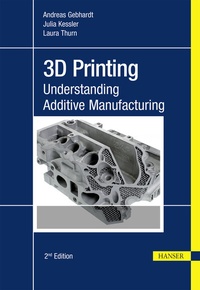
3D Printing
Understanding Additive Manufacturing
2nd Edition
Published on 13. November 2018
220 pages
978-1-56990-703-0 (ISBN)
Description

This book is a clear and concise guide to Additive Manufacturing (AM), now a well-established valuable tool for making models and prototypes, and also a manufacturing method for molds and final parts finding applications in industries such as medicine, car manufacturing, and aerospace engineering.
The book was designed as a supporting material for special courses on advanced manufacturing technology, and for supplementing the content of traditional manufacturing lessons.
This second edition has been updated to account for the recent explosion of availability of small, inexpensive 3D printers for domestic use, as well as new industrial printers for series production that have come onto the market.
Contents:
Basics of 3D Printing Technology
Additive Manufacturing Processes/3D Printing
The Additive Manufacturing Process Chain and Machines for Additive Manufacturing
Applications of Additive Manufacturing
Perspectives and Strategies of Additive Manufacturing
Materials and Design
Glossary of Terms, Abbreviations, and Definitions
More details
Other editions
Additional editions
E-Book
12/2018
2nd Edition
Hanser Publications
€89.99
Available for download
Book
11/2018
2nd Edition
Hanser Publications
€89.99
Shipment within 3-4 weeks
Persons
Author
Dr.-Ing. Andreas Gebhardt studierte an der technischen Hochschule Aachen Maschinenbau mit dem Schwerpunkt Motoren- und Turbinenbau. Nach Stationen als Geschäftsführer in der mittelständischen Wirtschaft wurde er zum Sommersemester 2000 als Professor für Hochleistungsverfahren der Fertigungstechnik und Rapid Prototyping an die Fachhochschule Aachen berufen. Dort leitet er eine Forschergruppe und Labore zum Lasersintern von Metallen (SLM Verfahren), Polymerdrucken, 3D-Drucken (Pulver-Binder Verfahren), Extrusionsverfahren (FDM) und zum Einsatz unterschiedlicher Fabber. Seit dem Wintersemester 2000 ist Andreas Gebhardt Gastprofessor am City College der City University New York.
2004 gründete er das RTeJournal (www.rtejournal.de), eine "open-access" online-Zeitschrift für Rapid Technology und ist dessen Herausgeber.
ISNI:
ISNI:
Dr.-Ing. Julia Kessler schloss ihr Studium als Bachelor für Biomedizintechnik und als Master für Produktentwicklung an der Fachhochschule Aachen ab. Von 2012 bis 2015 war sie wissenschaftliche Mitarbeiterin in der Forschungsgruppe GoetheLab for Additive Manufacturing der Fachhochschule Aachen. Von 2015 bis 2017 leitete sie das GoetheLab-Team, das sich mit der Additiven Fertigung von Metallen, Kunststoffen und Keramiken beschäftigt. Im Oktober 2017 legte sie die Doktorprüfung erfolgreich ab. Im Jahr 2015 wurde sie zur Geschäftsführerin der IwF GmbH ernannt, die der Fachhochschule Aachen in Form eines An-Instituts angegliedert ist.
ISNI:
ISNI:
Content
- Intro
- Contents
- V Preface
- VII Acknowledgments
- IX About the Authors
- 1 Basics of 3D Printing Technology
- 1.1 Basic Terms and Definitions
- 1.1.1 Additive Manufacturing
- 1.1.2 The Principle of Layer-Based Processes
- 1.2 Application Levels
- 1.2.1 Direct Processes
- 1.2.1.1 Rapid Prototyping
- 1.2.1.2 Rapid Manufacturing
- 1.2.1.3 Rapid Tooling
- 1.2.2 Indirect Processes
- 1.2.2.1 Indirect Prototyping
- 1.2.2.2 Indirect Tooling
- 1.2.2.3 Indirect Manufacturing
- 1.3 Classification of Machines for Additive Manufacturing
- 1.3.1 Generic Terms for AM Machines
- 1.3.2 Classification of Machines and Properties of Parts
- 1.4 Conclusions
- 1.5 Questions
- 2 Additive Manufacturing Processes/3D Printing
- 2.1 Direct Additive Processes
- 2.1.1 Polymerization
- 2.1.1.1 Laser-Stereolithography (LS)
- 2.1.1.2 Polymer Printing and Polymer Jetting
- 2.1.1.3 Digital Light Processing
- 2.1.1.4 Micro Stereolithography
- 2.1.2 Sintering and Melting
- 2.1.2.1 Laser Sintering/Selective Laser Sintering (LS/SLS)
- 2.1.2.2 Laser Melting/Selective Laser Melting (SLM)
- 2.1.2.3 Electron Beam Melting
- 2.1.3 Extrusion/Fused Layer Modeling
- 2.1.4 Powder-Binder Process
- 2.1.4.1 3D Printer-3D Systems/Z Corporation
- 2.1.4.2 Metal and Sand Printer-ExOne
- 2.1.4.3 3D Printing System-Voxeljet
- 2.1.5 Layer Laminate Manufacturing (LLM)
- 2.1.5.1 Laminated Object Manufacturing (LOM)
- 2.1.5.2 Selective Deposition Lamination (SDL)
- 2.1.5.3 LLM Machines for Metal Parts
- 2.1.6 Hybrid Processes
- 2.1.6.1 Controlled Metal Buildup (CMB)
- 2.1.6.2 Direct Metal Deposition (DMD)
- 2.1.6.3 Extruding and Milling-Big Area Additive Manufacturing (BAAM)
- 2.1.7 Further Processes
- 2.1.7.1 Aerosol Printing
- 2.1.7.2 Bioplotter
- 2.2 Indirect Processes/Follow-Up Processes
- 2.3 Conclusions
- 2.4 Questions
- 3 The Additive Manufacturing Process Chain and Machines for Additive Manufacturing
- 3.1 Data Processing and Process Chains
- 3.1.1 AM Process Chain
- 3.1.1.2 Process Chain: Rapid Manufacturing
- 3.1.1.1 Process Chain: Rapid Prototyping
- 3.1.2 Data Structure, Errors, and Repair
- 3.2 Machines for Additive Manufacturing
- 3.2.1 Personal Printers
- 3.2.1.1 Fabber and Do-It-Yourself Printers (DIY)
- 3.2.1.2 Desktop Printers
- 3.2.2 Professional Printers
- 3.2.3 Production Printers
- 3.2.4 Industrial Printers
- 3.3 Conclusions and Outlook
- 3.4 Questions
- 4 Applications of Additive Manufacturing
- 4.1 Automotive Industry and Sub-Suppliers
- 4.1.1 Automobile-Interior Components
- 4.1.2 Automobile Exterior Components
- 4.2 Aerospace Industry
- 4.3 Consumer Goods
- 4.4 Toy Industry
- 4.5 Art and History of Art
- 4.6 Mold and Die Making (Rapid Tooling)
- 4.7 Medical Engineering
- 4.8 Architecture and Landscaping
- 4.9 Miscellaneous Applications
- 4.9.1 Mathematical Functions
- 4.9.2 3D Decoration Objects and Ornaments
- 4.9.3 Aerodynamic and Freeform Objects
- 4.10 Conclusions
- 4.11 Questions
- 5 Perspectives and Strategies of Additive Manufacturing
- 5.1 Potential of Additive Manufacturing
- 5.1.1 Complex Geometries
- 5.1.2 Integrated Geometry
- 5.1.3 Integrated Functions
- 5.1.4 Multi-Material Parts and Graded Materials
- 5.2 Strategies of Additive Manufacturing Processes
- 5.2.1 Customized Mass Production
- 5.2.1.1 One-of-a-Kind and Small Batch Production
- 5.2.1.2 Individualization
- 5.2.1.3 Personalization
- 5.2.2 Personal Production
- 5.2.3 Distributed Individualized Production
- 5.3 Conclusions
- 5.4 Questions
- 6 Materials and Design
- 6.1 Materials
- 6.1.1 Anisotropic Properties
- 6.1.2 Isotropic Basic Materials
- 6.1.2.1 Plastics
- 6.1.2.2 Metals
- 6.1.2.3 Ceramic Materials
- 6.1.2.4 Composite Materials
- 6.1.2.5 Further Materials
- 6.1.3 Graded Materials and Composite Materials
- 6.2 Construction-Engineering Design
- 6.2.1 Tolerances-From the Digital Design to the Part
- 6.2.2 Design Freedom
- 6.2.3 Relative Fit
- 6.2.4 Flexures, Hinges, and Snap-Fits
- 6.2.5 Orientation and Positioning of Parts in the Build Space
- 6.2.6 Bores (Holes), Gaps, Pins, and Walls
- 6.3 Selection Criteria and Process Organization
- 6.4 Conclusions and Outlook
- 6.5 Questions
- 7 Glossary
- Index
