

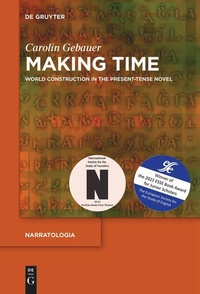
Making Time
World Construction in the Present-Tense Novel
1st Edition
Published on 19. April 2021
XVII, 378 pages
978-3-11-070813-4 (ISBN)
Description

2023 Perkins Prize of the International Society for the Study of Narrative
ESSE Book Award for Junior Scholars for a book in the field of Literatures in the English Language
Responding to the current surge in present-tense novels, Making Time is an innovative contribution to narratological research on present-tense usage in narrative fiction. Breaking with the tradition of conceptualizing the present tense purely as a deictic category denoting synchronicity between a narrative event and its presentation, the study redefines present-tense narration as a fully-fledged narrative strategy whose functional potential far exceeds temporal relations between story and discourse. The first part of the volume presents numerous analytical categories that systematically describe the formal, structural, functional, and syntactic dimensions of present-tense usage in narrative fiction. These categories are then deployed to investigate the uses and functions of present-tense narration in selected twenty-first century novels, including Hilary Mantel's Wolf Hall, Margaret Atwood's Oryx and Crake, Ian McEwan's Nutshell, and Irvine Welsh's Skagboys. The seven case studies serve to illustrate the ubiquity of present-tense narration in contemporary fiction, ranging from the historical novel to the thriller, and to investigate the various ways in which the present tense contributes to narrative worldmaking.
ESSE Book Award for Junior Scholars for a book in the field of Literatures in the English Language
Responding to the current surge in present-tense novels, Making Time is an innovative contribution to narratological research on present-tense usage in narrative fiction. Breaking with the tradition of conceptualizing the present tense purely as a deictic category denoting synchronicity between a narrative event and its presentation, the study redefines present-tense narration as a fully-fledged narrative strategy whose functional potential far exceeds temporal relations between story and discourse. The first part of the volume presents numerous analytical categories that systematically describe the formal, structural, functional, and syntactic dimensions of present-tense usage in narrative fiction. These categories are then deployed to investigate the uses and functions of present-tense narration in selected twenty-first century novels, including Hilary Mantel's Wolf Hall, Margaret Atwood's Oryx and Crake, Ian McEwan's Nutshell, and Irvine Welsh's Skagboys. The seven case studies serve to illustrate the ubiquity of present-tense narration in contemporary fiction, ranging from the historical novel to the thriller, and to investigate the various ways in which the present tense contributes to narrative worldmaking.
More details
Other editions
Additional editions
Book
06/2023
1st Edition
De Gruyter
€24.95
Shipment within 7-9 days
E-Book
04/2021
1st Edition
De Gruyter
€99.95
Available for download
Book
04/2021
1st Edition
De Gruyter
€99.95
Shipment within 5-7 days
Person
Carolin Gebauer, Bergische Universitaet Wuppertal, Wuppertal, Germany.
Content
- Intro
- Acknowledgments
- Contents
- List of Figures and Tables
- Abbreviations of Titles
- 1 Introduction
- Part I: Mapping the Research Field on Present-Tense Narration
- 2 Linguistic, Narratological, and Philosophical Considerations on Tense Usage in Narrative Fiction
- Part II: A Narratological Model of Present-Tense Usage in Narrative Fiction
- 3 The 'Grammatical' Fallacy, or: Why We Need a Descriptive and Analytical Model of Present- Tense Narration
- 4 The Formal-Structural Dimension of Fictional (Present-)Tense Usage: Textual Distribution and Narrative Orchestration
- 5 The Functional Dimension of Fictional Present-Tense Usage: Uses and Functions of Present-Tense Narration
- 6 The Syntactic Dimension of Fictional Present-Tense Usage: Correlations between (Different Kinds of) Present-Tense Narration and Other Narrative Strategies and/or Phenomena
- Part III: Uses and Functions of Present-Tense Narration in Contemporary Narrative Fiction
- 7 Narrative of Reformation: The Revision of History and Narrative Form in Hilary Mantel's Wolf Hall (2003) and Bring Up the Bodies (2012)
- 8 Narrative of Punishment: Experientiality, Immersion, and the Representation of Narrative Space in Margaret Atwood's Oryx and Crake (2003)
- 9 Narrative of Reminiscence: Intercultural Understanding and Narrative Empathy in Nadeem Aslam's Maps for Lost Lovers (2004)
- 10 Narrative of Deception: Narrative Progression, Suspense, and Surprise in Don Winslow's The Power of the Dog (2005)
- 11 Narrative of Emergence: Metanarration, Intertextuality, and the Disclosure of Worldmaking in Ian McEwan's Nutshell (2016)
- 12 Narrative of Emancipation: Character-Centered Illusion, Cognitive Dissonance, and Narrative Unreliability in Emma Donoghue's Room (2010)
- 13 Narrative of Life: Orality, Narrative Authority, and the (Broken) Illusion of Immediacy in Irvine Welsh's Skagboys (2012) and Dead Men's Trousers (2018)
- 14 Concluding Remarks, or: The Future of Research on Present-Tense Narration
- Works Cited
- Author Index
- Subject Index
