

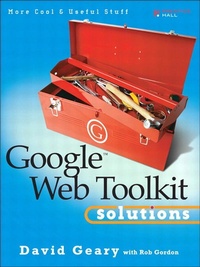
Google Web Toolkit Solutions
More Cool & Useful Stuff (Adobe Reader)
1st Edition
Published on 29. October 2007
408 pages
978-0-13-234534-7 (ISBN)
Description

Cu>
Google Web Toolkit (GWT) is an open source Java development framework for building Ajax-enabled web applications. Instead of the hodgepodge of technologies that developers typically use for Ajax-JavaScript, HTML, CSS, and XMLHttpRequest-GWT lets developers implement rich client applications with pure Java, using familiar idioms from the AWT, Swing, and SWT. GWT goes beyond most Ajax frameworks by making it easy to build desktop-like applications that run in the ubiquitous browser, where the richness of the user interface is limited only by the developer's imagination.
This book focuses on the more advanced aspects of GWT that you need to implement real-world applications with rich user interfaces but without the heavy lifting of JavaScript and other Ajax-related technologies. Each solution in this practical, hands-on book is more than a recipe. The sample programs are carefully explained in detail to help you quickly master advanced GWT techniques, such as implementing drag-and-drop, integrating JavaScript libraries, and using advanced event handling methodologies.
Solutions covered include
* Building custom GWT widgets, including both high-level composites and low-level components
* Implementing a viewport class that includes iPhone-style automated scrolling
* Integrating web services with GWT applications
* Incorporating the Script.aculo.us JavaScript framework into GWT applications
* Combining Hibernate and GWT to implement database-backed web applications
* Extending the GWT PopupPanel class to implement a draggable and resizable window
* Creating a drag-and-drop module, complete with drag sources and drop targets
* Deploying GWT applications to an external server
* Dynamically resizing flex tables
* Using GWT widgets in legacy applications developed with other frameworks, such as Struts and JavaServer Faces
Complete Sample Code Available at www.coolandusefulgwt.com
All of the code used in this book has been tested, both in hosted and web modes, and in an external version of Tomcat (version 5.5.17), under Windows, Linux, and Mac OS X. For Windows and Linux, we used 1.4.60, and for the Mac we used 1.4.61. NOTE: There are three separate versions of the code. Please download the correct JAR file for the operating system you are using.
Foreword xiii
Preface xvi
Acknowledgments xviii
About the Authors xix
Solution 1: GWT Fundamentals and Beyond 1
Solution 2: JavaScript Integration 53
Solution 3: Custom Widget Implementation 71
Solution 4: Viewports and Maps 103
Solution 5: Access to Online Web Services 133
Solution 6: Drag and Drop 167
Solution 7: Simple Windows 199
Solution 8: Flex Tables 237
Solution 9: File Uploads 283
Solution 10: Hibernate Integration 303
Solution 11: Deployment to an External Server 325
Solution 12: GWT and Legacy Code 343
Index 371
Google Web Toolkit (GWT) is an open source Java development framework for building Ajax-enabled web applications. Instead of the hodgepodge of technologies that developers typically use for Ajax-JavaScript, HTML, CSS, and XMLHttpRequest-GWT lets developers implement rich client applications with pure Java, using familiar idioms from the AWT, Swing, and SWT. GWT goes beyond most Ajax frameworks by making it easy to build desktop-like applications that run in the ubiquitous browser, where the richness of the user interface is limited only by the developer's imagination.
This book focuses on the more advanced aspects of GWT that you need to implement real-world applications with rich user interfaces but without the heavy lifting of JavaScript and other Ajax-related technologies. Each solution in this practical, hands-on book is more than a recipe. The sample programs are carefully explained in detail to help you quickly master advanced GWT techniques, such as implementing drag-and-drop, integrating JavaScript libraries, and using advanced event handling methodologies.
Solutions covered include
* Building custom GWT widgets, including both high-level composites and low-level components
* Implementing a viewport class that includes iPhone-style automated scrolling
* Integrating web services with GWT applications
* Incorporating the Script.aculo.us JavaScript framework into GWT applications
* Combining Hibernate and GWT to implement database-backed web applications
* Extending the GWT PopupPanel class to implement a draggable and resizable window
* Creating a drag-and-drop module, complete with drag sources and drop targets
* Deploying GWT applications to an external server
* Dynamically resizing flex tables
* Using GWT widgets in legacy applications developed with other frameworks, such as Struts and JavaServer Faces
Complete Sample Code Available at www.coolandusefulgwt.com
All of the code used in this book has been tested, both in hosted and web modes, and in an external version of Tomcat (version 5.5.17), under Windows, Linux, and Mac OS X. For Windows and Linux, we used 1.4.60, and for the Mac we used 1.4.61. NOTE: There are three separate versions of the code. Please download the correct JAR file for the operating system you are using.
Foreword xiii
Preface xvi
Acknowledgments xviii
About the Authors xix
Solution 1: GWT Fundamentals and Beyond 1
Solution 2: JavaScript Integration 53
Solution 3: Custom Widget Implementation 71
Solution 4: Viewports and Maps 103
Solution 5: Access to Online Web Services 133
Solution 6: Drag and Drop 167
Solution 7: Simple Windows 199
Solution 8: Flex Tables 237
Solution 9: File Uploads 283
Solution 10: Hibernate Integration 303
Solution 11: Deployment to an External Server 325
Solution 12: GWT and Legacy Code 343
Index 371
More details
Edition
1. Auflage
Language
English
Place of publication
United States
Publishing group
Pearson Education (US)
Target group
Professional and scholarly
ISBN-13
978-0-13-234534-7 (9780132345347)
Copyright in bibliographic data and cover images is held by Nielsen Book Services Limited or by the publishers or by their respective licensors: all rights reserved.
Schweitzer Classification
Other editions
Additional editions
Book
11/2007
Prentice Hall
€34.65
Article exhausted; check different version
Persons
David Geary is the author of eight books on Java technology, including the bestselling Graphic Java 2 Series, Advanced JavaServer Pages, and Core JavaServer Faces (all from Prentice-Hall). David was a member of Sun's Expert Groups for the JavaServer Pages Standard Template Library (JSTL), and JavaServer Faces (JSF) 1.0. He also was the second Apache Struts committer and the inventor of the Struts Template Library, the precursor to the popular Tiles open-source framework for composing web pages from JSP fragments. David wrote questions for Sun's Web Developer Certification Exam and is the president of Clarity Training Inc., a training and consulting company focusing on server-side Java technology.
Rob Gordon is an independent consultant specializing in the design and implementation of enterprise systems. He is a former Sun developer and author of Essential JNI and coauthor of Essential JMF.
Rob Gordon is an independent consultant specializing in the design and implementation of enterprise systems. He is a former Sun developer and author of Essential JNI and coauthor of Essential JMF.
Content
Foreword xiii
Preface xvi
Acknowledgments xviii
About the Authors xix
Solution 1: GWT Fundamentals and Beyond 1
Solution 2: JavaScript Integration 53
Solution 3: Custom Widget Implementation 71
Solution 4: Viewports and Maps 103
Solution 5: Access to Online Web Services 133
Solution 6: Drag and Drop 167
Solution 7: Simple Windows 199
Solution 8: Flex Tables 237
Solution 9: File Uploads 283
Solution 10: Hibernate Integration 303
Solution 11: Deployment to an External Server 325
Solution 12: GWT and Legacy Code 343
Index 371
Preface xvi
Acknowledgments xviii
About the Authors xix
Solution 1: GWT Fundamentals and Beyond 1
Solution 2: JavaScript Integration 53
Solution 3: Custom Widget Implementation 71
Solution 4: Viewports and Maps 103
Solution 5: Access to Online Web Services 133
Solution 6: Drag and Drop 167
Solution 7: Simple Windows 199
Solution 8: Flex Tables 237
Solution 9: File Uploads 283
Solution 10: Hibernate Integration 303
Solution 11: Deployment to an External Server 325
Solution 12: GWT and Legacy Code 343
Index 371
