

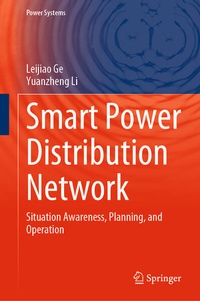
Smart Power Distribution Network
Description

The surge in renewable and distributed energy sources has posed significant challenges for smart power distribution network (SPDN). These challenges fall into two main categories: the unpredictability of renewable energy sources and the complexities introduced by numerous electrical devices and their interdependencies, affecting forecasting and operational performance. As the emphasis on SPDN's economic and environmental aspects grows, this book focuses on the vital themes of sustainability and cost-efficiency in SPDN forecasting, planning, and operation. It is structured into three key parts:
1. SPDN Situation Awareness: This section assesses prior research methods, analyzes their shortcomings while dissecting SPDN's unique situation awareness characteristics. Then, some forecast and virtual collection methods are presented.
2. Boosting SPDN Planning: Addressing optimal planning challenges in SPDN, this part introduces advanced modelling and algorithm solvingtechniques, tailored to mitigate SPDN's inherent uncertainty.
3. Enhancing SPDN Operation: Considering a variety of equipment types and controllable loads, this section explores strategies to boost SPDN operational performance. It covers control methodologies for electric vehicles, flexible loads, energy storage, and related equipments, etc.
Tailored for university researchers, engineers, and graduate students in electrical engineering and computer science, this book is a valuable resource for comprehending SPDN's situation awareness, planning, and operation intricacies in the context of sustainability and economic efficiency.
More details
Other editions
Additional editions
Persons
Dr. Leijiao Ge received the Bachelor's degree in electrical engineering and its automation from Beihua University, China, in 2006, the Master's degree in electrical engineering from Hebei University of Technology, China, in 2009, and Ph.D. degree in electrical engineering from Tianjin University, Tianjin, China, in 2016. He is currently an associate professor in the school of electrical and information engineering at Tianjin University. His main research interests are situational awareness of smart power distribution networks, optimal control of new energy, cloud computing, and big data.
Dr. Yuanzheng Li is currently an associate professor in the school of artificial intelligence and automation at Huazhong University of Science and Technology. His main research fields are artificial intelligence and its application in smart grid, deep learning, reinforcement learning, big data analysis, operation research optimization, etc. He has investigated 2 projects of the National Natural Science Foundation of China, 2 Science and Technology projects of the State Grid of China Corporation, and participated in the National Key Basic Research and Development Plan (973 Plan). Among them, the research results were selected as excellent achievements of the State Key Laboratory of Renewable Energy Power System and research innovation points of the 973 program. He has published more than 50 journal papers, including more than 40 IEEE Transactions. Currently, he is the associate editor of IEEE Transactions on Intelligent Vehicles and the editorial board of IET Renewable Power Generation.
Content
Chapter 1. System overview.- Chapter 2. Smart distribution power network situation awareness.- Chapter 3. Photovoltaic prediction, virtual collection.- Chapter 4. Multi-energy load forecasting of integrated energy system.- Chapter 5. Optimal planning of energy storage considering uncertainty of load and wind generation.- Chapter 6. Energy supplying facilities planning for electric vehicles.- Chapter 7. Multiple equipment planning for integrated energy system.- Chapter 8. ay-ahead risk averse market clearing considering demand response.- Chapter 9. Optimal operation via cooperative energy and reserve scheduling.- Chapter 10. Optimal interaction strategy for vehicle-to-grid.- Chapter 11. Concluding remarks.
