

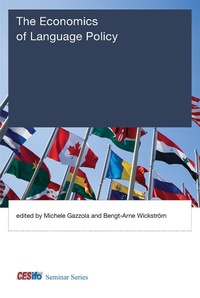
The Economics of Language Policy
Description

In an era of globalization, issues of language diversity have economic and political implications. Transnational labor mobility, trade, social inclusion of migrants, democracy in multilingual countries, and companies' international competitiveness all have a linguistic dimension; yet economists in general do not include language as a variable in their research. This volume demonstrates that the application of rigorous economic theories and research methods to issues of language policy yields valuable insights.
The contributors offer both theoretical and empirical analyses of such topics as the impact of language diversity on economic outcomes, the distributive effects of policy regarding official languages, the individual welfare consequences of bilingualism, and the link between language and national identity. Their research is based on data from countries including Canada, India, Kazakhstan, and Indonesia and from the regions of Central America, Europe, and Sub-Saharan Africa. Theoretical models are explained intuitively for the nonspecialist. The relationships among linguistic variables, inequality, and the economy are approached from different perspectives, including economics, sociolinguistics, and political science. For this reason, the book offers a substantive contribution to interdisciplinary work on languages in society and language policy, proposing a common framework for a shared research area.
Contributors Alisher Aldashev, Katalin Buzási, Ramon Caminal, Alexander M. Danzer, Maxime Leblanc Desgagné, Peter H. Egger, Ainhoa Aparicio Fenoll, Michele Gazzola, Victor Ginsburgh, Gilles Grenier, François Grin, Zoe Kuehn, Andrea Lassmann, Stephen May, Serge Nadeau, Suzanne Romaine, Selma K. Sonntag, Stefan Sperlich, José-Ramón Uriarte, François Vaillancourt, Shlomo Weber, Bengt-Arne Wickström, Lauren Zentz
More details
Other editions
Additional editions
Persons
Bengt-Arne Wickström was until his retirement Director of the Institute for Public Economics at Humboldt-Universität zu Berlin and is now Herder Professor at Andrássy-Universität Budapest.
Michele Gazzola is a Research Fellow at Humboldt-Universität zu Berlin.
Bengt-Arne Wickström was until his retirement Director of the Institute for Public Economics at Humboldt-Universität zu Berlin and is now Herder Professor at Andrássy-Universität Budapest.
Victor Ginsburgh is Professor of Economics at the Université Libre de Bruxelles and at the Center for Operations Research and Econometrics (CORE) at the Université Catholique de Louvain. Michiel Keyzer is Professor of Economics and Director of the Centre for World Food Studies at Vrije Universiteit in Amsterdam.
