

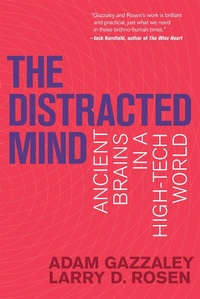
The Distracted Mind
Description

"Brilliant and practical, just what we need in these techno-human times."—Jack Kornfield, author of The Wise Heart
Most of us will freely admit that we are obsessed with our devices. We pride ourselves on our ability to multitask—read work email, reply to a text, check Facebook, watch a video clip. Talk on the phone, send a text, drive a car. Enjoy family dinner with a glowing smartphone next to our plates. We can do it all, 24/7! Never mind the errors in the email, the near-miss on the road, and the unheard conversation at the table. In The Distracted Mind, Adam Gazzaley and Larry Rosen—a neuroscientist and a psychologist—explain why our brains aren't built for multitasking, and suggest better ways to live in a high-tech world without giving up our modern technology.
The authors explain that our brains are limited in their ability to pay attention. We don't really multitask but rather switch rapidly between tasks. Distractions and interruptions, often technology-related—referred to by the authors as "interference”—collide with our goal-setting abilities. We want to finish this paper/spreadsheet/sentence, but our phone signals an incoming message and we drop everything. Even without an alert, we decide that we "must” check in on social media immediately.
Gazzaley and Rosen offer practical strategies, backed by science, to fight distraction. We can change our brains with meditation, video games, and physical exercise; we can change our behavior by planning our accessibility and recognizing our anxiety about being out of touch even briefly. They don't suggest that we give up our devices, but that we use them in a more balanced way.
More details
Other editions
Additional editions
Persons
Larry D. Rosen is Professor Emeritus of Psychology at California State University, Dominguez Hills. He is a blogger for Psychology Today and the author of iDisorder: Understanding Our Obsession with Technology and Overcoming Its Hold on Us and six other books.
Content
- Intro
- Half Title
- Title
- Copyright
- Table of Contents
- Acknowledgments
- Prologue
- Part I: Cognition and the Essence of Control
- Chapter 1: Interference
- Chapter 2: Goals and Cognitive Control
- Chapter 3: The Brain and Control
- Chapter 4: Control Limitations
- Chapter 5: Variations and Fluctuations
- Part II: Behavior in a High-Tech World
- Chapter 6: The Psychology of Technology
- Chapter 7: The Impact of Constantly Shifting Our Attention
- Chapter 8: The Impact of Technology on Diverse Populations
- Chapter 9 Why Do We Interrupt Ourselves?
- Part III: Taking Control
- Chapter 10 Boosting Control
- Chapter 11 Modifying Behavior
- Notes
- Index
