

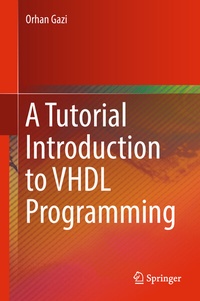
A Tutorial Introduction to VHDL Programming
Description

This book helps readers create good VHDL descriptions and simulate VHDL designs. It teaches VHDL using selected sample problems, which are solved step by step and with precise explanations, so that readers get a clear idea of what a good VHDL code should look like.
The book is divided into eight chapters, covering aspects ranging from the very basics of VHDL syntax and the module concept, to VHDL logic circuit implementations. In the first chapter, the entity and architecture parts of a VHDL program are explained in detail. The second chapter explains the implementations of combinational logic circuits in VHDL language, while the following chapters offer information on the simulation of VHDL programs and demonstrate how to define data types other than the standard ones available in VHDL libraries. In turn, the fifth chapter explains the implementation of clocked sequential logic circuits, and the sixth shows the implementation of registers and counter packages. The book's last two chapters detail how components, functions and procedures, as well as floating-point numbers, are implemented in VHDL.The book offers extensive exercises at the end of each chapter, inviting readers to learn VHDL by doing it and writing good code.
More details
Other editions
Additional editions
Person
Orhan Gazi is an Associate Professor at the Electronic and Communication Engineering Department, Cankaya University. He completed his BS, MS, and PhD degrees in Electrical and Electronics Engineering from Middle East Technical University, Ankara, Turkey, in 1996, 2001 and 2007, respectively.
His research areas involve signal processing, information theory, and forward error correction. More recently, he has begun studying polar channel codes and preparing publications in this area.
He has published several textbooks on Digital Signal Processing and Information Theory, as well as a monograph on Channel Coding.
