

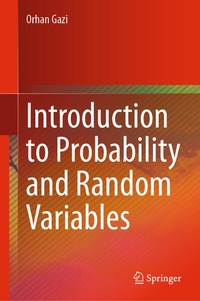
Introduction to Probability and Random Variables
Description

This textbook provides a straightforward, clear explanation of probability and random variables for communications engineering students. The author focuses on the most essential subjects of probability and random variables, eliminating unnecessary details of this difficult subject. After an introduction to the topic, the author covers the essentials of experiments, sample spaces, events, and probability laws, while investigating how they relate to communications engineering work. He goes on to discuss total probability theorems, after which he covers discrete random variables and continuous random variables. The author uses his years of teaching probability and random variable concepts to engineering students to form the text in a very understandable manner. The book features exercises, examples, case studies, and other key classroom materials
Reviews / Votes
"The book can be used as textbook for one semester probability theory course. Examples are provided to explain basic concepts which are simple and provide succinct information. The book is useful reading for anyone interested in probability theory." (Pavel Stoynov, zbMATH 1544.60002, 2024)
More details
Other editions
Additional editions
Person
Orhan Gazi
is employed as a Professor of Electrical and Electronics Engineering in Ankara Medipol University. He completed his BS, MS, and PhD degrees in Electrical and Electronics Engineering from Middle East Technical University, Ankara, Turkey, in 1996, 2001 and 2007, respectively. His research areas involve signal processing, information theory, and forward error correction. More recently, he has begun studying polar channel codes and preparing publications in this area. He has published several textbooks on signal processing, information theory, channel coding, VHDL circuit design, and FPGA programming.
Content
Introduction.- Experiments, Sample Spaces, Events and Probability Laws.- Total Probability Theorem, Independence, Combinatorial.- Discrete Random Variables.- Functions of Random Variables.- Continuous Random Variables.- More than one Random Variables.- Conclusion.
