
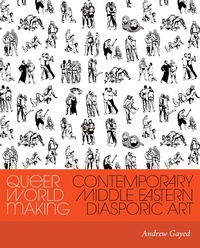
Queer World Making
Description
Alles über E-Books | Antworten auf Fragen rund um E-Books, Kopierschutz und Dateiformate finden Sie in unserem Info- & Hilfebereich.
An abundantly illustrated look at how queerness is performed within artistic practice
Premodern archives from the Middle East show rich and diverse homoerotic worlds that were disrupted by the colonial imposition of Western models of sexuality. Andrew Gayed traces how contemporary Arab and Middle Eastern diasporic artists have remembered and reinvented these historical ways of being in their work in order to imagine a different present. Building on global art histories and transnational queer theory, Queer World Making illuminates contemporary understandings of queer sexuality in the Middle Eastern diaspora. The author focuses on the visual works of artists who create political art about queer identity, including Jamil Hellu, Ebrin Bagheri, 2Fik, Laurence Rasti, Nilbar Güres, and Alireza Shojaian.
Through engaging with these artists, Gayed is seeking to articulate a Western and non-Western modernity that works beyond the dichotomy of sexual oppression, stereotypically associated with the Middle East, versus sexual acceptance, attributed to North American norms. Instead, Gayed traces how diasporic subjects create coming-out narratives and identities that provide alternatives to inscribed Western models. Queer World Making reframes Arab homosexualities in terms of desire and alternative gender norms rather than through Western notions of visibility and coming out, narratives that are not conducive to understanding how queer Arabs living in the West experience their sexuality.
All prices
More details
Other editions
Additional editions
Person
Andrew Gayed is assistant professor of art history and visual culture at the Ontario College of Art and Design University (OCADU).
Content
- Cover
- Title Page
- Copyright
- Dedication
- Contents
- List of Illustrations
- Acknowledgments
- Prologue: Autotheory: A Queer Feminist Practice
- Introduction: Queer World Making and Deimperializing Visual Culture
- Part One: Decolonial Methods: Imagininga Horizontal Art History and Queer Theory
- One: Thinking Decolonially: Horizontal Methods to Queer Theory and Art History
- Two: Trauma and the Single Narrative: Reading Arab Artand Photography
- Three: Islamicate as Method: Minor Transnationalisms and Worlding Art History
- Part Two: Queer Diasporic World Making: Visualizing Place, Race, and Self
- Four: An Alternative History of Sexuality: Diaspora Consciousness and the Queer Diasporic Lens
- Five: Queering Archives of Photography: Linking a Colonial History to a Diasporic Present
- Six: Coming Out à l'Orientale: Diasporic Art and Colonial Wounds
- Seven: Historicizing Homophobia: Contesting the Double Binds of Homocolonialism and Homonationalism
- Conclusion: Queer World Making, Diaspora Consciousness,and Futurity
- Notes
- Bibliography
- Index
- Back Cover

System requirements
File format: ePUB
Copy protection: Adobe-DRM (Digital Rights Management)
System requirements:
- Computer (Windows; MacOS X; Linux): Install the free reader Adobe Digital Editions prior to download (see eBook Help).
- Tablet/smartphone (Android; iOS): Install the free app Adobe Digital Editions or the app PocketBook before downloading (see eBook Help).
- E-reader: Bookeen, Kobo, Pocketbook, Sony, Tolino and many more (not Kindle).
The file format ePub works well for novels and non-fiction books – i.e., „flowing” text without complex layout. On an e-reader or smartphone, line and page breaks automatically adjust to fit the small displays.
This eBook uses Adobe-DRM, a „hard” copy protection. If the necessary requirements are not met, unfortunately you will not be able to open the eBook. You will therefore need to prepare your reading hardware before downloading.
Please note: We strongly recommend that you authorise using your personal Adobe ID after installation of any reading software.
For more information, see our ebook Help page.
File format: PDF
Copy-Protection: Adobe-DRM (Digital Rights Management)
System requirements:
- Computer (Windows; MacOS X; Linux): Install the free reader Adobe Digital Editions prior to download (see eBook Help).
- Tablet/smartphone (Android; iOS): Install the free app Adobe Digital Editions or the app PocketBook before downloading (see eBook Help).
- E-reader: Bookeen, Kobo, Pocketbook, Sony, Tolino and many more (only limited: Kindle).
The file format PDF always displays a book page identically on any hardware. This makes PDF suitable for complex layouts such as those used in textbooks and reference books (images, tables, columns, footnotes). Unfortunately, on the small screens of e-readers or smartphones, PDFs are rather annoying, requiring too much scrolling.
This eBook uses Adobe-DRM, a „hard” copy protection. If the necessary requirements are not met, unfortunately you will not be able to open the eBook. You will therefore need to prepare your reading hardware before downloading.
Please note: We strongly recommend that you authorise using your personal Adobe ID after installation of any reading software.
For more information, see our eBook Help page.
File format: ePUB
Copy protection: without DRM (Digital Rights Management)
System requirements:
- Computer (Windows; MacOS X; Linux): Use a reader that can handle the file format ePUB, such as Adobe Digital Editions or FBReader – both free (see eBook Help).
- Tablet/Smartphone (Android; iOS): Install the free app Adobe Digital Editions or the app PocketBook (see eBook Help).
- E-reader: Bookeen, Kobo, Pocketbook, Sony, Tolino and many more (not Kindle).
The file format ePUB works well for novels and non-fiction books – i.e., 'flowing' text without complex layout. On an e-reader or smartphone, line and page breaks automatically adjust to fit the small displays.
This eBook does not use copy protection or Digital Rights Management
For more information, see our eBook Help page.
