

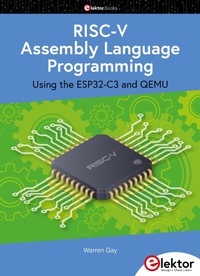
RISC-V Assembly Language Programming using ESP32-C3 and QEMU
Published on 3. November 2022
267 pages
978-3-89576-680-0 (ISBN)
Description

With the availability of free and open source C/C++ compilers today, you might wonder why someone would be interested in assembler language. What is so compelling about the RISC-V Instruction Set Architecture (ISA)? How does RISC-V differ from existing architectures? And most importantly, how do we gain experience with the RISC-V without a major investment? Is there affordable hardware available?
The availability of the Espressif ESP32-C3 chip provides a way to get hands-on experience with RISC-V. The open sourced QEMU emulator adds a 64-bit experience in RISC-V under Linux. These are just two ways for the student and enthusiast alike to explore RISC-V in this book.
The projects in this book are boiled down to the barest essentials to keep the assembly language concepts clear and simple. In this manner you will have "aha!" moments rather than puzzling about something difficult. The focus in this book is about learning how to write RISC-V assembly language code without getting bogged down. As you work your way through this tutorial, you'll build up small demonstration programs to be run and tested. Often the result is some simple printed messages to prove a concept. Once you've mastered these basic concepts, you will be well equipped to apply assembly language in larger projects.
The availability of the Espressif ESP32-C3 chip provides a way to get hands-on experience with RISC-V. The open sourced QEMU emulator adds a 64-bit experience in RISC-V under Linux. These are just two ways for the student and enthusiast alike to explore RISC-V in this book.
The projects in this book are boiled down to the barest essentials to keep the assembly language concepts clear and simple. In this manner you will have "aha!" moments rather than puzzling about something difficult. The focus in this book is about learning how to write RISC-V assembly language code without getting bogged down. As you work your way through this tutorial, you'll build up small demonstration programs to be run and tested. Often the result is some simple printed messages to prove a concept. Once you've mastered these basic concepts, you will be well equipped to apply assembly language in larger projects.
More details
Other editions
Additional editions
Book
10/2022
1st Edition
Elektor
€44.95
Article exhausted; check different version
Person
Warren Gay is a datablocks.net senior software developer, writing Linux internet servers in C++. He got involved with electronics at an early age, and since then he has built microcomputers and has worked with MC68HC705, AVR, STM32, ESP32 and ARM computers, just to name a few.
