

Progress and Values in the Humanities
Comparing Culture and Science
1st Edition
Published on 25. September 2015
288 pages
978-0-231-51981-6 (ISBN)
Description

Money and support tend to flow in the direction of economics, science, and other academic departments that demonstrate measurable "progress." The humanities, on the other hand, offer more abstract and uncertain outcomes. A humanist's objects of study are more obscure in certain ways than pathogens and cells. Consequently, it seems as if the humanities never truly progress. Is this a fair assessment?
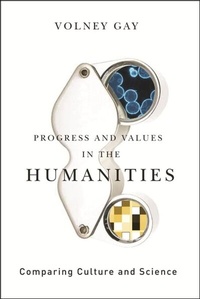
By comparing objects of science, such as the brain, the galaxy, the amoeba, and the quark, with objects of humanistic inquiry, such as the poem, the photograph, the belief, and the philosophical concept, Volney Gay reestablishes a fundamental distinction between science and the humanities. He frees the latter from its pursuit of material-based progress and restores its disciplines to a place of privilege and respect. Using the metaphor of magnification, Gay shows that, while we can investigate natural objects to the limits of imaging capacity, magnifying cultural objects dissolves them into noise. In other words, cultural objects can be studied only within their contexts and through the prism of metaphor and narrative.
Gathering examples from literature, art, film, philosophy, religion, science, and psychoanalysis, Gay builds a new justification for the humanities. By revealing the unseen and making abstract ideas tangible, the arts create meaningful wholes, which itself is a form of progress.
By comparing objects of science, such as the brain, the galaxy, the amoeba, and the quark, with objects of humanistic inquiry, such as the poem, the photograph, the belief, and the philosophical concept, Volney Gay reestablishes a fundamental distinction between science and the humanities. He frees the latter from its pursuit of material-based progress and restores its disciplines to a place of privilege and respect. Using the metaphor of magnification, Gay shows that, while we can investigate natural objects to the limits of imaging capacity, magnifying cultural objects dissolves them into noise. In other words, cultural objects can be studied only within their contexts and through the prism of metaphor and narrative.
Gathering examples from literature, art, film, philosophy, religion, science, and psychoanalysis, Gay builds a new justification for the humanities. By revealing the unseen and making abstract ideas tangible, the arts create meaningful wholes, which itself is a form of progress.
All prices
More details
Other editions
Additional editions
Book
12/2009
Columbia University Press
€52.04
Article not available at the moment
Person
Volney Gay is professor of religion, psychiatry, and anthropology at Vanderbilt University and is a training analyst at the St. Louis Psychoanalytic Institute. He is the author of six other books, including Freud on Sublimation: Reconsiderations; Joy and the Objects of Psychoanalysis: Literature, Belief, and Neurosis; and Reading Jung: Science, Psychology, and Religion.
Content
Acknowledgments
Introduction
1. A New Answer
2. Magnification and Cultural Objects
3. Back to Freud, Back to the Greeks!
4. Seven of Nine and Five of Nine
5. Canals on Mars: Exploring Imaginary Worlds
6. Searching for Essences: Freud and Wittgenstein
7. High Art and the Power to Guess the Unseen from the Seen
Notes
Index
Introduction
1. A New Answer
2. Magnification and Cultural Objects
3. Back to Freud, Back to the Greeks!
4. Seven of Nine and Five of Nine
5. Canals on Mars: Exploring Imaginary Worlds
6. Searching for Essences: Freud and Wittgenstein
7. High Art and the Power to Guess the Unseen from the Seen
Notes
Index

