

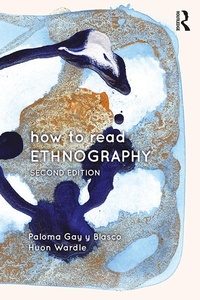
How to Read Ethnography
2nd Edition
Published on 8. April 2019
234 pages
978-1-317-29658-4 (ISBN)
Description

How to Read Ethnography is an essential guide to approaching anthropological texts. It helps students to cultivate the skills they need to critically examine and understand how ethnographies are built up, as well as to think anthropologically and develop an anthropological imagination of their own. The authors reveal how ethnographically-informed anthropology plays a distinctive and valuable role in comprehending the complexity of the world we live in.
This fully revised second edition includes fresh excerpts from key texts for analysis and comparison along with lucid explanations. In addition to concerns with argument, authority, and the relationship between theory and data, the book engages with the purpose, value, and accountability of ethnographic texts, as well as with their reception and usage. A brand new chapter looks at the kinds of collaboration between informants/consultants and anthropologists that go into the making of ethnographic writing.
This fully revised second edition includes fresh excerpts from key texts for analysis and comparison along with lucid explanations. In addition to concerns with argument, authority, and the relationship between theory and data, the book engages with the purpose, value, and accountability of ethnographic texts, as well as with their reception and usage. A brand new chapter looks at the kinds of collaboration between informants/consultants and anthropologists that go into the making of ethnographic writing.
Reviews / Votes
'This is a fine book and a superb guide for students reading ethnographic texts. Drawing upon a judicious sampling of ethnographies from many epochs and parts of the world, the authors succeed brilliantly in disclosing the complex character of every essay in human understanding, as well as inspiring anthropologists to ponder the notion of comparison in radically new ways.'Michael D. Jackson, Harvard University, USA
'With veritable cartographic genius, the authors lead us across the fascinating terrain of ethnography and its diverse interlocuters. This second edition moves some important new horizons into sight. As surefooted and perspicacious as ever, the way our guides have us pause to take bearings on the journey gives fresh impetus to teaching and learning.'
Marilyn Strathern, University of Cambridge, UK
'There is a major and dominant image of anthropology, presenting it as the result of a sequence of progressive and ascending stages (fieldwork, ethnography, anthropological theory) toward a 'science of mankind'. How to Read Ethnography documents, analyses, and exposes another image of the discipline - minor, interstitial, and much more interesting: the practice of anthropology as a movement of continuous and reversible variations between the dimensions of a knowledge that can only be built at the crossroads of what we learn in the field and what we read in the library.'
Marcio Goldman, Federal University of Rio de Janeiro, Brazil
More details
Edition
2nd edition
Language
English
Place of publication
London
United Kingdom
Publishing group
Taylor & Francis Ltd
Target group
College/higher education
Product notice
Reflowable
Illustrations
1 Illustrations, black and white
File size
1,52 MB
ISBN-13
978-1-317-29658-4 (9781317296584)
Copyright in bibliographic data and cover images is held by Nielsen Book Services Limited or by the publishers or by their respective licensors: all rights reserved.
Schweitzer Classification
Other editions
Additional editions
Paloma Gay Blasco | Huon Wardle
How to Read Ethnography
Book
05/2019
2nd Edition
Routledge
€61.20
Shipment within 10-20 days
Paloma Gay Blasco | Huon Wardle
How to Read Ethnography
Book
04/2019
2nd Edition
Routledge
€206.30
Shipment within 10-20 days
Persons
Paloma Gay y Blasco is a Senior Lecturer in Social Anthropology at the University of St Andrews, UK.
Huon Wardle is a Senior Lecturer in Social Anthropology and Director of the Centre for Cosmopolitan Studies at the University of St Andrews, UK.
Huon Wardle is a Senior Lecturer in Social Anthropology and Director of the Centre for Cosmopolitan Studies at the University of St Andrews, UK.
Content
Preface to the second edition Introduction: The concerns and distinctiveness of ethnography 1. Comparison: the ethnographic outlook 2. People in context 3. Relationships and meanings 4. Narrating the immediate 5. Ethnography as argument 6. Authors and authority 7. Taking a stance: theories for a changing world 8. Informants, interlocutors, collaborators Conclusion: Ethnography in the human conversation: a final remark
