

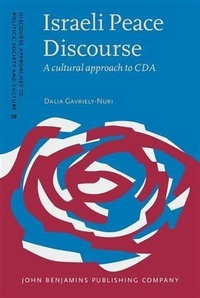
Israeli Peace Discourse
A cultural approach to CDA
1st Edition
Published on 12. February 2015
XVIII, 155 pages
978-90-272-6898-3 (ISBN)
Description

What role do language and discourse play in the advancement of peace? What is the connection between a given society's "peace language" and the repeated failure of peace initiatives involving it? At the heart of this book lie these basic questions and the attempt to shed light on them from new angles. The book focuses on an analysis of Israeli peace discourse and indicates the need for change in this discourse in order to promote a "culture of peace". It presents the process of peace-estrangement, a set of linguistic, discursive and cultural devices intended for creating doubt regarding the positive meaning associated with the concept of peace. The approach adopted in this book is the Cultural Approach to Critical Discourse Analysis (CCDA). This approach aims at exposing the cultural codes embedded in the discourse, which contribute to reproducing abuses of social power. The analytic chapters focus on different historical periods, since the beginning of the 20th century to this day, and deal with various genres found in diverse corpora, such as Knesset records and school textbooks.
More details
Other editions
Additional editions
Book
02/2015
John Benjamins Publishing Co
€100.70
Shipment within 10-15 days
Person
Content
- Israeli Peace Discourse
- Editorial page
- Title page
- LCC data
- Dedication page
- Table of contents
- Acknowledgements
- Abbreviations and key terms
- Israeli wars and peace agreements 1948-2012
- Strategies of peace-estrangement: Alphabetical lexicon
- Foreword
- Why Israel?
- About the English language in this book
- The structure of the book
- 1. Peace-Estrangement Discourse (PED)
- Peace-Estrangement Discourse (PED) and War-Normalizing Discourse
- Semantic-Conceptual Blurring between peace and war
- Cultural Approach to CDA (CCDA)
- CCDA: Towards a "culture of peace" and "ecological discourse"
- PED in politicians' discourse
- 2. Peace-estrangement after 1967
- The political context: Israel 1967-1973
- The corpus
- A "double-faced" peace discourse
- The declared position:"All we want is peace"
- Constructing "the peace problem"
- Peace is dangerous
- Peace is deceptive
- Peace is a total object
- Critique by Israeli authors
- 3. Idiosyncratic "peace" in Knesset discourse
- Applying CCDA
- Applicability: Using UNESCO's peace model
- Cultural sensitivity
- CCDA of Knesset peace discourse 1987-2008
- The corpus and "dominant characteristics"
- Peace phrases
- The mythic metaphor "We extend a hand in peace"
- Peace components in Prime Minister Ariel Sharon's speech
- Why is Israeli peace discourse an oppressive one?
- 4. "Peace" in war speeches
- Theoretical framework and historical context
- Israeli just war rhetoric
- "Discursive capital" and the global just war rhetoric
- The corpus
- Peace in the Service of War 1982-2008
- Peace in the Service of War: Discursive strategies
- False narrative
- Dogma: "War is the only way to achieve peace"
- The metaphor: "We extend a hand in peace"
- Binarism
- Peace in the Service of War's and the just war rhetoric
- 5. Victory is the new peace
- Semantic blurring of the conflict's basic concepts
- War = Victory
- Victory = Peace
- Occupation = Peace
- The creation of the 1967 victory myth
- The political context
- Mythmaking and the purification of the victory
- The victory in counter culture
- 6. "We extend a hand in peace"
- Metaphors in political discourse
- The corpus
- Principles of analysis
- Four models of the metaphor's use
- The European model
- The Sabra model
- The metaphor and PED
- PED: Beyond politicians' discourse
- 7. Peace in current school textbooks
- Textbooks as a dynamic discursive arena
- Peace-estrangement strategies in Israeli textbooks
- The corpus
- Estranging war: Anti-war texts
- The false logic leading to the war.
- Criticism of war propaganda.
- The damage caused by the war.
- The media's contribution to the war.
- Strategies of peace-estrangement
- Quantitative exclusion of "peace"
- Qualitative strategies of peace-estrangement: strategies of abstraction
- The conflict as a "mechanical" process
- Impersonalization
- Over-metaphorization
- Hyper-causality
- Strategies of abstraction and political correctness
- Conclusions
- Epilogue
- 8. Utopian "peace" in Herzl's Altneuland (1902)
- About the book Altneuland
- Reconciliation theory
- The "missing link" in Altneuland
- Peace-estrangement in Altneuland
- The literary device: Invisible Arabs
- The cultural solution: Turning both groups into Europeans
- The liberal solution: All the human being are born equal
- The economic-technological solution
- The "missing link" in current visions of peace
- The missing link in Shimon Peres's "Vision of a New Middle East"
- The missing link in Israeli peace-making discourse
- Conclusions
- Epilogue: Peace and time
- 9. Towards a "culture of peace" in the daily Ha'aretz
- Collective memories as a zero-sum game
- Israeli collective memory
- Obituaries as memory agents
- Cosmopolitan memory
- Cosmopolitan memory and reconciliation
- Discursive strategies for constructing cosmopolitan memory
- Analysis
- The corpus
- Unifying discursive strategies
- 1. Selectivity
- 2. Conciliation
- 3. Avoidance of oppositional terminology
- Conclusions
- Epilogue: Moon landing 1969: National vs. cosmopolitan framing
- Conclusions
- Appendix A
- Bibliography
- Index
