

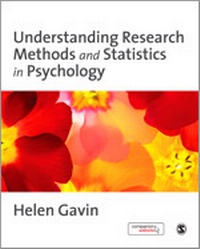
Understanding Research Methods and Statistics in Psychology
1st Edition
Published on 18. February 2008
424 pages
978-1-4462-0460-3 (ISBN)
Description

Understanding and applying research methods and statistics in psychology is one of the corner stones of study at undergraduate level. To enable all undergraduate psychology students to carry out their own investigations the textbook covers basic and advanced qualitative and quantitative methods and follows a sequential structure starting from first principles to more advanced techniques.
Accompanied by a companion website, the textbook:
- Grounds all techniques to psychological theory relating each topic under discussion to well established pieces of research
- Can be used by the student at beginning and more advanced undergraduate level - therefore a `one-stop' shop
- Includes a creative and practical selection of heuristic devices that cement knowledge of the techniques and skills covered in the textbook
Accompanied by a companion website, the textbook:
- Grounds all techniques to psychological theory relating each topic under discussion to well established pieces of research
- Can be used by the student at beginning and more advanced undergraduate level - therefore a `one-stop' shop
- Includes a creative and practical selection of heuristic devices that cement knowledge of the techniques and skills covered in the textbook
Reviews / Votes
'This text covers more than most research methods and statistics texts in terms of its breadth ...Not only will students understand a range of methods and analytical techniques, they will understand why and how these have been used in relation to key psychological studies. By putting key studies at the heart of this book it demonstrates the importance of understanding methods and analysis in order to fully appreciate and understand psychology' - Dr Paul Redford, University of West of England'Understanding Research Methods and Statistics in Psychology provides an excellent introduction for any student new to psychology and psychological research. Each chapter clearly and systematically covers a key area, ranging from research ethics through quantitative methods to complex designs and qualitative analysis. I highly recommend this book to anybody who would like a good understanding of basic research methods and statistics in psychology and related disciplines' - Dr David Popplewell, University of Oxford
All prices
More details
Language
English
Place of publication
London
United Kingdom
Target group
College/higher education
ISBN-13
978-1-4462-0460-3 (9781446204603)
Copyright in bibliographic data and cover images is held by Nielsen Book Services Limited or by the publishers or by their respective licensors: all rights reserved.
Schweitzer Classification
Other editions
Additional editions
Book
02/2008
1st Edition
SAGE Publications Inc
€108.20
Shipment within 10-20 days
Book
02/2008
1st Edition
SAGE Publications Inc
€231.76
Shipment within 10-20 days
Person
Helen Gavin was, before retiring in 2023, Subject Lead in Criminal Psychology at the University of Huddersfield, having previously been Head of Psychology at two universities. She taught undergraduate and postgraduate courses in this area, and now carries out research that focuses on deviant and homicidal sexual expression. She is currently collaborating with researchers and practitioners across the UK and in the USA, concerned with projects in female aggression, non-apprehended offenders, and issues concerning policing. She has supervised a number of research students, some of whom have investigated female aggression and psychopathy, the effect of childhood abuse, witchcraft and child homicide, sexual assault in hidden populations, traumatic incidents experienced by police officers, characteristics of homicide, sexual deviancy and disgust responses, and incarcerated sex offenders.
Previous books include Women and the Abuse of Power (Emerald), Understanding Research Methods and Statistics in Psychology (Sage), The Essence of Cognitive Psychology (Prentice-Hall), and Sex Drugs and Rock & Roll: Psychological, Legal, and Cultural Examinations of Sex and Sexuality (ID-Net Press). She has also contributed chapters to over a dozen edited books, and published widely in forensic and medical journals. Helen feels that studying criminal psychology can make one lose a sense of perspective, so she also studies cultural issues such as music and fairy tales, both of which, she has discovered, have a dark side.
Previous books include Women and the Abuse of Power (Emerald), Understanding Research Methods and Statistics in Psychology (Sage), The Essence of Cognitive Psychology (Prentice-Hall), and Sex Drugs and Rock & Roll: Psychological, Legal, and Cultural Examinations of Sex and Sexuality (ID-Net Press). She has also contributed chapters to over a dozen edited books, and published widely in forensic and medical journals. Helen feels that studying criminal psychology can make one lose a sense of perspective, so she also studies cultural issues such as music and fairy tales, both of which, she has discovered, have a dark side.
Content
PART ONE: FIRST EXPLORATIONS
The Range of Research
Ethics in Research
Some Shocking Cases
Some Basic Concepts in Psychological Research
PART TWO: BEGINNING QUANTITATIVE RESEARCH
Using Numbers to Describe Behaviour
Inferential Statistics
Why and What?
Simple Experimental Designs
Being Watched
Single Factorial Designs
The Levels of Processing Experiments
Survey Research
Who is afraid of Crime?
Correlational Designs
The Poor Relation?
PART THREE: COMPLEX QUANTITATIVE DESIGNS
Factorial Designs with More than One Factor
A Closer Look at Memory
Multivariate Statistics
Complex Correlational Designs and Analysis
Stats Can Be Murder
PART FOUR: BEGINNING QUALITATIVE RESEARCH
Theory in Qualitative Research
Designing Qualitative Research
PART FIVE: COMPLEX QUALITATIVE RESEARCH
Interviews and Focus Groups
Participant Observation
Girls, Gangs and Aggression
Thematic Analysis
Discourse Analysis
Power and Control
Evaluation Research
PART SIX: COMMUNICATION OF RESEARCH
Communicating Research
The Range of Research
Ethics in Research
Some Shocking Cases
Some Basic Concepts in Psychological Research
PART TWO: BEGINNING QUANTITATIVE RESEARCH
Using Numbers to Describe Behaviour
Inferential Statistics
Why and What?
Simple Experimental Designs
Being Watched
Single Factorial Designs
The Levels of Processing Experiments
Survey Research
Who is afraid of Crime?
Correlational Designs
The Poor Relation?
PART THREE: COMPLEX QUANTITATIVE DESIGNS
Factorial Designs with More than One Factor
A Closer Look at Memory
Multivariate Statistics
Complex Correlational Designs and Analysis
Stats Can Be Murder
PART FOUR: BEGINNING QUALITATIVE RESEARCH
Theory in Qualitative Research
Designing Qualitative Research
PART FIVE: COMPLEX QUALITATIVE RESEARCH
Interviews and Focus Groups
Participant Observation
Girls, Gangs and Aggression
Thematic Analysis
Discourse Analysis
Power and Control
Evaluation Research
PART SIX: COMMUNICATION OF RESEARCH
Communicating Research
