

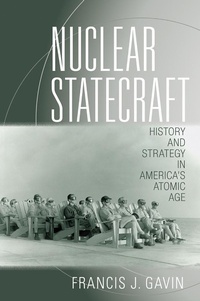
Nuclear Statecraft
History and Strategy in America's Atomic Age
Published on 11. October 2012
232 pages
978-0-8014-6532-1 (ISBN)
Description

"Gavin not only succeeds in disentangling postwar nuclear history from the US-Soviet rivalry of the Cold War, but provides a deeper and more complex understanding of the long-term effects of nuclear weapons on Great Power relations."- Matthew Jones a* International Affairs
We are at a critical juncture in world politics. Nuclear strategy and policy have risen to the top of the global policy agenda, and issues ranging from a nuclear Iran to the global zero movement are generating sharp debate. The historical origins of our contemporary nuclear world are deeply consequential for contemporary policy, but it is crucial that decisions are made on the basis of fact rather than myth and misapprehension. In Nuclear Statecraft, Francis J. Gavin challenges key elements of the widely accepted narrative about the history of the atomic age and the consequences of the nuclear revolution.
On the basis of recently declassified documents, Gavin reassesses the strategy of flexible response, the influence of nuclear weapons during the Berlin Crisis, the origins of and motivations for U.S. nuclear nonproliferation policy, and how to assess the nuclear dangers we face today.
In case after case, he finds that we know far less than we think we do about our nuclear history. Archival evidence makes it clear that decision makers were more concerned about underlying geopolitical questions than about the strategic dynamic between two nuclear superpowers.Gavin's rigorous historical work not only tells us what happened in the past but also offers a powerful tool to explain how nuclear weapons influence international relations. Nuclear Statecraft provides a solid foundation for future policymaking.
We are at a critical juncture in world politics. Nuclear strategy and policy have risen to the top of the global policy agenda, and issues ranging from a nuclear Iran to the global zero movement are generating sharp debate. The historical origins of our contemporary nuclear world are deeply consequential for contemporary policy, but it is crucial that decisions are made on the basis of fact rather than myth and misapprehension. In Nuclear Statecraft, Francis J. Gavin challenges key elements of the widely accepted narrative about the history of the atomic age and the consequences of the nuclear revolution.
On the basis of recently declassified documents, Gavin reassesses the strategy of flexible response, the influence of nuclear weapons during the Berlin Crisis, the origins of and motivations for U.S. nuclear nonproliferation policy, and how to assess the nuclear dangers we face today.
In case after case, he finds that we know far less than we think we do about our nuclear history. Archival evidence makes it clear that decision makers were more concerned about underlying geopolitical questions than about the strategic dynamic between two nuclear superpowers.Gavin's rigorous historical work not only tells us what happened in the past but also offers a powerful tool to explain how nuclear weapons influence international relations. Nuclear Statecraft provides a solid foundation for future policymaking.
Reviews / Votes
Nuclear Statecraft is a provocative and fascinating book. The writing is lucid, the analysis tightly woven and sophisticated, and the book's core conclusion-that much of what is said and thought about nuclear policy today remains hobbled by a pervasive ignorance of history (even, or perhaps especially, among nuclear policy experts)-is well argued and compelling. This book makes a significant contribution to the body of scholarly research about the evolution of US nuclear policy.- Janne E. Nolan (Nonproliferation Review) Francis J. Gavin's elegant and eloquently argued Nuclear Statecraft is a useful and timely reminder to appreciate better the historical origins of the contemporary nuclear world.. [The] section dealing with Gavin's debunking of the four myths on which nuclear alarmism is grounded-rogue states, tipping points, nuclear terrorism, and the so-called Long Peace-is worth the book's price and should be compulsory reading for decision makers and policy practitioners everywhere. Nuclear Statecraft is a must acquisition for academic and public libraries.
- Joseph M. Siracusa (Journal of American History) Gavin not only succeeds in disentangling postwar nuclear history from the US-Soviet rivalry of the Cold War, but provides a deeper and more complex understanding of the long-term effects of nuclear weapons on Great Power relations.
- Matthew Jones (International Affairs) Gavin's project is not merely to set the rest of us straight on nuclear history so that we can 'get it right.' Rather, it is to point out that the most useful insights to nuclear weapon issues are likely found at the convergence of nuclear theory, policy, and history, with the additional caution that even a firm grasp of the former two does not imply an equally firm grasp of the latter.... To each related theory and policy discussion he imparts a useful perspective concerning both the neglect and misuse of historical data.
- Col. John Mark Mattox (Military Review)
More details
Series
Language
English
Place of publication
Ithaca
United States
Product notice
Reflowable
ISBN-13
978-0-8014-6532-1 (9780801465321)
Copyright in bibliographic data and cover images is held by Nielsen Book Services Limited or by the publishers or by their respective licensors: all rights reserved.
Schweitzer Classification
Other editions
Additional editions
Book
11/2012
Cornell University Press
€19.80
Shipment within 10-20 days
Book
10/2012
Cornell University Press
€53.23
Shipment within 10-20 days
Person
Francis J. Gavin is Frank Stanton Chair in Nuclear Security Policy Studies and Professor of Political Science at MIT. He is the author of Gold, Dollars, and Power: The Politics of International Monetary Relations, 1958-1971.
