

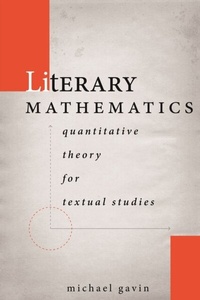
Literary Mathematics
Quantitative Theory for Textual Studies
Published on 25. October 2022
280 pages
978-1-5036-3391-9 (ISBN)
Available for download
Description

Across the humanities and social sciences, scholars increasingly use quantitative methods to study textual data. Considered together, this research represents an extraordinary event in the long history of textuality. More or less all at once, the corpus has emerged as a major genre of cultural and scientific knowledge. In Literary Mathematics, Michael Gavin grapples with this development, describing how quantitative methods for the study of textual data offer powerful tools for historical inquiry and sometimes unexpected perspectives on theoretical issues of concern to literary studies.
Student-friendly and accessible, the book advances this argument through case studies drawn from the Early English Books Online corpus. Gavin shows how a copublication network of printers and authors reveals an uncannily accurate picture of historical periodization; that a vector-space semantic model parses historical concepts in incredibly fine detail; and that a geospatial analysis of early modern discourse offers a surprising panoramic glimpse into the period's notion of world geography. Across these case studies, Gavin challenges readers to consider why corpus-based methods work so effectively and asks whether the successes of formal modeling ought to inspire humanists to reconsider fundamental theoretical assumptions about textuality and meaning. As Gavin reveals, by embracing the expressive power of mathematics, scholars can add new dimensions to digital humanities research and find new connections with the social sciences.
Student-friendly and accessible, the book advances this argument through case studies drawn from the Early English Books Online corpus. Gavin shows how a copublication network of printers and authors reveals an uncannily accurate picture of historical periodization; that a vector-space semantic model parses historical concepts in incredibly fine detail; and that a geospatial analysis of early modern discourse offers a surprising panoramic glimpse into the period's notion of world geography. Across these case studies, Gavin challenges readers to consider why corpus-based methods work so effectively and asks whether the successes of formal modeling ought to inspire humanists to reconsider fundamental theoretical assumptions about textuality and meaning. As Gavin reveals, by embracing the expressive power of mathematics, scholars can add new dimensions to digital humanities research and find new connections with the social sciences.
Reviews / Votes
"Literary Mathematics is a new kind of book. A project of this scope is guaranteed to be controversial, but everyone interested in literary history will find it worth their time."-Ted Underwood, University of Illinois Urbana-Champaign "This book is a timely, well-reasoned, and readable contribution to digital humanities and literary studies. Literary Mathematics will help guide the next generation of researchers in quantitative approaches to historical and literary texts."-Mel Evans, University of Leeds "Theoretically, historically, and critically informed, this is the most ambitious, and practical, book I know on the computational revolution in literary studies."-Jonathan Hope, Arizona State University "With Literary Mathematics, Gavin achieves what he sets forth to do: demonstrate quantitative models that can be used to describe the relationships between a corpus and its source texts, facilitating insights into the culture from which these historical documents emerged. Gavin's call for 'a curious spirit' that brings 'creative, rather than merely critical, thinking' is a welcome approach. Gavin takes risks in his corpus-level analyses and asks scholars to join him by looking at thousands of texts with an openness to the possibilities of what they may find."-Mary Learner, H-Sci-Med-Tech "Gavin's approach will be of great value to those who have been witnessing the debate about digital humanities as a set of methods.... Literary mathematics, not just in the sense of a title, is very likely to be seen as a concept that anchors contemporary debates and trends in digital humanities in replacing computers and digital technology with math as a site of meaning making."-Soni Wadhwa, South Atlantic Review "In his monograph Michael Gavin presents an insightful introduction into the application of mathematical analysis in literary corpus studies."-Katrin Dennerlein, Jahrbuch fuer KommunikationsgeschichteMore details
Series
Edition
New edition
Language
English
Place of publication
Palo Alto
United States
Target group
Professional and scholarly
Edition type
New edition
ISBN-13
978-1-5036-3391-9 (9781503633919)
Copyright in bibliographic data and cover images is held by Nielsen Book Services Limited or by the publishers or by their respective licensors: all rights reserved.
Schweitzer Classification
Other editions
Additional editions
Book
10/2022
Stanford University Press
€30.50
Shipment within 15-20 days
Book
10/2022
Stanford University Press
€91.50
Shipment within 15-20 days
Person
Michael Gavin is Associate Professor of English at the University of South Carolina and author of The Invention of English Criticism, 1650-1760 (2015).
Content
Introduction: The Corpus as an Object of Study
1. Networks and the Study of Bibliographical Metadata
2. The Computation of Meaning
3. Conceptual Topography
4. Principles of Literary Mathematics
Conclusion: Similar Words Tend to Appear in Documents with Similar Metadata
1. Networks and the Study of Bibliographical Metadata
2. The Computation of Meaning
3. Conceptual Topography
4. Principles of Literary Mathematics
Conclusion: Similar Words Tend to Appear in Documents with Similar Metadata

