

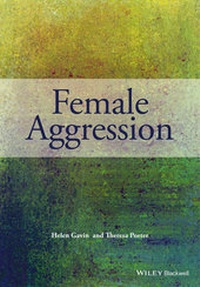
Female Aggression
Description

Reviews / Votes
"This book represents a truly fantastic addition to the literature on female aggression. It covers a whole host of aggressive crimes from a very thoughtful and gender-informed perspective. This book is an absolute necessity for professionals working with or researching women who have offended. I've no doubt that this book is a landmark text which will springboard important future research and practice in this area." --Professor Theresa A. Gannon, University of Kent "Helen Gavin and Theresa Porter have written a brave and uncompromising book, one that is scholarly, firm, careful, and a bit daunting. They challenge our most cherished feminist beliefs about women as the more compassionate, cooperative, 'maternal,' and non-violent of the genders. Clearly, they are not only writing about teenage 'mean girls'; the authors are weighing the research on women, including mothers, who abuse and neglect children; batter their partners, both male and female, sexually assault (or join in group sexual assaults) of women, kill their babies, kill other adults. They refuse to minimize the importance of female aggression only because men are more violent and, to their credit, Gavin and Porter critique others for doing so. And why? Because the authors have treatment goals in mind, ways of helping anti-social mothers and/or of rescuing their children. An entirely laudable endeavor. This is a serious work and demands that the reader drop many preconceptions in order to benefit from the material presented. Brava for taking on this painful, difficult and important subject." --Phyllis Chesler, Author of Women and Madness and Woman's Inhumanity to WomanMore details
Other editions
Additional editions
Persons
Content
Acknowledgements xi
1 Theories, Research and Misconceptions about Female Aggression 1
Introduction 1
Aggression and Women 2
Violent Crime and Women 5
Theories of Aggression 8
Theories based on biological difference 8
Environmental factors 18
Psychological models 19
Measuring aggression 26
2 The Evolution of Aggression 29
Darwinism and Sociobiology 29
The Naked Ape - Was She in the Jungle or the Sea? 31
The Evolution of Aggression and the Archaeology of War 32
Intersexual vs Intrasexual Aggression 33
Conclusion 36
3 Indirect Aggression 38
Indirect Aggression in Girls and Teens 39
Women and Indirect Aggression 40
4 Child Abuse and Neglect by Women 44
Introduction 44
Prevalence 45
Mental Illness 48
Social Learning and Own Abuse History 49
Antisocial Mothers 50
Other Factors in Child Abuse 52
Failure to Protect 53
Abusive Mothers' Perspective on Their Children 54
Recidivism 57
Effects of Abuse on Children 57
Conclusion 59
5 Intimate Partner Violence by Women 61
Introduction 61
Prevalence of Women's Violence Against Heterosexual Partners 64
Prevalence of Women's Violence Against Homosexual Partners 67
Severity and Injury 67
Recidivism 68
Women's Intimate Partner Violence and Stalking 68
Intimate Partner Violence by Women Resulting in Homicide 69
Intimate Partner Violence Initiation vs Self-Defence 70
Anger, Communication and Control 71
Social Learning and Intimate Partner Violence by Women 72
Personality and Intimate Partner Violence by Women 73
Typologies 74
Reporting Issues by Victims 75
Witnessing Inter-Parental Violence 76
Treatment 77
Conclusion 78
6 Rape, Sexual Assault and Molestation by Women 80
Introduction 80
Rape, Sexual Assaults and Coercion: Beyond the Male Perpetrator-Female Victim Paradigm 80
The Prevalence of Female Sexual Assaults Based on Perpetrator Self-Report 81
Victim prevalence reports 82
Theories Regarding Sexual Assault by Women 83
Women Who Sexually Offend Against Children 85
Prevalence 85
Similarities and differences compared with male sex offenders (MSOs) 85
Typologies 87
Deviant arousal and mental illness 90
Past victimization 91
Child Pornography and the Internet 92
Victim Effects 93
Awareness, Gender Bias and the Social Construction of Women 94
Legal Issues 95
Assessment, Treatment and Recidivism 96
A Brief Note on Juvenile Female Sex Offenders 100
Conclusion 101
7 Filicide by Women 102
Introduction 102
Neonaticide 103
Pregnancy Concealment, Denial and Negation 104
Infanticide 107
Sudden Infant Death Syndrome and Infanticide 108
Child Homicide by Women 109
Language, Filicide and Objectification 111
Gender and Filicide 112
Typologies 113
Mental Illness and Filicide 114
Serial Infanticide 117
Legalities 120
Conclusion 122
8 Homicide and Women 123
What Is Homicide? 123
Types of Homicide 124
Genocide 124
Mass murder 128
Mass murder for ideology 131
Murder 132
Killing for love 133
Women who kill from fear 134
Women who kill for money 136
Girls who kill 137
Manslaughter 142
Suicide 142
Conclusion 143
9 Serial Murder and Women 144
What Is Serial Murder? 145
Explanations for Serial Murder 146
Childhood 146
Psychiatric explanations 152
The role of psychopathy 153
The role of paraphilias 155
Neurological contributions 157
Female Serial Killers 158
Comfort serial killers 158
Couples Who Kill 160
Conclusion 163
10 Conclusion 165
References 169
Index 217
2
The Evolution of Aggression
The idea that all life is descended from a common ancestor and that complex creatures descend from simpler is very old, and can be found in ancient writings such as those of Anaximander, the Greek philosopher who lived in the sixth century BC (Couprie, Hahn, & Gerard, 2003). However, we do not have to look quite that far back to examine modern, more scientific thought on the origin of our species, nor its paradoxical and seemingly unstoppable quest to destroy itself.
Darwinism and Sociobiology
Modern evolutionary theory is based on the writings of Charles Darwin, and it adds more scientific knowledge to the understanding of the process of descent. The process of this change is genetic mutation, and those mutations that are beneficial to an organism will survive to the next generation. The process by which beneficial mutations survive is known as natural selection. This refers to the preservation of a functional advantage that enables a species to compete better for food, territory, mates and so on, and leads to the elimination of inferior species gradually over time. Evolutionary biology concentrates on the physical aspects of species and how they have adapted over time. Evolutionary psychology, on the other hand, focuses on behaviour that demonstrates psychological adaptations to recurring problems. Hence, it attempts to identify how emotional and cognitive adaptations have evolved. A genetic mutation has no hope of being successfully passed to the next generation without some accompanying behaviour that allows it to aid in the reproductive success of the organism and the survival of its offspring. In dimorphic organisms, those that have developed two sexes of different forms, these behaviours relate to sexual selection, as well as all the other changes needed to survive, such as gathering food, finding shelter and so on. Psychological adaptations are specialized for the environment of evolutionary adaptedness, or EEA (Gaulin & McBurney, 2003). Hence, humans have evolved adaptations related to mating. In males, this means adaptations which assist them to compete for females; in females, it means adaptations allowing choice of mate and behaviour designed to enable offspring to survive. Males are adapted to fight for the privilege of having females choose them for their mates. In non-human animals, this competition can be very fierce, if not fatal. In humans, this behaviour is no longer tolerated, and such inhibition of aggression against competitors for female preference has led to very complex behaviour around human mate selection (to say the least) and investment in offspring. How can we explain the massive industries that we find in the western world, dedicated to attracting a mate, keeping him and then making sure he stays around to look after his young? Why has the balance of female mate selection turned into females vying to appear attractive in the male gaze, when predominantly, for non-humans, it is female animals who need to be impressed by the male's aggressive acts?
Humans have very few offspring in comparison to other mammals, but invest large amounts of time and resources in caring for them. If you doubt that, just take a trip round your local branch of Mothercare or Babies R Us (a US store). This is costly in biological terms (as well as financial ones in our society) and means that a female must choose a mate wisely, one that can afford this investment in children. It also means she must be able to attract mates in order for her to have the possibility of selection, and have some way of keeping the chosen mate loyal to her. Hence we see the complex behaviours we call dating, courting, betrothal and marriage. We have also evolved complex adjunct activities that have become inseparable from these behaviours. We call this fashion and beauty care.
How did we arrive at the point of all this when our primate cousins just, well, get on with it? Why are we so different? And why are we so naked?
The Naked Ape - Was She in the Jungle or the Sea?
According to evolutionary theory, the psychological and biological adaptations are inextricably linked. A major hypothesis in the twentieth century was concerned with why and how humans became bipedal, the only primate to do so, and why we became hairless, again unlike all of the primates. The so-called 'Savannah theory' suggested that, as the population of early humans grew, they needed to expand and so outgrew the forested regions. Moving in to the grasslands (savannah) meant that humans that stood up to see further gained an advantage in hunting, and this ability was passed on through natural selection. In addition, long-range hunting in hot regions meant that males needed to sweat to achieve homeostasis so the shedding of hair was beneficial. Hence, humans evolved into hunting, omnivorous creatures that needed to adapt to the environment in such a way that the males could move quickly and capture food. Females waited in the home territory for males to return from hunting and received whatever was left after the males had had their fill. Females adapted to this by ensuring males stayed with them and provided for them and their offspring by becoming more attractive and available for sex. So hunting males were dominant and females simply became the adjunct to this and a handy place to keep babies while they grew viable enough to survive outside the womb.
Does anyone else think this sounds strange? As you can probably tell from this, most of the influential writers in evolutionary theory in the twentieth century were male. Female writers were not quite as taken with the savannah hypothesis. If males shed their hair in order to sweat in the hunting ground, why would females shed hair too? It does not seem feasible to suggest that they needed to. Also, why would giving less food to females and young be advantageous? Surely it was in the males' vested interests to keep mates and offspring healthy and well fed. It would also mean that potential and current mates would be attracted to them because they could provide this food. Also, why would only adaptations beneficial to the male be those that perpetuated and not any that helped a female who needed to care for offspring? For example, in the Naked Ape (1967), Desmond Morris suggested that human females developed rounded breasts and buttocks as sexual signalling devices, and that pair bonding (and its counterpart, sexual jealousy) evolved so that hunters out on the savannah knew that their mates were not having sex with other males.
In 1972, one woman writer did indeed think this was a bit odd, and decided to see if there was an alternative. There is, and it has nothing to do with intelligent design, creationism or table scraps. Elaine Morgan's book The Descent of Woman championed the alternative hypothesis, that of the aquatic ape, and the alternative perspective, that of the female (note, this is not the feminist). First proposed by Hardy in 1960, and later elaborated upon by Morgan, this hypothesis was, originally, completely censured by the scientific community, although it did attract attention. In this position, the evolution of human nakedness and bipedalism is explained as adaptation to an aquatic lifestyle, with female layers of fat, which contribute to the rounded breasts and buttocks, being needed for warmth, for babies to hold onto and for sitting for long periods on a pebble beach whilst babies were being fed. There are some heavy criticisms of this position, such as the high cost of maintaining body temperature in relatively small hairless creatures (Rantala, 2007). Whilst not fully accepted as a viable position amongst evolutionary theorists, it does demonstrate that evolutionary theory is a matter of best interpretation of evidence, and that there is the potential for alternative explanations. This potential for alternative positions can be seen when examining the evolution of aggression.
The Evolution of Aggression and the Archaeology of War
Humans, as a species, do have a violent past; this can be seen in archaeological, anthropological and comparative data. Skeletal remains show the marks of weapons (Lambert, 2002); not all such injuries and deaths could have been accidental. Traumatic injuries in ancient bones illustrate, in ways historical records cannot, that interpersonal violence has been present in all forms of social organizations (Walker, 2001). This is demonstrated by studies of societies that are classified as 'traditional', i.e., those that live without modern technology, or economic and social organization. For example, the Ya¸nomamö are an indigenous people of the Amazon rainforest who led a life completely without contact with the modern world until the 1960s. According to Chagnon (2000), 25 per cent of Ya¸nomamö males die in a violent manner, usually homicide; the tribes are described as ferocious and warlike. Often this violence is turned on the womenfolk, with particularly unpleasant and sometimes fatal punishments for transgressions such as sexual infidelity.
This account of perpetual warfare has been revised as Ferguson (2001) concluded warfare was the result of western influence, not a lack of it; however, the fact remains that there is still ubiquitous violence within societies that are living at subsistence levels. The argument revolves around the question of whether violence has evolved among the Ya¸nomamö because of competition resulting from a lack of nutritional resources in their territory. So, did we evolve to be violent and naturally aggressive? Archaeology and anthropology suggests that half of us did...
