

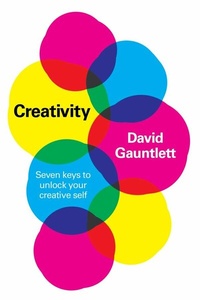
Creativity
Description

This is a lively and thought-provoking book about how to do creativity, unlock your potential, and make a difference.
The artists, musicians, and writers we think of as 'very creative' are just like us, except that they have spent time developing and realizing ideas, and have found the confidence to share them with the world. None of this comes naturally. This wide-ranging book offers research, advice, and philosophy to fuel your understanding and passion for creativity.
David Gauntlett draws on his own experiences of making music and experimenting with digital media alongside 25 years of researching creativity. Including insights from a diverse array of creators, the book highlights the vitality of the individual creative voice in a world where social media offers a weird mix of inspiration and suffocation, and our struggles for social justice are equally hopeful and upsetting.
Creativity shows how vulnerability, experimentation, and courage can enable us to become bold and engaging creators.
Also available as an audiobook narrated by the author.
More details
Other editions
Additional editions
Person
Content
Acknowledgements
Introduction
1. Identity
2. Experimenting
3. Doing
4. Inspiration
5. Diversity
6. Keep going
7. Becoming
Conclusion
Notes
Index
Introduction
Hello
This is a book about creativity, which is meant to help you with doing creativity, and also to give you some interesting ways to think about creativity as a practice and a process and a transformational force in the world, and in your life. I realize that talk about 'creativity' has become ubiquitous. It's not new to have a book about creativity. There are so many TED talks about it. There are lots of psychology articles about it. Social media can give you dozens of inspirational quotes about creativity.
But when people talk about creativity today, a lot of the time we hear about the power of collaboration - the more people you have working on a hard problem, sparking off each other, the better. This often comes with design thinking - based on the good and important idea that we need to really experience empathy with the people who will be using our 'products'. And we often hear about the vitality of failing - 'fail faster', they say, a curiously high-pressure demand.
These are all good points, if you are inventing rockets or gadgets. They are the mantras of tech companies, from groovy New York start-ups to Silicon Valley behemoths. But people seem to have mixed up the literature on innovation with thinking properly about creativity. We have absorbed from the business world a set of ideas that are of little use to most creative practitioners and artists or musicians - or, at least, their emphases have given it the wrong flavour. For instance, collaboration can be amazing in creative practice, but it works differently to industrial problem-solving. Empathy is beautiful, but it is not tied only to 'users' and 'products'. And things going not-in-the-way-you-intended is at the heart of learning about both creative techniques and your creative purpose, but we can reflect on this gently, gather the lessons tenderly, without needing to whoop and holler about out fail rate.
For me, there's a whole other set of things about creativity that we really need to talk about. These are about building a world that we can invite people to step into; creating new ways of expressing what it means to be a human living today; keeping going. These are the kinds of things that are important to creativity. They are things that are necessarily done by a thoughtful individual. Each of those individuals can work together to make something bigger and better than they might have done alone, but collaboration is nothing without the sparky individuals. If business is your concern, by the way, these things are absolutely important for business. Creativity is much more than a productivity hack. It's about being a human, in this world. Business has to connect with that. Everyone's interested in that.
A human activity
This book is about reclaiming creativity as a human practice. Creativity is a thing that we do. The business and tech worlds tend to position creativity as a kind of tool. Academic psychologists like to treat it as a 'trait', and as a quantity of solution-generating ability that you may or may not have. These approaches sometimes give us insights - partly because they are coming at creativity in a bit of a weird way, and weird is often good.
Generally, though, they miss the mark. They don't seem to be feeling creativity. Academic psychology clings to the idea that it is a straightforward 'science', even though this involves ignoring many decades of arguments that working with conscious humans is more complicated than that, as well as the observation that this faux-scientific language is a sort of colonialist project to stamp their appearance of authority across the world.
The business, tech, and innovation talk about creativity is typically more innocent than that, because they are more forthright about their motives. But when those emphases become our main way of talking about creativity today, then some important things are missed. And I think this more rounded view of creativity and creators, which is more centred on unlocking the vitality of creative individuals before anything else, has things that would be useful for the innovation people, and the psychologists, and everyone else.
So: this book offers seven keys to creativity, which are meant to help you unlock your creative identity, develop it, connect with others, and get stuff out there, with reasonable helpings of integrity, thoughtfulness, and fun. Needless to say, I'm not really claiming that these seven things are the only seven things you could ever say are the keys to creativity. But they are, of course, chosen with care, and based in the experience of many years researching about and with creativity, trying to do creative stuff, and working with individuals and organizations to find ways to unlock it. The book is not a collection of creativity 'tips' or techniques, per se. I mean, I'm not going to tell you to tidy your desk, or write three different poems about clouds, although both those things might be quite nice. This is a thinking book, in that it offers ways of thinking about creativity, and that's partly because it is, you know, a book. But these are absolutely intended to be frames that help you with doing creativity. All of this is about the doing. That's why we're here. That's why I'm here.
Creativity is everything
We should start by taking a moment to consider the delightful power of human creativity. What's so good about creativity? Creativity is what gives everything meaning. Through stories, imagery, music, and other things we have made, we celebrate and dig deeper into the experience of being human. We understand things better, and think about them more, as a consequence of our own creativity and the experience of other people's. In this way, creativity connects us with each other. All the fruits of human creativity that you experience form a web of meaningfulness that your own existence sits within. It shows you that there are shared things that tie us together, and that you are not alone. Our creativity gives us the chance to unlock fun and joy in ordinary things, to shine a light in places that would otherwise be dull, and to feel the incredible fulfilment of having made something where previously there was nothing.
Creativity involves an embodiment of the things that you are, beyond a knowledge of facts or a cluster of skills. Sometimes it is very physical and has evidently been made by your own hands. Sometimes - as with words or music - it may be rather intangible and have been made by sitting down at a machine. But either way, it's about making a thing, separate from yourself, which tells us something about you, and is an achievement, and is maybe your own little pocket universe. There's nothing better than having made a thing.
It isn't always triumphant. Creativity can also be uncertainty and awkwardness and wanting to do something but finding it hard. But it's this desire that is important. It's a yearning to do more, to be more, to be able to add a little bit of something to life. That's absolutely crucial. It doesn't matter about becoming 'the best' at it. What's important is the seeking, the hoping, the doing. Creativity is everything.
Modern living
Clearly, we live in challenging times. There's not really any escaping it. Life today comes with all the anxieties about climate change, racism and social injustice, nationalism and populism. We can't hide from all this, and we probably feel we can't do very much about it. Everything is 'always on', so we are continually pestered - via electronic devices that we choose to carry - not only by social media and news sources but also by work and friends. Some of these inputs can be good and encouraging, but perhaps more often they induce anxiety, and even the welcome things become stressful when there are so many of them.
So there's an overwhelming sense that everything is happening, lots of it is unwelcome, and we can't really do much about it. The only way to overcome this feeling is to establish some confidence that we are able to communicate, connect, make meanings, and make a difference. This doesn't need to be big. Any little flashes of personal agency can be really powerful. And we don't need any new inventions or technologies. We can use the tools around us. So the seven keys to creativity are timeless, but they are especially important now because they are the keys to our survival.
What is creativity anyway?
We should begin by saying what creativity is. This is straightforward. Sometimes people assert that creativity is 'impossible to define', but I don't think we need to give up so easily. Even the dictionary version is fine. The dictionary usually says something like, 'using the imagination to make something new or original'. Plus maybe something about 'expressing ideas'. That'll certainly do.
The same kind of people - the 'impossible to define' people - also say that creativity has become a meaningless buzzword.1 But that's a bit much. Creativity still has a meaning - people might over-use the word, but that's not the word's fault. You can use a potato for lots of...
